Wright Paul, Randall Billi, Clarke Alex, Tyler Lorraine K
Centre for Speech, Language and the Brain, Department of Psychology, University of Cambridge, Downing Street, Cambridge CB2 3EB, United Kingdom.
Centre for Speech, Language and the Brain, Department of Psychology, University of Cambridge, Downing Street, Cambridge CB2 3EB, United Kingdom.
Neuropsychologia. 2015 Sep;76:192-207. doi: 10.1016/j.neuropsychologia.2015.01.041. Epub 2015 Jan 29.
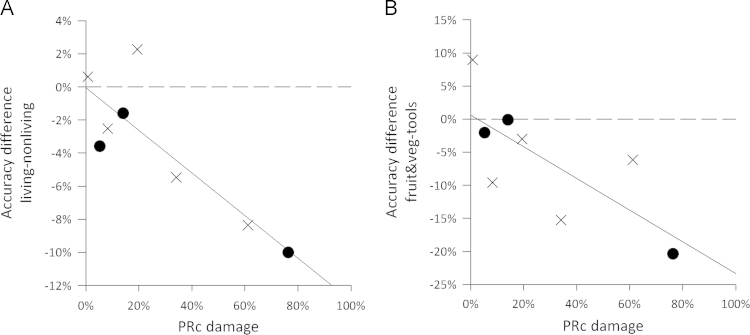
The anterior temporal lobe (ATL) plays a prominent role in models of semantic knowledge, although it remains unclear how the specific subregions within the ATL contribute to semantic memory. Patients with neurodegenerative diseases, like semantic dementia, have widespread damage to the ATL thus making inferences about the relationship between anatomy and cognition problematic. Here we take a detailed anatomical approach to ask which substructures within the ATL contribute to conceptual processing, with the prediction that the perirhinal cortex (PRc) will play a critical role for concepts that are more semantically confusable. We tested two patient groups, those with and without damage to the PRc, across two behavioural experiments - picture naming and word-picture matching. For both tasks, we manipulated the degree of semantic confusability of the concepts. By contrasting the performance of the two groups, along with healthy controls, we show that damage to the PRc results in worse performance in processing concepts with higher semantic confusability across both experiments. Further by correlating the degree of damage across anatomically defined regions of interest with performance, we find that PRc damage is related to performance for concepts with increased semantic confusability. Our results show that the PRc supports a necessary and crucial neurocognitve function that enables fine-grained conceptual processes to take place through the resolution of semantic confusability.
颞叶前部(ATL)在语义知识模型中起着重要作用,尽管目前尚不清楚ATL内的特定亚区域如何对语义记忆产生影响。患有神经退行性疾病(如语义性痴呆)的患者,其ATL受到广泛损伤,因此难以推断解剖结构与认知之间的关系。在此,我们采用详细的解剖学方法来探究ATL内哪些子结构有助于概念处理,并预测嗅周皮质(PRc)对于语义上更易混淆的概念将发挥关键作用。我们在两项行为实验(图片命名和单词 - 图片匹配)中测试了两组患者,一组有PRc损伤,另一组没有。对于这两项任务,我们都对概念的语义混淆程度进行了操控。通过对比两组患者以及健康对照组的表现,我们发现PRc损伤导致在两项实验中处理语义混淆度较高的概念时表现更差。进一步通过将解剖学定义的感兴趣区域的损伤程度与表现进行关联分析,我们发现PRc损伤与语义混淆度增加的概念的表现相关。我们的结果表明,PRc支持一种必要且关键的神经认知功能,该功能通过解决语义混淆来实现精细的概念处理过程。