Neupane Sudan Prasad, Lien Lars, Martinez Priscilla, Hestad Knut, Bramness Jørgen G
SERAF-Norwegian Centre for Addiction Research, University of Oslo, Oslo, Norway.
Alcohol Clin Exp Res. 2015 Mar;39(3):514-21. doi: 10.1111/acer.12651. Epub 2015 Jan 30.
Activation of the kynurenine pathway of tryptophan metabolism results in increased production of potentially depressogenic tryptophan catabolites and a reduction in tryptophan availability for serotonin synthesis. As alcohol consumption affects tryptophan metabolism and disposition, we determined serum levels of tryptophan, kynurenine, and an index of tryptophan degradation (kynurenine/tryptophan ratio) in patients with alcohol-use disorder (AUD) and compared their levels considering abstinence duration, AUD severity, and comorbid depression.
The study sample included 169 AUD inpatients from 8 alcohol treatment facilities in Kathmandu, Nepal. The Composite International Diagnostic Interview was administered to generate the AUD diagnosis. The Alcohol Use Disorder Identification Test (AUDIT) captured AUD severity and patterns of alcohol use. The Hopkins Symptom Checklist-25 was used to reveal current depressive symptoms. Serum kynurenine and tryptophan levels were determined by high-performance liquid chromatography, and tryptophan degradation was measured by KT ratio (kynurenine/tryptophan × 10(3)).
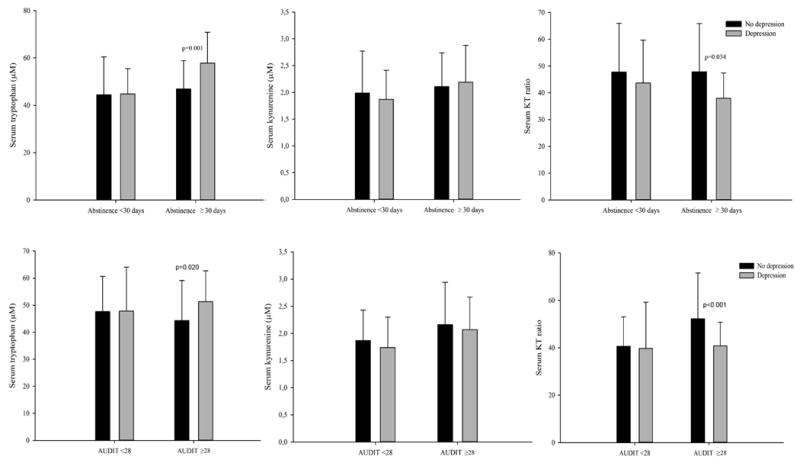
Patients with above average AUDIT scores had higher mean serum levels of kynurenine (2.1 μM ± 0.7 vs. 1.8 μM ± 0.6, p = 0.006) and KT ratios (48.6 ± 17.6 vs. 40.4 ± 14.3, p = 0.002) than those with below average scores. Patients with current depressive symptoms had higher mean tryptophan concentrations (49.9 μM ± 13 vs. 45.7 μM ± 14.1, p = 0.047) and lower KT ratios (41.4 ± 14 vs. 47.5 ± 17.6, p = 0.028) compared to patients whose reported depressive symptoms were below the standard cutoff. Higher tryptophan levels and lower KT ratios in the depressed group were specific to patients with longer abstinence and higher AUD severity.
Depression-related deregulation in tryptophan metabolism was found to depend on length of abstinence and on AUD severity. Together, results suggest that in AUD populations, peripheral tryptophan metabolism is subject to interactions between AUD severity and depressive symptoms.
色氨酸代谢的犬尿氨酸途径激活会导致潜在的致抑郁性色氨酸分解代谢产物生成增加,且可用于血清素合成的色氨酸可用性降低。由于饮酒会影响色氨酸的代谢和分布,我们测定了酒精使用障碍(AUD)患者血清中的色氨酸、犬尿氨酸水平以及色氨酸降解指数(犬尿氨酸/色氨酸比值),并根据戒酒时长、AUD严重程度和共病抑郁症情况对这些水平进行了比较。
研究样本包括来自尼泊尔加德满都8家酒精治疗机构的169名AUD住院患者。采用复合国际诊断访谈来做出AUD诊断。酒精使用障碍识别测试(AUDIT)评估了AUD严重程度和饮酒模式。使用霍普金斯症状清单-25来揭示当前的抑郁症状。血清犬尿氨酸和色氨酸水平通过高效液相色谱法测定,色氨酸降解通过KT比值(犬尿氨酸/色氨酸×10³)来衡量。
AUDIT评分高于平均水平的患者血清犬尿氨酸平均水平(2.1 μM±0.7 vs. 1.8 μM±0.6,p = 0.006)和KT比值(48.6±17.6 vs. 40.4±14.3,p = 0.002)高于评分低于平均水平的患者。与报告的抑郁症状低于标准临界值的患者相比,当前有抑郁症状的患者色氨酸平均浓度更高(49.9 μM±13 vs. 45.7 μM±14.1,p = 0.047),KT比值更低(41.4±14 vs. 47.5±17.6,p = 0.028)。抑郁组中较高的色氨酸水平和较低的KT比值在戒酒时间较长和AUD严重程度较高的患者中更为明显。
发现色氨酸代谢中与抑郁相关失调取决于戒酒时长和AUD严重程度。总体而言,结果表明在AUD人群中,外周色氨酸代谢受到AUD严重程度和抑郁症状之间相互作用的影响。