Weiler Sarah, Ademokun Jolaolu A, Norton John D
School of Biological Sciences, University of Essex, Colchester, Essex, CO4 3SQ, UK.
Department of Haematology, Ipswich Hospital NHS Trust, Heath Road, Ipswich, Suffolk, IP4 5PD, UK.
Mol Cancer. 2015 Feb 3;14(1):30. doi: 10.1186/s12943-014-0286-9.
Members of the inhibitor of DNA-binding (ID) family of helix-loop-helix proteins have been causally implicated in the pathogenesis of several types of B-cell lineage malignancy, either on the basis of mutation or by altered expression. B-cell chronic lymphocytic leukemia encompasses a heterogeneous group of disorders and is the commonest leukaemia type in the Western world. In this study, we have investigated the pathobiological functions of the ID2 and ID3 proteins in this disease with an emphasis on their role in regulating leukemic cell death/survival.
Bioinformatics analysis of microarray gene expression data was used to investigate expression of ID2/ID3 in leukemic versus normal B cells, their association with clinical course of disease and molecular sub-type and to reconstruct a gene regulatory network using the 'maximum information coefficient' (MIC) for target gene inference. In vitro cultured primary leukemia cells, either in isolation or co-cultured with accessory vascular endothelial cells, were used to investigate ID2/ID3 protein expression by western blotting and to assess the cytotoxic response of different drugs (fludarabine, chlorambucil, ethacrynic acid) by 3-(4,5-dimethylthiazol-2-yl)-2,5-diphenyltetrazolium bromide assay. ID2/ID3 protein levels in primary leukemia cells and in MEC1 cells were manipulated by transduction with siRNA reagents.
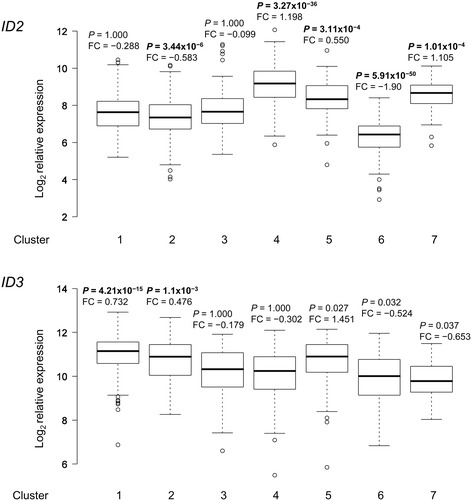
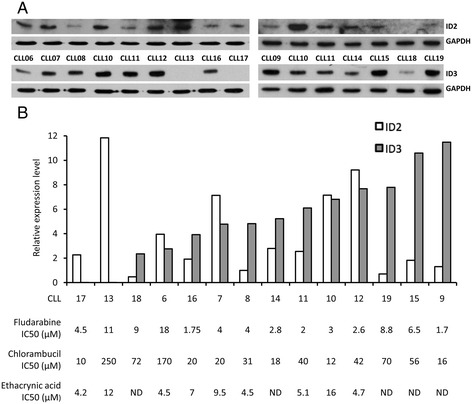
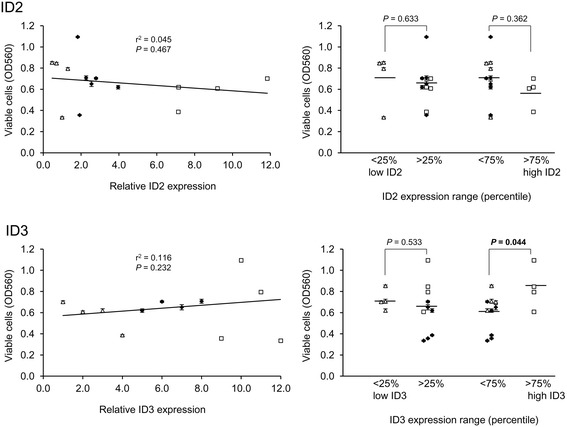
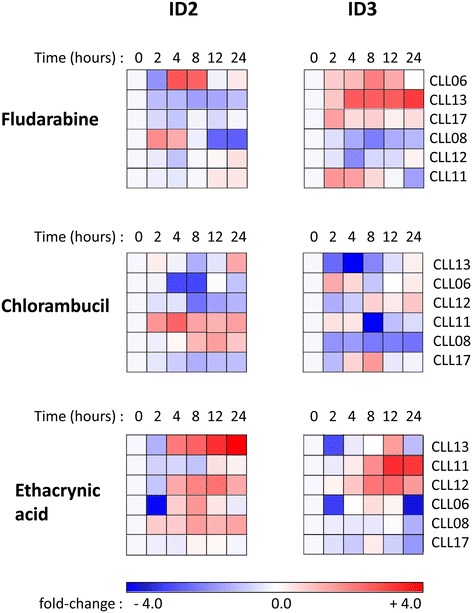
Datamining showed that the expression profiles of ID2 and ID3 are associated with distinct pathobiological features of disease and implicated both genes in regulating cell death/survival by targeting multiple non-overlapping sets of apoptosis effecter genes. Consistent with microarray data, the overall pattern of ID2/ID3 protein expression in relation to cell death/survival responses of primary leukemia cells was suggestive of a pro-survival function for both ID proteins. This was confirmed by siRNA knock-down experiments in MEC1 cells and in primary leukemia cells, but with variability in the dependence of leukemic cells from different patients on ID protein expression for cell survival. Vascular endothelial cells rescued leukemia cells from spontaneous and cytotoxic drug-induced cell death at least in part, via an ID protein-coupled redox-dependent mechanism.
Our study provides evidence for a pro-survival function of the ID2/ID3 proteins in chronic lymphocytic leukemia cells and also highlights these proteins as potential determinants of the pathobiology of this disorder.
DNA结合抑制因子(ID)家族的螺旋-环-螺旋蛋白成员,基于突变或表达改变,已被证实与几种B细胞系恶性肿瘤的发病机制有关。B细胞慢性淋巴细胞白血病包含一组异质性疾病,是西方世界最常见的白血病类型。在本研究中,我们调查了ID2和ID3蛋白在该疾病中的病理生物学功能,重点是它们在调节白血病细胞死亡/存活中的作用。
利用微阵列基因表达数据的生物信息学分析,研究ID2/ID3在白血病B细胞与正常B细胞中的表达、它们与疾病临床进程和分子亚型的关联,并使用“最大信息系数”(MIC)重建基因调控网络以推断靶基因。体外培养的原代白血病细胞,单独培养或与辅助血管内皮细胞共培养,用于通过蛋白质印迹法研究ID2/ID3蛋白表达,并通过3-(4,5-二甲基噻唑-2-基)-2,5-二苯基四氮唑溴盐法评估不同药物(氟达拉滨、苯丁酸氮芥、依他尼酸)的细胞毒性反应。通过用小干扰RNA(siRNA)试剂转导来调控原代白血病细胞和MEC1细胞中的ID2/ID3蛋白水平。
数据挖掘显示,ID2和ID3的表达谱与疾病的不同病理生物学特征相关,并且这两个基因均通过靶向多组不重叠的凋亡效应基因来调节细胞死亡/存活。与微阵列数据一致,ID2/ID3蛋白表达与原代白血病细胞的细胞死亡/存活反应相关的总体模式表明这两种ID蛋白均具有促存活功能。MEC1细胞和原代白血病细胞中的siRNA敲低实验证实了这一点,但不同患者的白血病细胞对ID蛋白表达以维持细胞存活的依赖性存在差异。血管内皮细胞至少部分地通过ID蛋白偶联的氧化还原依赖性机制,使白血病细胞免于自发和细胞毒性药物诱导的细胞死亡。
我们的研究为ID2/ID3蛋白在慢性淋巴细胞白血病细胞中的促存活功能提供了证据,也突出了这些蛋白作为该疾病病理生物学潜在决定因素的作用。