Gendron David, Lemay Anne-Marie, Tremblay Claudine, Lai Laetitia Ja, Langlois Anick, Bernatchez Émilie, Flamand Nicolas, Blanchet Marie-Renée, Don Anthony S, Bossé Ynuk, Bissonnette Élyse, Marsolais David
Centre de recherche de l'Institut universitaire de cardiologie et de pneumologie de Québec (CRIUCPQ), Québec, QC, Canada.
Laboratoires Charles River, Services Précliniques, Montréal, Canada.
Respir Res. 2015 Feb 3;16(1):7. doi: 10.1186/s12931-015-0180-z.
In vivo phosphorylation of sphingosine analogs with their ensuing binding and activation of their cell-surface sphingosine-1-phosphate receptors is regarded as the main immunomodulatory mechanism of this new class of drugs. Prophylactic treatment with sphingosine analogs interferes with experimental asthma by impeding the migration of dendritic cells to draining lymph nodes. However, whether these drugs can also alleviate allergic airway inflammation after its onset remains to be determined. Herein, we investigated to which extent and by which mechanisms the sphingosine analog AAL-R interferes with key features of asthma in a murine model during ongoing allergic inflammation induced by Dermatophagoides pteronyssinus.
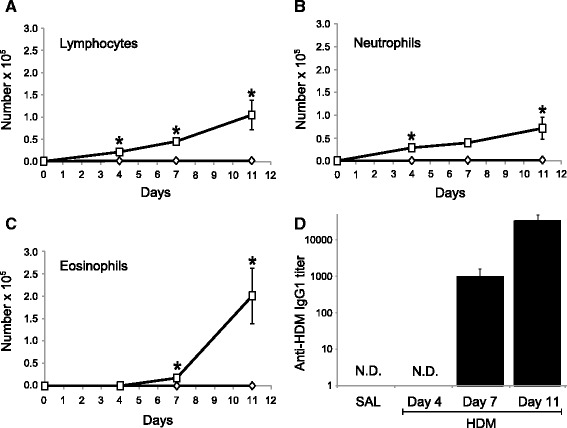
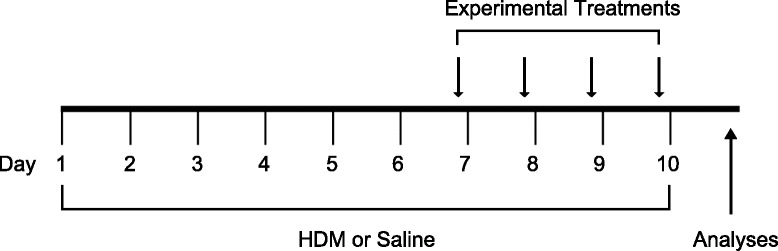
BALB/c mice were exposed to either D. pteronyssinus or saline, intranasally, once-daily for 10 consecutive days. Mice were treated intratracheally with either AAL-R, its pre-phosphorylated form AFD-R, or the vehicle before every allergen challenge over the last four days, i.e. after the onset of allergic airway inflammation. On day 11, airway responsiveness to methacholine was measured; inflammatory cells and cytokines were quantified in the airways; and the numbers and/or viability of T cells, B cells and dendritic cells were assessed in the lungs and draining lymph nodes.
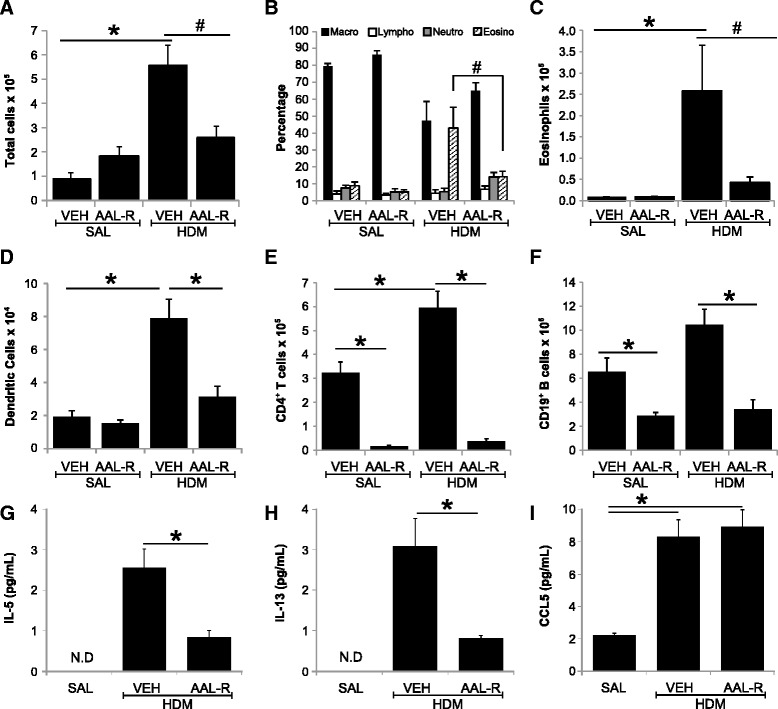
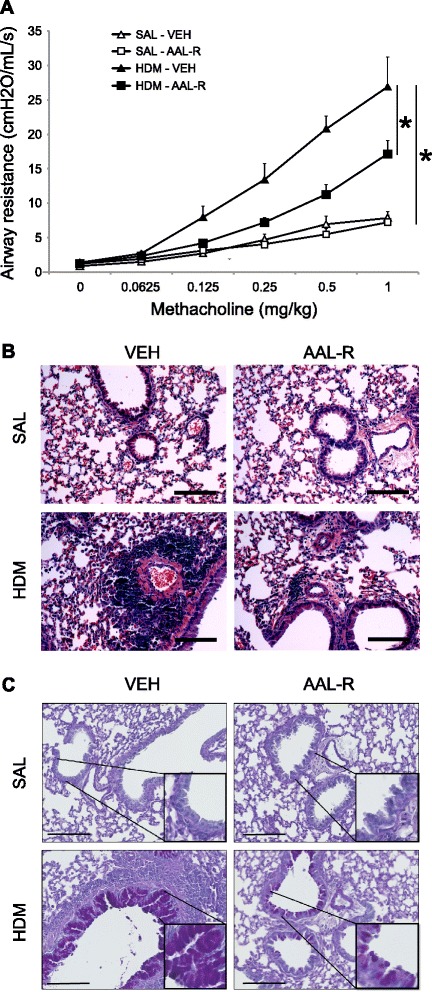
AAL-R decreased airway hyperresponsiveness induced by D. pteronyssinus by nearly 70%. This was associated with a strong reduction of IL-5 and IL-13 levels in the airways and with a decreased eosinophilic response. Notably, the lung CD4(+) T cells were almost entirely eliminated by AAL-R, which concurred with enhanced apoptosis/necrosis in that cell population. This inhibition occurred in the absence of dendritic cell number modulation in draining lymph nodes. On the other hand, the pre-phosphorylated form AFD-R, which preferentially acts on cell-surface sphingosine-1-phosphate receptors, was relatively impotent at enhancing cell death, which led to a less efficient control of T cell and eosinophil responses in the lungs.
Airway delivery of the non-phosphorylated sphingosine analog, but not its pre-phosphorylated counterpart, is highly efficient at controlling the local T cell response after the onset of allergic airway inflammation. The mechanism appears to involve local induction of lymphocyte apoptosis/necrosis, while mildly affecting dendritic cell and T cell accumulation in draining lymph nodes.
鞘氨醇类似物在体内发生磷酸化,随后与细胞表面的1 -磷酸鞘氨醇受体结合并激活,这被认为是这类新型药物的主要免疫调节机制。鞘氨醇类似物的预防性治疗通过阻碍树突状细胞向引流淋巴结的迁移来干预实验性哮喘。然而,这些药物在过敏性气道炎症发作后是否也能减轻炎症仍有待确定。在此,我们研究了鞘氨醇类似物AAL - R在由粉尘螨引起的持续性过敏性炎症期间,在何种程度上以及通过何种机制干扰小鼠模型中的哮喘关键特征。
将BALB/c小鼠经鼻内每日一次连续暴露于粉尘螨或生理盐水,持续10天。在过去四天即过敏性气道炎症发作后,每次过敏原激发前,给小鼠气管内注射AAL - R、其预磷酸化形式AFD - R或溶剂。在第11天,测量气道对乙酰甲胆碱的反应性;对气道中的炎性细胞和细胞因子进行定量;并评估肺和引流淋巴结中T细胞、B细胞和树突状细胞的数量和/或活力。
AAL - R使粉尘螨诱导的气道高反应性降低了近70%。这与气道中IL - 5和IL - 13水平的显著降低以及嗜酸性粒细胞反应的减弱有关。值得注意的是,AAL - R几乎完全消除了肺中的CD4(+) T细胞,这与该细胞群体中凋亡/坏死的增加相一致。这种抑制作用在引流淋巴结中树突状细胞数量未受调节的情况下发生。另一方面,优先作用于细胞表面1 -磷酸鞘氨醇受体的预磷酸化形式AFD - R在增强细胞死亡方面相对无效,这导致对肺中T细胞和嗜酸性粒细胞反应的控制效果较差。
在过敏性气道炎症发作后,非磷酸化鞘氨醇类似物经气道给药,而非其预磷酸化对应物,在控制局部T细胞反应方面非常有效。其机制似乎涉及局部诱导淋巴细胞凋亡/坏死,同时轻度影响引流淋巴结中树突状细胞和T细胞的积聚。