Bhalla Rajiv, Levason William, Luthra Sajinder K, McRobbie Graeme, Sanderson George, Reid Gillian
Centre for Advanced Imaging, University of Queensland, Brisbane, Queensland 4072 (Australia).
Chemistry. 2015 Mar 16;21(12):4688-94. doi: 10.1002/chem.201405812. Epub 2015 Feb 4.
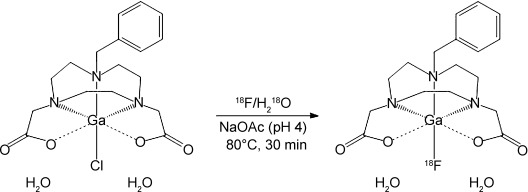
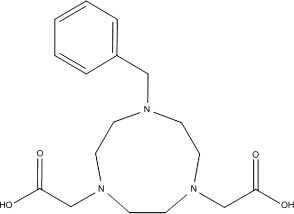
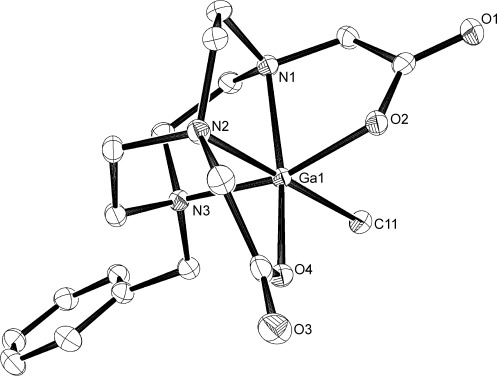
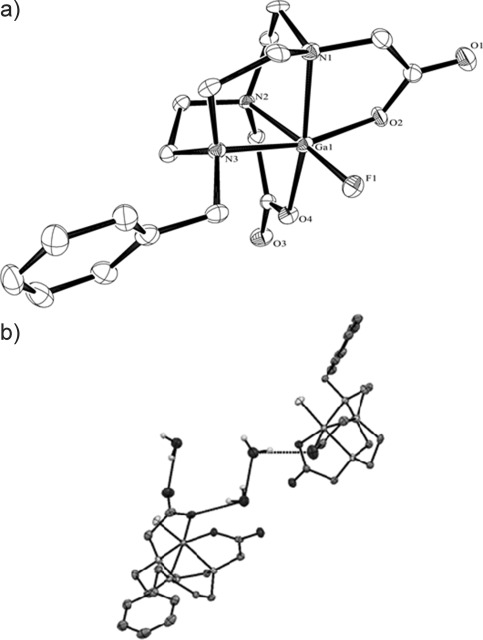
As part of a study to investigate the factors influencing the development of new, more effective metal-complex-based positron emission tomography (PET) imaging agents, the distorted octahedral complex, [GaCl(L)]⋅2 H2O has been prepared by reaction of 1-benzyl-1,4,7-triazacyclononane-4,7-dicarboxylic acid hydrochloride (H2L⋅HCl) with Ga(NO3)3⋅9 H2O, which is a convenient source of Ga(III) for reactions in water. Spectroscopic and crystallographic data for [GaCl(L)]⋅2 H2O are described, together with the crystal structure of [GaCl(L)]⋅MeCN. Fluorination of this complex by Cl(-)/F(-) exchange was achieved in high yield by treatment with KF in water at room temperature over 90 minutes, although the reaction was complete in approximately 30 minutes if heated to 80 °C, giving [GaF(L)]⋅2 H2O in good yield. The same complex was obtained by hydrothermal synthesis from GaF3⋅3 H2O and Li2L, and has been characterised by single-crystal X-ray analysis, IR, (1)H and (19)F{(1)H} NMR spectroscopy and ESI(+) MS. Radiofluorination of the pre-formed [GaCl(L)]⋅2 H2O has been demonstrated on a 210 nanomolar scale in aqueous NaOAc at pH 4 by using carrier-free (18)F(-), leading to 60-70% (18)F-incorporation after heating to 80 °C for 30 minutes. The resulting radioproduct was purified easily by using a solid-phase extraction (SPE) cartridge, leading to 98-99% radiochemical purity. The [Ga(18)F(L)] is stable for at least 90 minutes in 10% EtOH/NaOAc solution at pH 6, but defluorinates over this time scale at pH of approximately 7.5 in phosphate buffered saline (PBS) or human serum albumin (HSA). The subtle role of the Group 13 metal ion and co-ligand donor set in influencing the pH dependence of this system is discussed in the context of developing potential new imaging agents for PET.
作为一项研究的一部分,该研究旨在探究影响新型、更有效的基于金属配合物的正电子发射断层扫描(PET)显像剂发展的因素,通过1-苄基-1,4,7-三氮杂环壬烷-4,7-二羧酸盐酸盐(H₂L·HCl)与Ga(NO₃)₃·9H₂O反应制备了畸变八面体配合物[GaCl(L)]·2H₂O,Ga(NO₃)₃·9H₂O是用于水中反应的Ga(III)的便捷来源。描述了[GaCl(L)]·2H₂O的光谱和晶体学数据,以及[GaCl(L)]·MeCN的晶体结构。通过在室温下于水中用KF处理90分钟,以高产率实现了该配合物通过Cl⁻/F⁻交换的氟化,不过如果加热到80°C,反应在约30分钟内完成,以良好产率得到[GaF(L)]·2H₂O。通过水热合成由GaF₃·3H₂O和Li₂L得到了相同的配合物,并通过单晶X射线分析、红外光谱、¹H和¹⁹F{¹H}核磁共振光谱以及电喷雾电离(ESI(+))质谱对其进行了表征。通过在pH为4的乙酸钠水溶液中使用无载体¹⁸F⁻,已在210纳摩尔规模上证明了预先形成的[GaCl(L)]·2H₂O的放射性氟化,在加热到80°C 30分钟后导致60 - 70%的¹⁸F掺入。通过使用固相萃取(SPE)柱轻松纯化了所得的放射性产物,得到98 - 99%的放射化学纯度。[Ga(¹⁸F)(L)]在pH为6的10%乙醇/乙酸钠溶液中至少稳定90分钟,但在磷酸盐缓冲盐水(PBS)或人血清白蛋白(HSA)中,在约7.5的pH值下,在此时间范围内会发生脱氟。在开发潜在的新型PET显像剂的背景下,讨论了第13族金属离子和共配体供体组在影响该体系pH依赖性方面的微妙作用。