González Nieves, Martín-Duce Antonio, Martínez-Arrieta Félix, Moreno-Villegas Zaida, Portal-Núñez Sergio, Sanz Raúl, Egido Jesús
Renal, Vascular and Diabetes Research Laboratory, IIS-Jiménez Díaz Foundation, The Autonomous University of Madrid, Spanish Biomedical Research Network in Diabetes and Associated Metabolic Disorders (CIBERDEM), Madrid, Spain.
Department of Nursery, Unit of Surgery, Alcalá University, Madrid, Spain.
Int J Mol Med. 2015 Apr;35(4):925-31. doi: 10.3892/ijmm.2015.2090. Epub 2015 Feb 4.
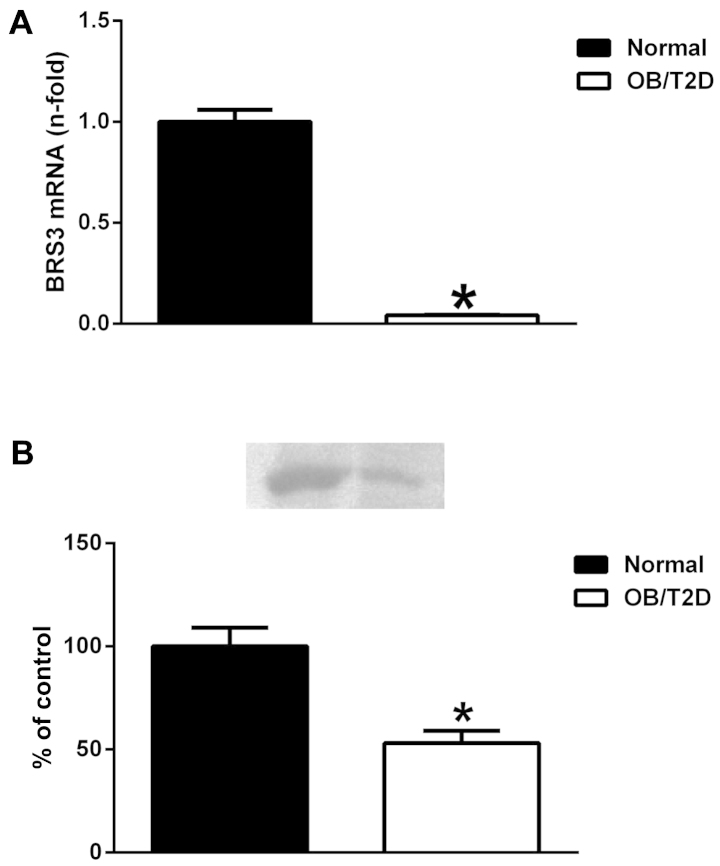
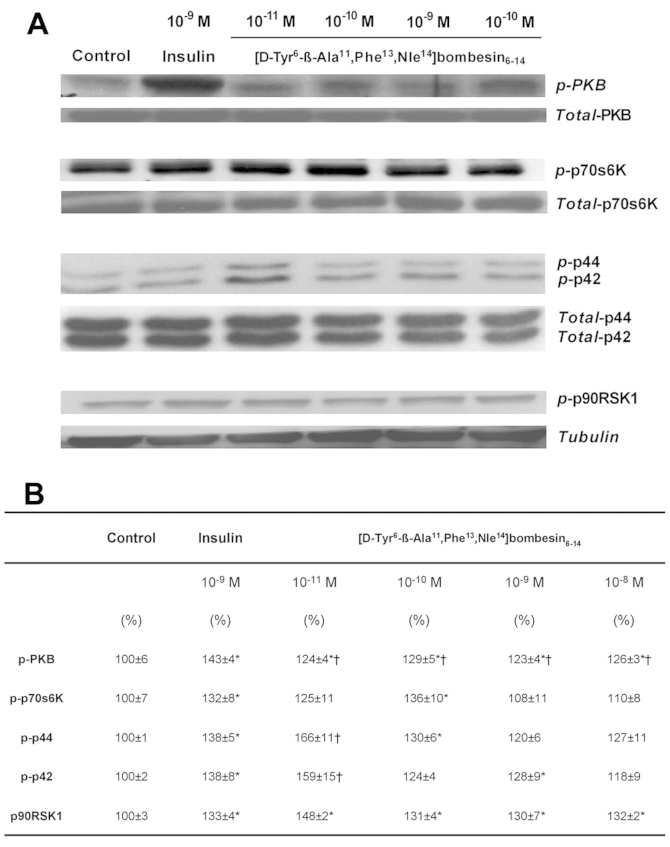
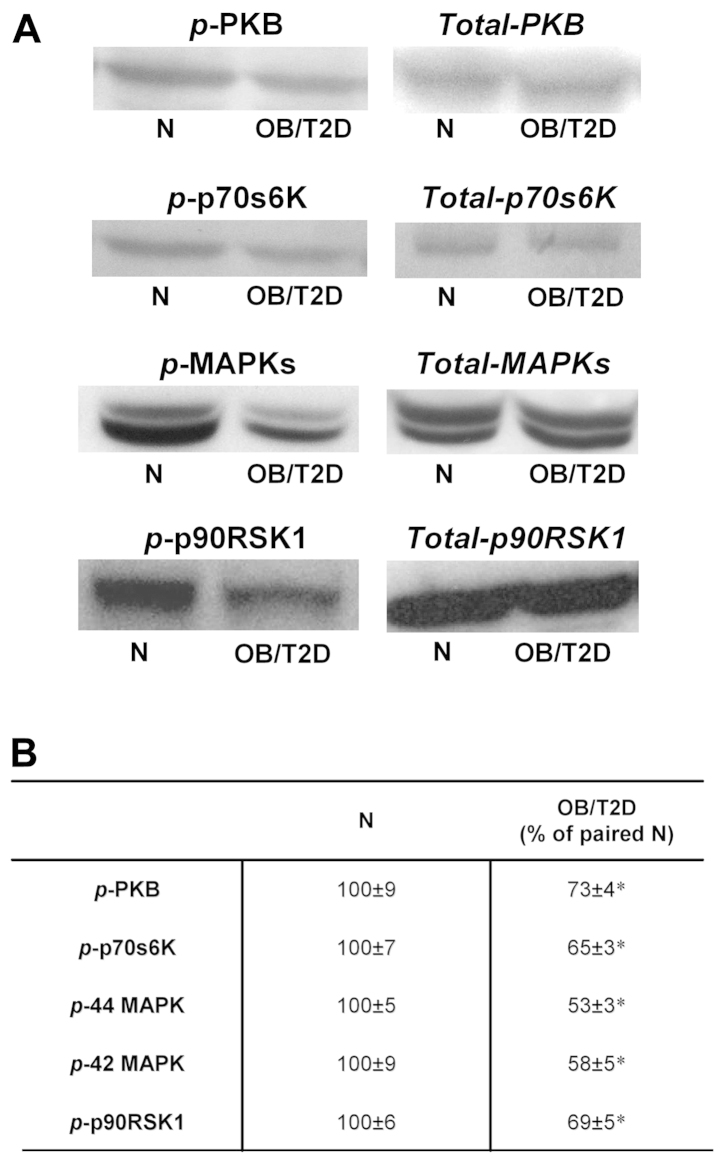
Bombesin receptor subtype-3 (BRS-3) is an orphan G-protein-coupled receptor (GPCR) member of the bombesin receptor family. Several studies have suggested an association between obesity, alterations in glucose metabolism, diabetes and the BRS-3 receptor. In this study, we focused on patients simultaneously diagnosed with obesity and type 2 diabetes (OB/T2D). The analysis of BRS-3 expression in the skeletal muscle of these patients revealed a marked decrease in the expression of BRS-3 at the mRNA (23.6 ± 1.3-fold downregulation, p<0.0001) and protein level (49 ± 7% decrease, p<0.05) compared to the normal patients (no obesity and diabetes). Moreover, in cultured primary myocytes from patients with OB/T2D, the synthetic BRS-3 agonist, [D-Try6,β-Ala11,Phe13,Nle14]bombesin6-14, significantly increased the phosphorylation levels of mitogen-activated protein kinase (MAPK), p90RSK1, protein kinase B (PKB) and p70s6K. Specifically, the ligand at 10-11 M induced the maximal phosphorylation of MAPKs (p42, 159 ± 15% of the control; p44, 166 ± 11% of the control; p<0.0001) and p90RSK1 (148 ± 2% of the control, p<0.0001). The basal phosphorylation levels of all kinases were reduced (p<0.05) in the patients with OB/T2D compared to the normal patients. Furthermore, the BRS-3 agonist stimulated glucose transport, which was already detected at 10-12 M (133 ± 9% of the control), reached maximal levels at 10-11 M (160 ± 9%, p<0.0001) and was maintained at up to 10-8 M (overall mean, 153 ± 7%; p < 0.007). This effect was less promiment than that attained with 10-8 M insulin (202 ± 9%, p = 0.009). The effect of the agonist on glycogen synthase a activity achieved the maximum effect at 10-11 M (165 ± 16% of the control; p<0.0001), which did not differ from that observed with higher concentrations of the agonist. These results suggest that muscle cells isolated from patients with OB/T2D have extremely high sensitivity to the synthetic ligand, and the effects are particularly observed on MAPK and p90RSK1 phosphorylation, as well as glucose uptake. Moreover, our data indicate that BRS-3 may prove to be useful as a potential therapeutic target for the treatment of patients with OB/T2D.
胃泌素释放肽受体亚型3(BRS-3)是胃泌素释放肽受体家族中一个孤儿G蛋白偶联受体(GPCR)成员。多项研究表明肥胖、糖代谢改变、糖尿病与BRS-3受体之间存在关联。在本研究中,我们聚焦于同时被诊断为肥胖症和2型糖尿病(OB/T2D)的患者。对这些患者骨骼肌中BRS-3表达的分析显示,与正常患者(无肥胖症和糖尿病)相比,BRS-3在mRNA水平(下调23.6±1.3倍,p<0.0001)和蛋白水平(降低49±7%,p<0.05)上显著降低。此外,在来自OB/T2D患者的原代培养心肌细胞中,合成的BRS-3激动剂[D-Try6,β-Ala11,Phe13,Nle14]胃泌素释放肽6-14显著增加了丝裂原活化蛋白激酶(MAPK)、p90RSK1、蛋白激酶B(PKB)和p70s6K的磷酸化水平。具体而言,10-11 M的配体诱导了MAPKs(p42为对照的159±15%;p44为对照的166±11%;p<0.0001)和p90RSK1(为对照的148±2%,p<0.0001)的最大磷酸化。与正常患者相比,OB/T2D患者中所有激酶的基础磷酸化水平均降低(p<0.05)。此外,BRS-3激动剂刺激葡萄糖转运,在10-12 M时即可检测到(为对照的133±9%),在10-11 M时达到最高水平(160±9%,p<0.0001),并维持至10-8 M(总体平均值为153±7%;p<0.007)。这种作用不如10-8 M胰岛素所达到的作用明显(202±9%,p = 0.009)。激动剂对糖原合酶a活性的作用在10-11 M时达到最大效应(为对照的165±16%;p<0.0001),与在更高浓度激动剂下观察到的效应无差异。这些结果表明,从OB/T2D患者分离出的肌肉细胞对合成配体具有极高的敏感性,且在MAPK和p90RSK1磷酸化以及葡萄糖摄取方面尤其明显。此外,我们的数据表明,BRS-3可能被证明是治疗OB/T2D患者的潜在治疗靶点。