Shiba Eiichi, Yamashita Hiroko, Kurebayashi Junichi, Noguchi Shinzaburo, Iwase Hirotaka, Ohashi Yasuo, Sasai Kiyofumi, Fujimoto Tsukasa
Department of Breast Surgery, Osaka Breast Clinic, 1-3-4 Fukushima, Fukushima-ku, Osaka, 553-0003, Japan.
Department of Breast and Endocrine Surgery, Nagoya City University Hospital, Nagoya, Japan.
Breast Cancer. 2016 May;23(3):499-509. doi: 10.1007/s12282-015-0593-z. Epub 2015 Feb 6.
Luteinizing hormone-releasing hormone (LH-RH) agonists provide effective adjuvant treatment for premenopausal women with endocrine-responsive breast cancer. Here, we investigated appropriate treatment durations of an LH-RH agonist, leuprorelin.
We conducted an open-label, randomized controlled pilot study to evaluate the safety and efficacy of leuprorelin subcutaneously administered every-3-months for 2 versus 3 or more, up to 5 years, together with daily tamoxifen for 5 years in premenopausal endocrine-responsive breast cancer patients. Primary endpoints were disease-free survival (DFS) and safety.
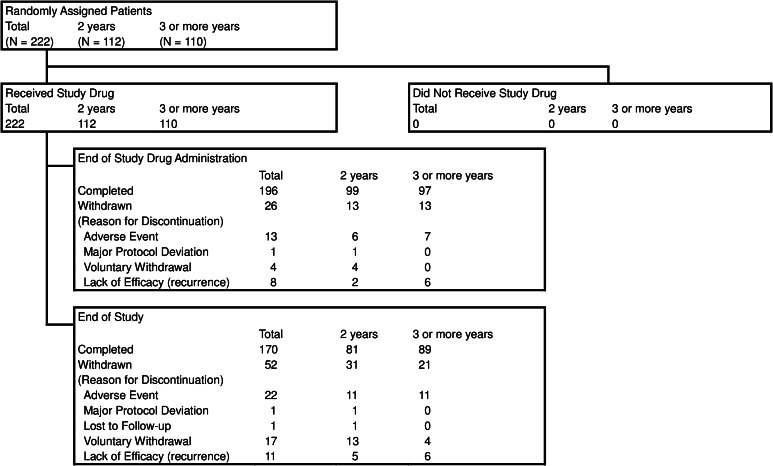
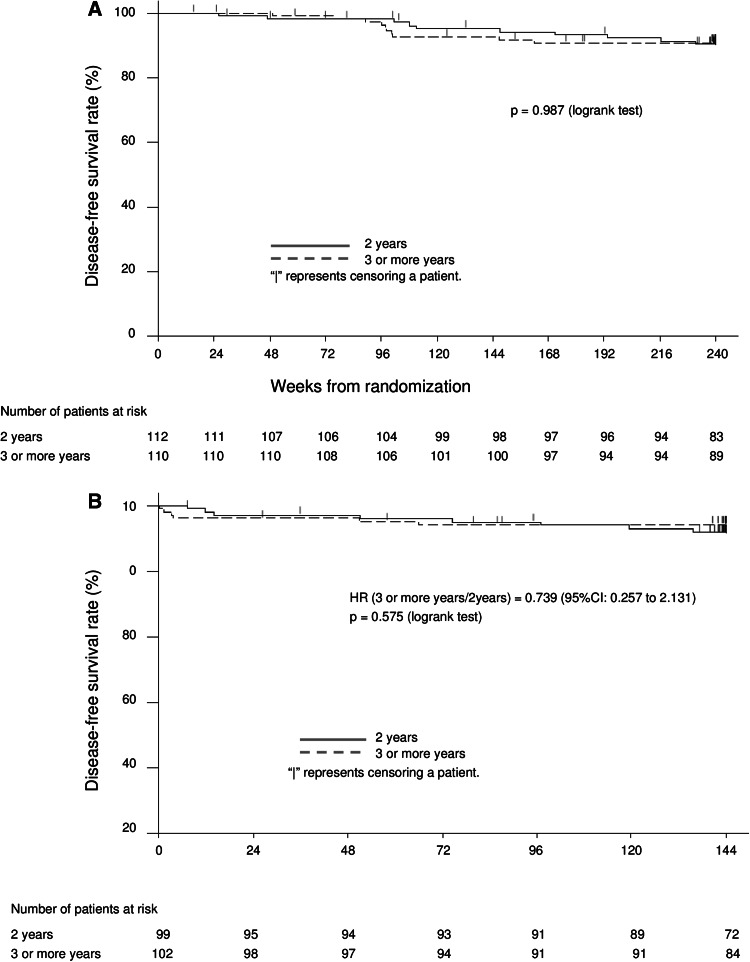
Eligible patients (N = 222) were randomly assigned to receive leuprorelin for either 2 years (N = 112) or 3 or more years (N = 110) with tamoxifen for 5 years after surgery. Leuprorelin treatment for 3 or more years provided no significant difference in DFS rate over 2 years: 94.1 versus 91.8 % at 144 weeks (3 years) after the second year (week 96) and 90.8 versus 90.4 % at the fifth year (week 240). The overall survival rate was 100 % for both groups during the third through fifth year study period. There were no significant differences in the incidence of adverse events (AEs) between the 2 groups: most AEs were rated grade 1 or 2.
Adjuvant leuprorelin treatment for 3 or more years with tamoxifen showed a survival benefit and safety profile similar to that for 2 years in premenopausal endocrine-responsive breast cancer patients. No new safety signal was identified for long-term leuprorelin treatment. Longer follow-up observation is needed to determine the optimal duration of leuprorelin treatment.
促黄体生成激素释放激素(LH-RH)激动剂为绝经前内分泌反应性乳腺癌女性提供了有效的辅助治疗。在此,我们研究了LH-RH激动剂亮丙瑞林的合适治疗时长。
我们开展了一项开放标签、随机对照的试点研究,以评估每3个月皮下注射亮丙瑞林2年与3年或更长时间(最长5年),并联合每日服用他莫昔芬5年,用于绝经前内分泌反应性乳腺癌患者的安全性和疗效。主要终点为无病生存期(DFS)和安全性。
符合条件的患者(N = 222)被随机分配接受亮丙瑞林治疗2年(N = 112)或3年及以上(N = 110),术后服用他莫昔芬5年。亮丙瑞林治疗3年及以上与2年相比,DFS率无显著差异:在第二年(第96周)后的144周(3年)时分别为94.1%和91.8%,在第五年(第240周)时分别为90.8%和90.4%。在研究的第三至第五年期间,两组的总生存率均为100%。两组之间不良事件(AE)的发生率无显著差异:大多数AE评分为1级或2级。
在绝经前内分泌反应性乳腺癌患者中,亮丙瑞林与他莫昔芬联合辅助治疗3年及以上显示出与2年相似的生存获益和安全性。未发现亮丙瑞林长期治疗有新的安全信号。需要更长时间的随访观察来确定亮丙瑞林治疗的最佳时长。