Senft Daniela, Ronai Ze'ev A
Sanford-Burnham Medical Research Institute, La Jolla, CA, 92037, USA.
Trends Biochem Sci. 2015 Mar;40(3):141-8. doi: 10.1016/j.tibs.2015.01.002. Epub 2015 Feb 2.
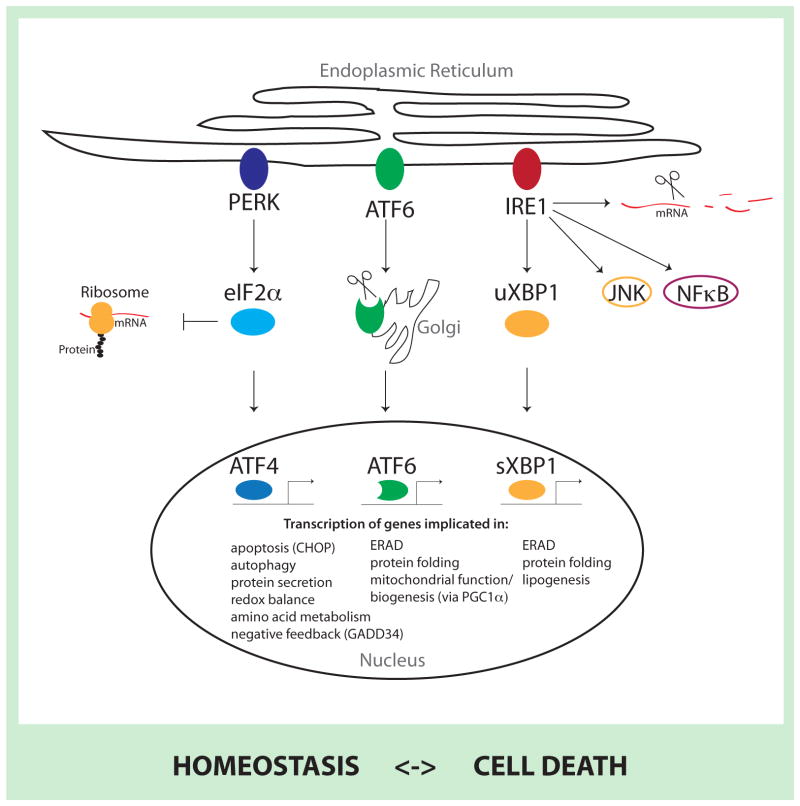
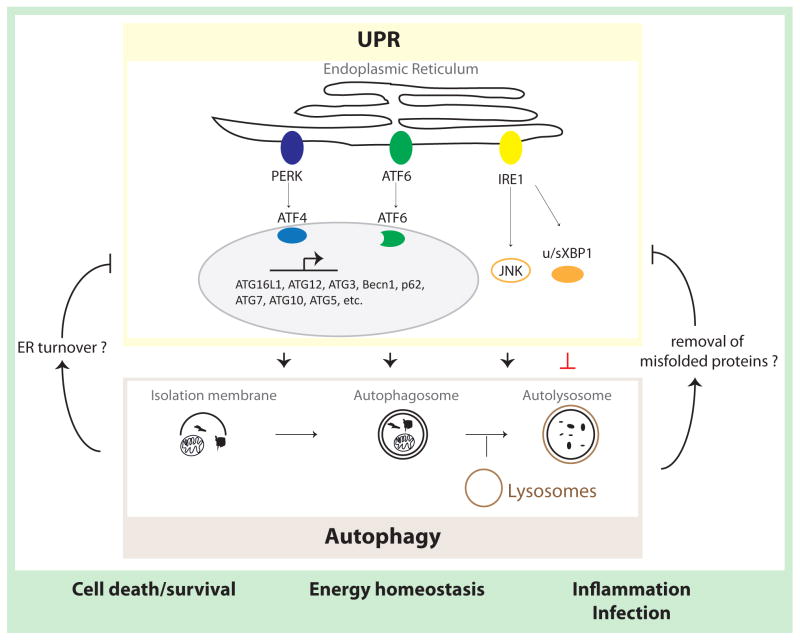
Cellular stress, induced by external or internal cues, activates several well-orchestrated processes aimed at either restoring cellular homeostasis or committing to cell death. Those processes include the unfolded protein response (UPR), autophagy, hypoxia, and mitochondrial function, which are part of the global endoplasmic reticulum (ER) stress (ERS) response. When one of the ERS elements is impaired, as often occurs under pathological conditions, overall cellular homeostasis may be perturbed. Further, activation of the UPR could trigger changes in mitochondrial function or autophagy, which could modulate the UPR, exemplifying crosstalk processes. Among the numerous factors that control the magnitude or duration of these processes are ubiquitin ligases, which govern overall cellular stress outcomes. Here we summarize crosstalk among the fundamental processes governing ERS responses.
由外部或内部信号诱导的细胞应激会激活几个精心编排的过程,这些过程旨在恢复细胞内稳态或导致细胞死亡。这些过程包括未折叠蛋白反应(UPR)、自噬、缺氧和线粒体功能,它们是整体内质网(ER)应激(ERS)反应的一部分。当ERS的其中一个要素受损时(这在病理条件下经常发生),整体细胞内稳态可能会受到干扰。此外,UPR的激活可能会引发线粒体功能或自噬的变化,而这又可能调节UPR,这是相互作用过程的例证。在控制这些过程的幅度或持续时间的众多因素中,泛素连接酶起着重要作用,它们决定了整体细胞应激的结果。在这里,我们总结了控制ERS反应的基本过程之间的相互作用。