Iglesias Virginia, Yospin Gabriel I, Whitlock Cathy
Montana Institute on Ecosystems, Montana State University Bozeman, MT, USA.
Montana Institute on Ecosystems, Montana State University Bozeman, MT, USA ; Department of Earth Sciences, Montana State University Bozeman, MT, USA.
Front Plant Sci. 2015 Jan 22;5:785. doi: 10.3389/fpls.2014.00785. eCollection 2014.
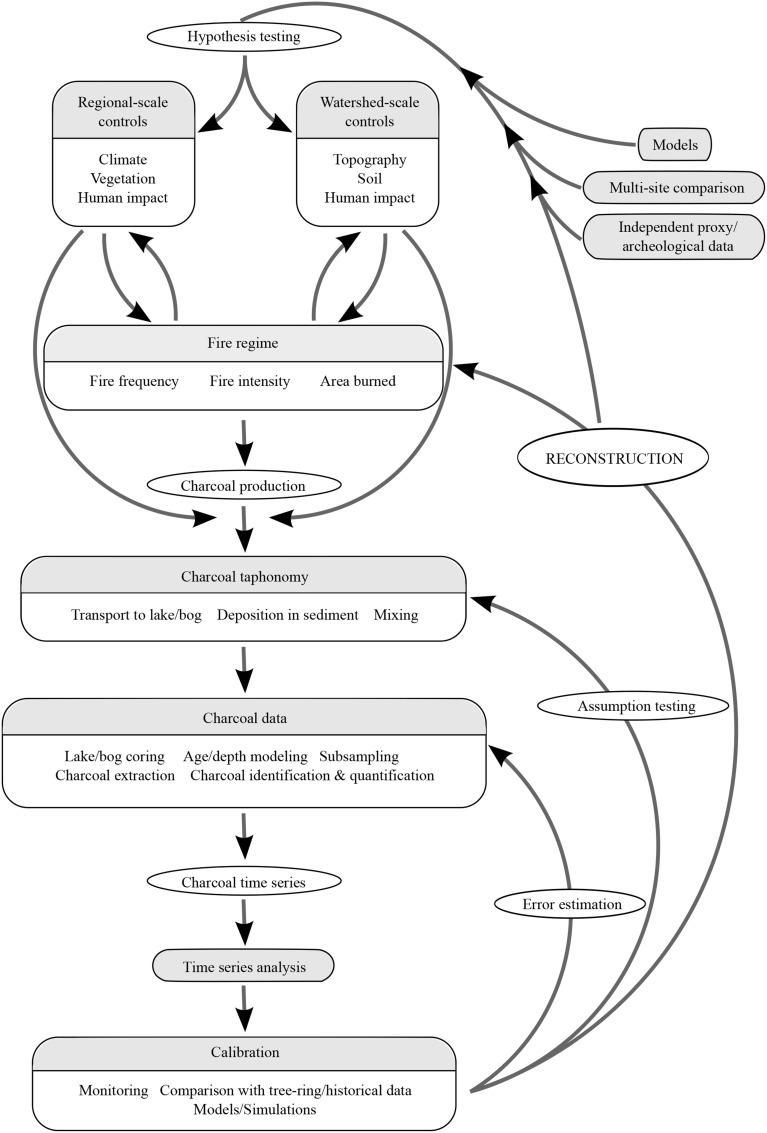
Fire is a key ecological process affecting vegetation dynamics and land cover. The characteristic frequency, size, and intensity of fire are driven by interactions between top-down climate-driven and bottom-up fuel-related processes. Disentangling climatic from non-climatic drivers of past fire regimes is a grand challenge in Earth systems science, and a topic where both paleoecology and ecological modeling have made substantial contributions. In this manuscript, we (1) review the use of sedimentary charcoal as a fire proxy and the methods used in charcoal-based fire history reconstructions; (2) identify existing techniques for paleoecological modeling; and (3) evaluate opportunities for coupling of paleoecological and ecological modeling approaches to better understand the causes and consequences of past, present, and future fire activity.
火灾是影响植被动态和土地覆盖的关键生态过程。火灾的特征频率、规模和强度是由自上而下的气候驱动过程和自下而上的燃料相关过程之间的相互作用所驱动的。区分过去火灾模式的气候驱动因素和非气候驱动因素是地球系统科学中的一项重大挑战,也是古生态学和生态建模都做出了重大贡献的一个主题。在本手稿中,我们(1)回顾了沉积木炭作为火灾代理的用途以及基于木炭的火灾历史重建中使用的方法;(2)确定古生态建模的现有技术;(3)评估耦合古生态和生态建模方法的机会,以更好地理解过去、现在和未来火灾活动的原因和后果。