Shimotohno Akie, Sotta Naoyuki, Sato Takafumi, De Ruvo Micol, Marée Athanasius F M, Grieneisen Verônica A, Fujiwara Toru
Graduate School of Agricultural and Life Sciences, the University of Tokyo, Yayoi, Bunkyo-ku, Tokyo, 113-8657 Japan These authors contributed equally to this work.
Graduate School of Agricultural and Life Sciences, the University of Tokyo, Yayoi, Bunkyo-ku, Tokyo, 113-8657 Japan.
Plant Cell Physiol. 2015 Apr;56(4):620-30. doi: 10.1093/pcp/pcv016. Epub 2015 Feb 9.
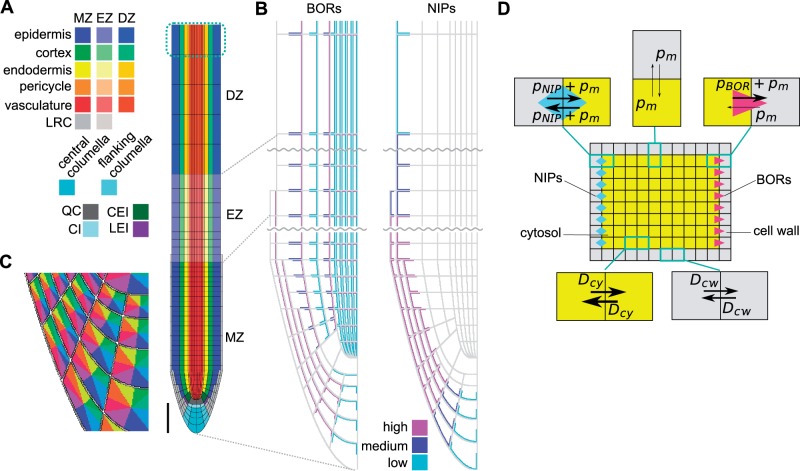
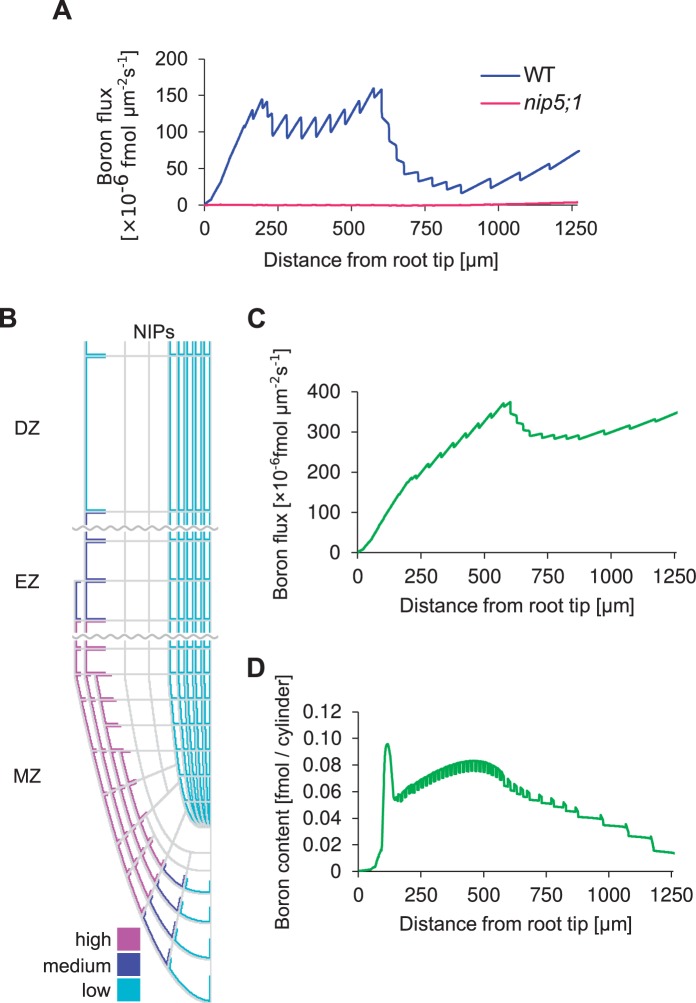
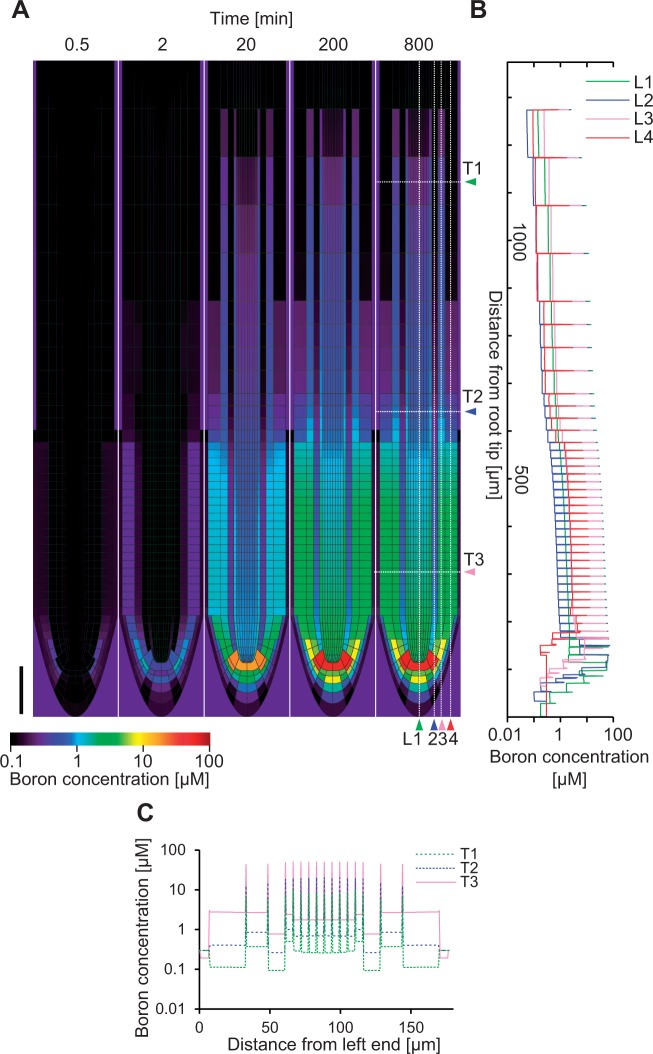
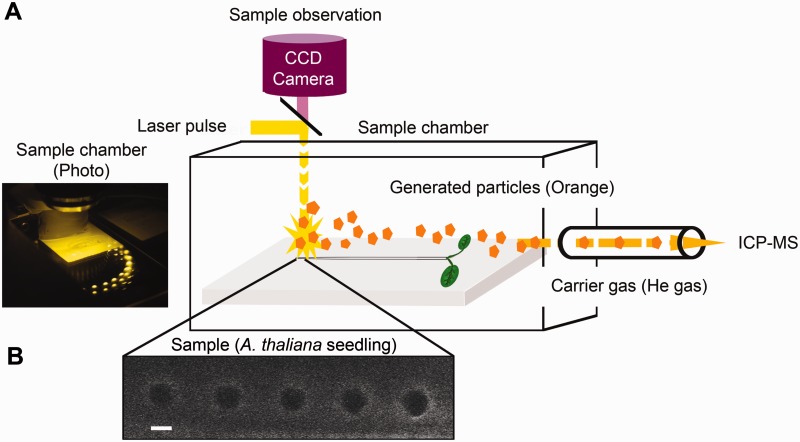
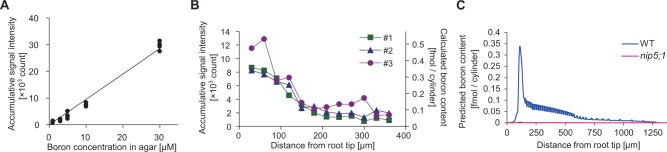
Boron, an essential micronutrient, is transported in roots of Arabidopsis thaliana mainly by two different types of transporters, BORs and NIPs (nodulin26-like intrinsic proteins). Both are plasma membrane localized, but have distinct transport properties and patterns of cell type-specific accumulation with different polar localizations, which are likely to affect boron distribution. Here, we used mathematical modeling and an experimental determination to address boron distributions in the root. A computational model of the root is created at the cellular level, describing the boron transporters as observed experimentally. Boron is allowed to diffuse into roots, in cells and cell walls, and to be transported over plasma membranes, reflecting the properties of the different transporters. The model predicts that a region around the quiescent center has a higher concentration of soluble boron than other portions. To evaluate this prediction experimentally, we determined the boron distribution in roots using laser ablation-inductivity coupled plasma-mass spectrometry. The analysis indicated that the boron concentration is highest near the tip and is lower in the more proximal region of the meristem zone, similar to the pattern of soluble boron distribution predicted by the model. Our model also predicts that upward boron flux does not continuously increase from the root tip toward the mature region, indicating that boron taken up in the root tip is not efficiently transported to shoots. This suggests that root tip-absorbed boron is probably used for local root growth, and that instead it is the more mature root regions which have a greater role in transporting boron toward the shoots.
硼是一种必需的微量营养素,在拟南芥根部主要通过两种不同类型的转运蛋白进行运输,即BORs和NIPs(类结节26内在蛋白)。这两种转运蛋白都定位于质膜,但具有不同的转运特性和细胞类型特异性积累模式,且极性定位不同,这可能会影响硼的分布。在此,我们使用数学建模和实验测定来研究硼在根中的分布。在细胞水平上创建了一个根的计算模型,按照实验观察结果描述硼转运蛋白。允许硼扩散到根中、细胞内和细胞壁中,并在质膜上进行转运,以反映不同转运蛋白的特性。该模型预测,静止中心周围的区域可溶性硼浓度高于其他部分。为了通过实验评估这一预测,我们使用激光烧蚀-电感耦合等离子体质谱法测定了根中的硼分布。分析表明,硼浓度在根尖附近最高,在分生组织区更靠近近端的区域较低,这与模型预测的可溶性硼分布模式相似。我们的模型还预测,硼向上的通量并非从根尖到成熟区持续增加,这表明根尖吸收的硼没有有效地运输到地上部分。这表明根尖吸收的硼可能用于根的局部生长,相反,在将硼向地上部分运输方面,更成熟的根区域发挥着更大的作用。