Mahajan Shikha, Manetsch Roman, Merkler David J, Stevens Stanley M
Department of Chemistry, University of South Florida, 4202 E. Fowler Ave., Tampa, FL, 33620, United States of America.
Department of Chemistry, University of South Florida, 4202 E. Fowler Ave., Tampa, FL, 33620, United States of America; Department of Chemistry and Chemical Biology and Department of Pharmaceutical Sciences, Northeastern University, 360 Huntington Avenue, Boston, MA, 02115, United States of America.
PLoS One. 2015 Feb 11;10(2):e0115644. doi: 10.1371/journal.pone.0115644. eCollection 2015.
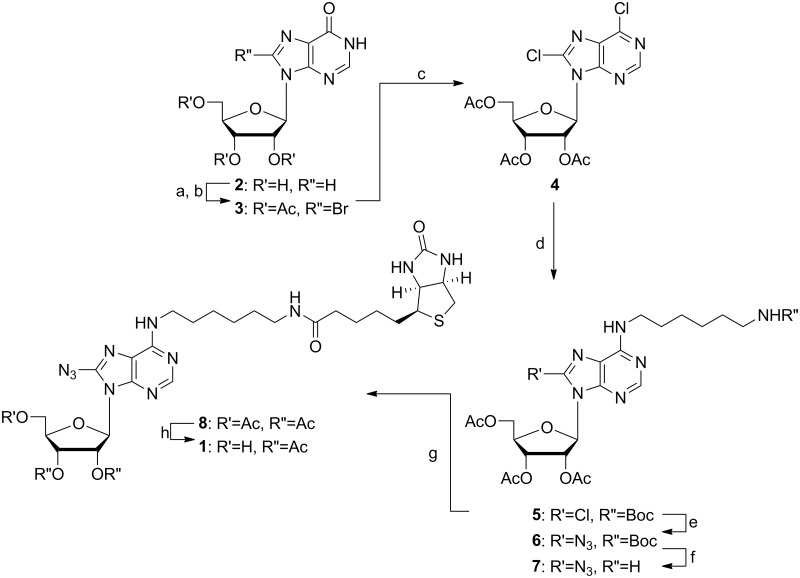
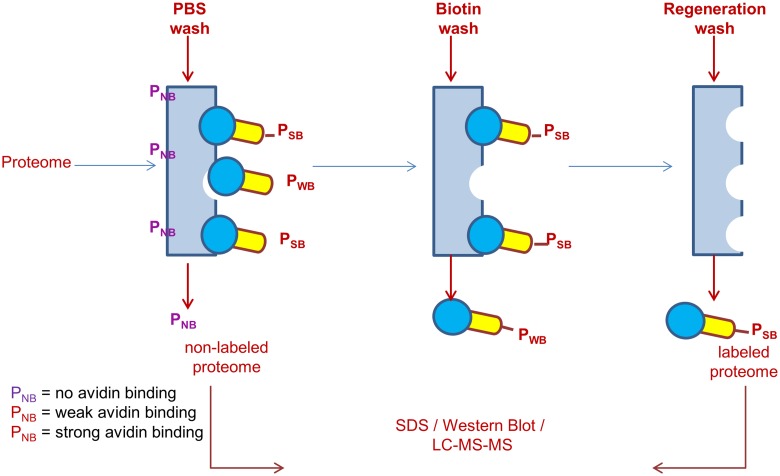
Proteomics is a powerful approach used for investigating the complex molecular mechanisms of disease pathogenesis and progression. An important challenge in modern protein profiling approaches involves targeting of specific protein activities in order to identify altered molecular processes associated with disease pathophysiology. Adenosine-binding proteins represent an important subset of the proteome where aberrant expression or activity changes of these proteins have been implicated in numerous human diseases. Herein, we describe an affinity-based approach for the enrichment of adenosine-binding proteins from a complex cell proteome. A novel N6-biotinylated-8-azido-adenosine probe (AdoR probe) was synthesized, which contains a reactive group that forms a covalent bond with the target proteins, as well as a biotin tag for affinity enrichment using avidin chromatography. Probe specificity was confirmed with protein standards prior to further evaluation in a complex protein mixture consisting of a lysate derived from mouse neuroblastoma N18TG2 cells. Protein identification and relative quantitation using mass spectrometry allowed for the identification of small variations in abundance of nucleoside- and nucleotide-binding proteins in these samples where a significant enrichment of AdoR-binding proteins in the labeled proteome from the neuroblastoma cells was observed. The results from this study demonstrate the utility of this method to enrich for nucleoside- and nucleotide-binding proteins in a complex protein mixture, pointing towards a unique set of proteins that can be examined in the context of further understanding mechanisms of disease, or fundamental biological processes in general.
蛋白质组学是一种用于研究疾病发病机制和进展的复杂分子机制的强大方法。现代蛋白质谱分析方法中的一个重要挑战涉及针对特定蛋白质活性,以识别与疾病病理生理学相关的分子过程改变。腺苷结合蛋白是蛋白质组的一个重要子集,这些蛋白质的异常表达或活性变化与多种人类疾病有关。在此,我们描述了一种基于亲和力的方法,用于从复杂的细胞蛋白质组中富集腺苷结合蛋白。合成了一种新型的N6-生物素化-8-叠氮基腺苷探针(AdoR探针),它含有一个与靶蛋白形成共价键的反应基团,以及一个用于通过抗生物素蛋白色谱进行亲和富集的生物素标签。在由小鼠神经母细胞瘤N18TG2细胞裂解物组成的复杂蛋白质混合物中进行进一步评估之前,先用蛋白质标准品确认了探针的特异性。使用质谱进行蛋白质鉴定和相对定量,能够鉴定这些样品中核苷和核苷酸结合蛋白丰度的微小变化,其中观察到神经母细胞瘤细胞标记蛋白质组中AdoR结合蛋白有显著富集。这项研究的结果证明了该方法在复杂蛋白质混合物中富集核苷和核苷酸结合蛋白的实用性,指出了一组独特的蛋白质,可在进一步理解疾病机制或一般基本生物学过程的背景下进行研究。