Zhou Wei, Zhang Jun, Marcus Adam I
Department of Hematology and Medical Oncology, The Winship Cancer Institute, Emory University School of Medicine, Atlanta, Georgia.
Genes Dis. 2014 Sep 1;1(1):64-74. doi: 10.1016/j.gendis.2014.06.002.
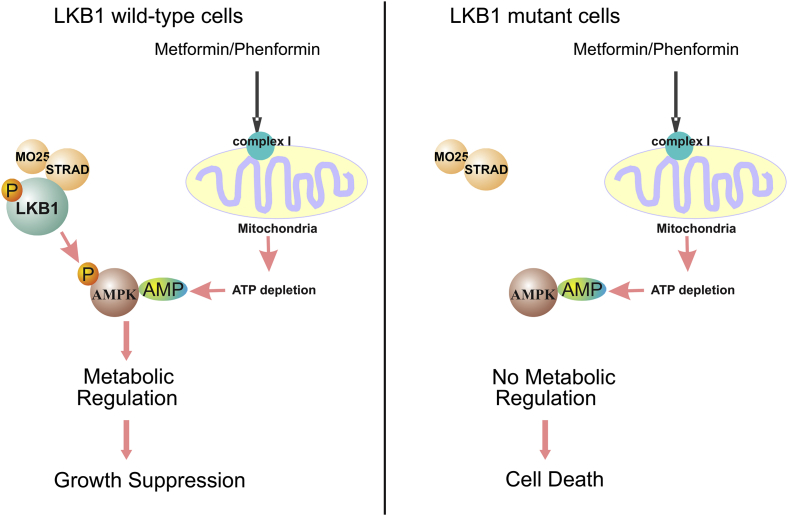
LKB1 is commonly thought of as a tumor suppressor gene because its hereditary mutation is responsible for a cancer syndrome, and somatic inactivation of LKB1 is found in non-small cell lung cancer, melanoma, and cervical cancers. However, unlike other tumor suppressors whose main function is to either suppress cell proliferation or promote cell death, one of the functions of LKB1-regulated AMPK signaling is to suppress cell proliferation in order to promote cell survival under energetic stress conditions. This unique, pro-survival function of LKB1 has led to the discovery of reagents, such as phenformin, that specifically exploit the vulnerability of LKB1-null cells in their defect in sensing energetic stress. Such targeted agents represent a novel treatment strategy because they induce cell killing when LKB1 is absent. This review article summarizes various vulnerabilities of LKB1-mutant cells that have been reported in the literature and discusses the potential of using existing or developing novel reagents to target cancer cells with defective LKB1.
LKB1通常被认为是一种肿瘤抑制基因,因为其遗传性突变会导致一种癌症综合征,并且在非小细胞肺癌、黑色素瘤和宫颈癌中发现了LKB1的体细胞失活。然而,与其他主要功能是抑制细胞增殖或促进细胞死亡的肿瘤抑制基因不同,LKB1调节的AMPK信号传导的功能之一是在能量应激条件下抑制细胞增殖以促进细胞存活。LKB1这种独特的促存活功能导致了如苯乙双胍等试剂的发现,这些试剂专门利用LKB1缺失细胞在感知能量应激方面的缺陷。这种靶向药物代表了一种新的治疗策略,因为当LKB1不存在时它们会诱导细胞死亡。这篇综述文章总结了文献中报道的LKB1突变细胞的各种弱点,并讨论了使用现有或开发新型试剂靶向LKB1缺陷癌细胞的潜力。