Department of Pharmacology and Toxicology, College of Medicine and Health Sciences, An-Najah National University, Nablus, Palestine.
Department of Clinical and Community Pharmacy, College of Medicine and Health Sciences, An-Najah National University, Nablus, Palestine.
Infect Dis Poverty. 2015 Feb 2;4(1):2. doi: 10.1186/2049-9957-4-2. eCollection 2015.
To meet the future challenges of infectious diseases and limit the spread of multidrug resistant microorganisms, a better understanding of published studies in the field of infectious diseases is needed. The objective of this study was to analyze the quantity and quality of research activity in the field of infectious diseases in Arab countries and compare it with that in non-Arab countries.
Documents published in Arab countries within the research category of "infectious diseases" were extracted and analyzed using the Web of Science database. The data analyzed represent research productivity during the time interval between 1900 - 2012.
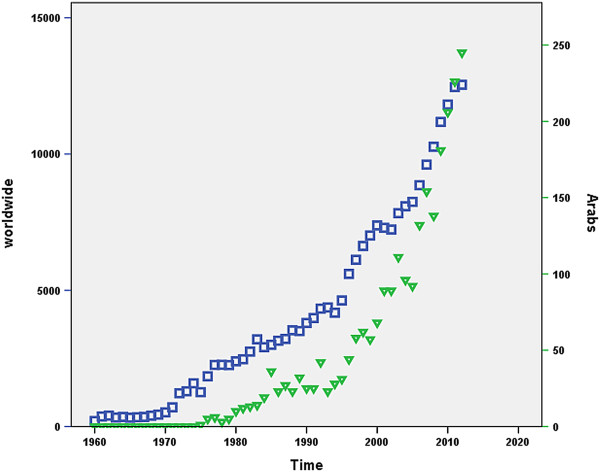
Worldwide, the total number of documents published in the field of infectious diseases up to 2012 was 227,188. A total of 2,408 documents in the field of infectious diseases were published in Arab countries, which represents 1.06% of worldwide research output. Research output from Arab countries in the field of infectious diseases was low for decades. However, approximately a five-fold increase was observed in the past decade. Arab countries ranked 56(th) to 218(th) on the standard competition ranking (SCR) in worldwide publications in the field of infectious diseases. Egypt, with a total publication of 464 (19.27%) documents ranked first among Arab countries, while Kuwait University was the most productive institution with a total of 158 (6.56%) documents. Average citation per document published in Arab countries was 13.25 and the h-index was 64. Tuberculosis (230; 9.55%), malaria (223; 9.26%), and hepatitis (189; 7.8%) were the top three infectious diseases studied as according to the retrieved documents.
The present data reveals that some Arab countries contribute significantly to the field of infectious diseases. However, Arab countries need to work harder to bridge the gap in this field. Compared with non-Arab countries in the Middle East, research output from Arab countries was high, but more efforts are needed to enhance the quality of this output. Future research in the field should be encouraged and correctly directed.
为了应对未来传染病的挑战,限制多药耐药微生物的传播,需要更好地了解传染病领域的已发表研究。本研究的目的是分析阿拉伯国家传染病领域的研究活动的数量和质量,并与非阿拉伯国家进行比较。
从 Web of Science 数据库中提取并分析了在阿拉伯国家发表的属于“传染病”研究类别的文献。分析的数据代表了 1900 年至 2012 年期间的研究生产力。
在全球范围内,截至 2012 年,传染病领域发表的文献总数为 227188 篇。在阿拉伯国家共发表了 2408 篇传染病领域的文献,占全球研究产出的 1.06%。阿拉伯国家在传染病领域的研究产出数十年来一直很低。然而,在过去十年中观察到大约五倍的增长。在全球传染病领域的出版物标准竞争排名(SCR)中,阿拉伯国家排名第 56 位至 218 位。埃及以总计 464 篇(19.27%)文献的发表量位居阿拉伯国家之首,而科威特大学以总计 158 篇(6.56%)文献的发表量成为最具生产力的机构。阿拉伯国家发表的每篇文献的平均引文数为 13.25,h 指数为 64。根据检索到的文献,结核病(230;9.55%)、疟疾(223;9.26%)和肝炎(189;7.8%)是研究最多的三种传染病。
本研究数据表明,一些阿拉伯国家对传染病领域做出了重要贡献。然而,阿拉伯国家需要更加努力地缩小这一领域的差距。与中东的非阿拉伯国家相比,阿拉伯国家的研究产出较高,但仍需加大努力提高产出质量。应鼓励并正确引导该领域的未来研究。