
由射电亮源和射电宁静日冕物质抛射驱动激波中的超临界区和次临界区。
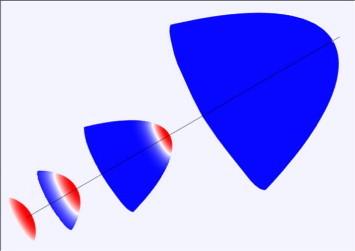
Super- and sub-critical regions in shocks driven by radio-loud and radio-quiet CMEs.
机构信息
INAF - Osservatorio Astrofisico di Torino, via Osservatorio 20, 10025 Pino Torinese (TO), Italy.
出版信息
J Adv Res. 2013 May;4(3):287-91. doi: 10.1016/j.jare.2012.09.005. Epub 2012 Nov 9.
White-light coronagraphic images of Coronal Mass Ejections (CMEs) observed by SOHO/LASCO C2 have been used to estimate the density jump along the whole front of two CME-driven shocks. The two events are different in that the first one was a "radio-loud" fast CME, while the second one was a "radio quiet" slow CME. From the compression ratios inferred along the shock fronts, we estimated the Alfvén Mach numbers for the general case of an oblique shock. It turns out that the "radio-loud" CME shock is initially super-critical around the shock center, while later on the whole shock becomes sub-critical. On the contrary, the shock associated with the "radio-quiet" CME is sub-critical at all times. This suggests that CME-driven shocks could be efficient particle accelerators at the shock nose only at the initiation phases of the event, if and when the shock is super-critical, while at later times they lose their energy and the capability to accelerate high energetic particles.
SOHO/LASCO C2 拍摄的日冕物质抛射(CME)白光日冕像被用于估计两个 CME 驱动激波整个前缘的密度跃变。这两个事件有所不同,第一个是“射电亮”的快速 CME,而第二个是“射电安静”的慢速 CME。从激波前缘推断的压缩比,我们估计了斜激波的一般情况的阿尔芬马赫数。结果表明,“射电亮”CME 激波在激波中心附近最初是超临界的,而后来整个激波变为亚临界的。相反,与“射电安静”CME 相关的激波一直处于亚临界状态。这表明,如果激波是超临界的,那么在事件的初始阶段,CME 驱动的激波可能是在激波头部有效加速粒子的,而在稍后的阶段,它们会失去能量和加速高能粒子的能力。


 Zotero 插件