
阿尔茨海默病前驱期的白质损伤:与海马萎缩及情景记忆表现的关系。
White matter disruption at the prodromal stage of Alzheimer's disease: relationships with hippocampal atrophy and episodic memory performance.
作者信息
Rémy Florence, Vayssière Nathalie, Saint-Aubert Laure, Barbeau Emmanuel, Pariente Jérémie
机构信息
Centre de Recherche Cerveau et Cognition, Université de Toulouse, UPS, France ; CNRS, CerCo, Toulouse, France.
Centre for Alzheimer Research, Department of Neurobiology, Division of Translational Alzheimer Neurobiology, Care Sciences and Society, Karolinska Institute, Stockholm, Sweden.
出版信息
Neuroimage Clin. 2015 Jan 27;7:482-92. doi: 10.1016/j.nicl.2015.01.014. eCollection 2015.
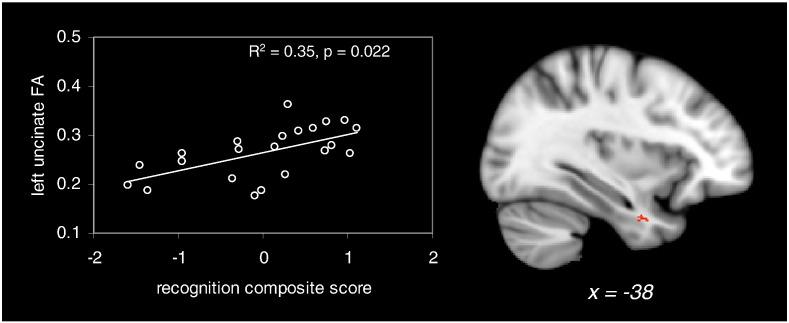
White matter tract alterations have been consistently described in Alzheimer's disease (AD). In particular, limbic fronto-temporal connections, which are critical to episodic memory function, may degenerate early in the course of the disease. However the relation between white matter tract degeneration, hippocampal atrophy and episodic memory impairment at the earliest stages of AD is still unclear. In this magnetic resonance imaging study, white matter integrity and hippocampal volumes were evaluated in patients with amnestic mild cognitive impairment due to AD (Albert et al., 2011) (n = 22) and healthy controls (n = 15). Performance in various episodic memory tasks was also evaluated in each participant. Relative to controls, patients showed a significant reduction of white matter fractional anisotropy (FA) and increase of radial diffusivity (RD) in the bilateral uncinate fasciculus, parahippocampal cingulum and fornix. Within the patient group, significant intra-hemispheric correlations were notably found between hippocampal grey matter volume and FA in the uncinate fasciculus, suggesting a relationship between atrophy and disconnection of the hippocampus. Moreover, episodic recognition scores were related with uncinate fasciculus FA across patients. These results indicate that fronto-hippocampal connectivity is reduced from the earliest pre-demential stages of AD. Disruption of fronto-hippocampal connections may occur progressively, in parallel with hippocampal atrophy, and may specifically contribute to early initial impairment in episodic memory.
在阿尔茨海默病(AD)中,白质纤维束改变一直被提及。特别是对情景记忆功能至关重要的边缘叶额颞连接,可能在疾病进程早期就发生退化。然而,在AD最早阶段,白质纤维束退化、海马萎缩与情景记忆损害之间的关系仍不清楚。在这项磁共振成像研究中,对因AD导致的遗忘型轻度认知障碍患者(Albert等人,2011年)(n = 22)和健康对照者(n = 15)的白质完整性和海马体积进行了评估。还对每位参与者在各种情景记忆任务中的表现进行了评估。与对照组相比,患者双侧钩束、海马旁扣带和穹窿的白质分数各向异性(FA)显著降低,径向扩散率(RD)增加。在患者组中,显著发现海马灰质体积与钩束FA之间存在显著的半球内相关性,提示海马萎缩与断开之间存在关联。此外,患者的情景识别分数与钩束FA相关。这些结果表明,从AD最早的痴呆前期阶段开始,额颞叶连接就已减少。额颞叶连接的中断可能与海马萎缩同时逐渐发生,并且可能特别导致情景记忆的早期初始损害。


 Zotero 插件