Kui Balázs, Balla Zsolt, Vasas Béla, Végh Eszter T, Pallagi Petra, Kormányos Eszter S, Venglovecz Viktória, Iványi Béla, Takács Tamás, Hegyi Péter, Rakonczay Zoltán
First Department of Medicine, University of Szeged, Szeged, Hungary.
Department of Pathology, University of Szeged, Szeged, Hungary.
PLoS One. 2015 Feb 17;10(2):e0117588. doi: 10.1371/journal.pone.0117588. eCollection 2015.
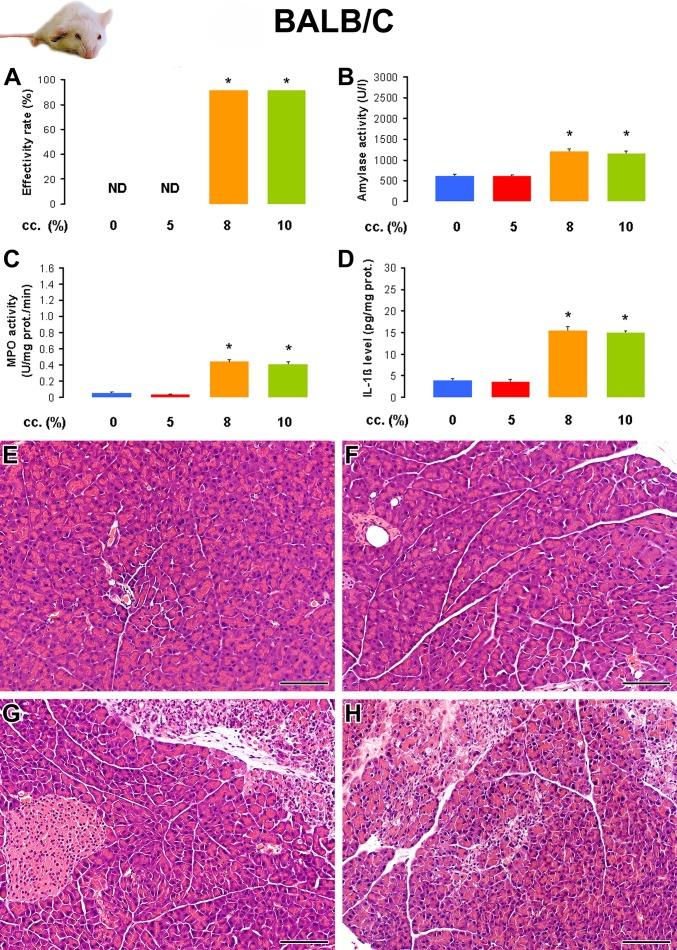
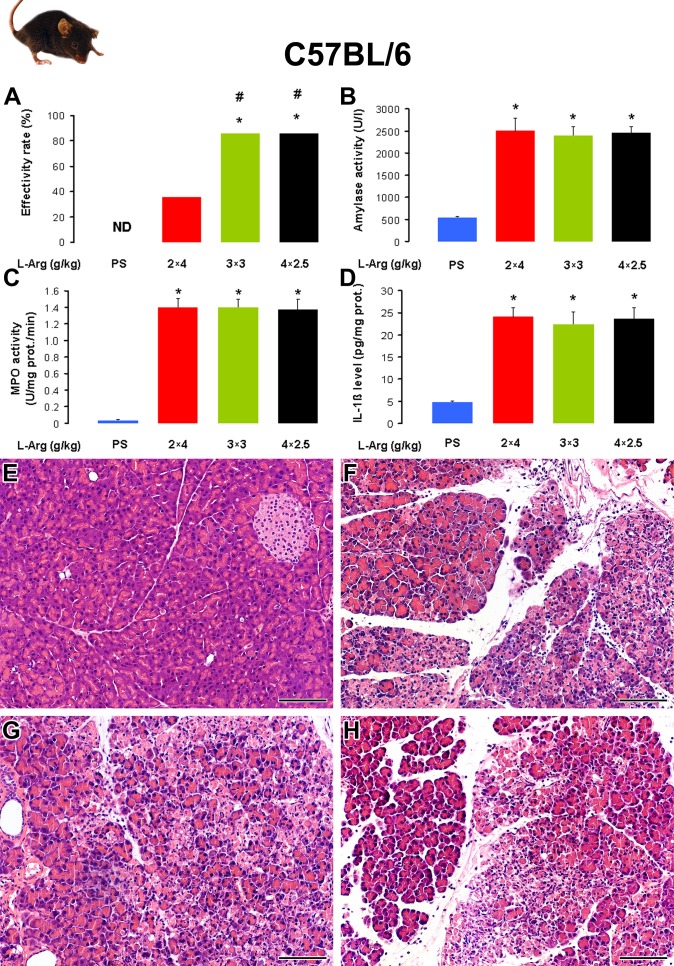
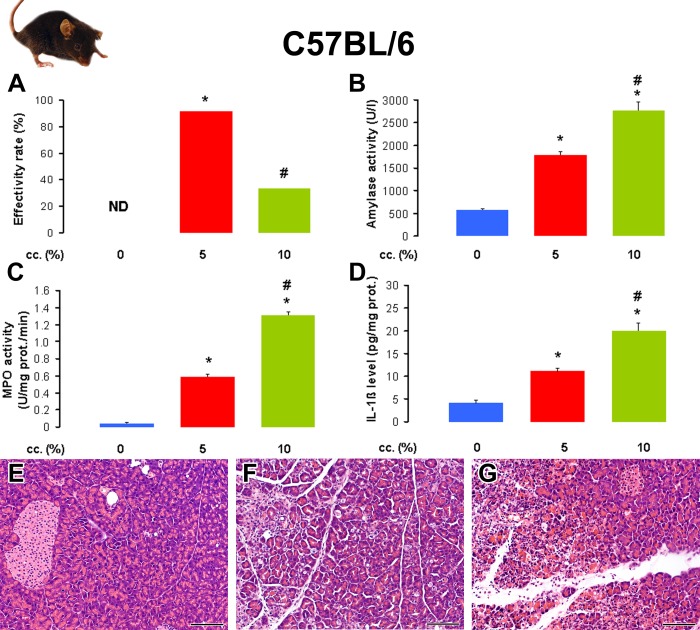
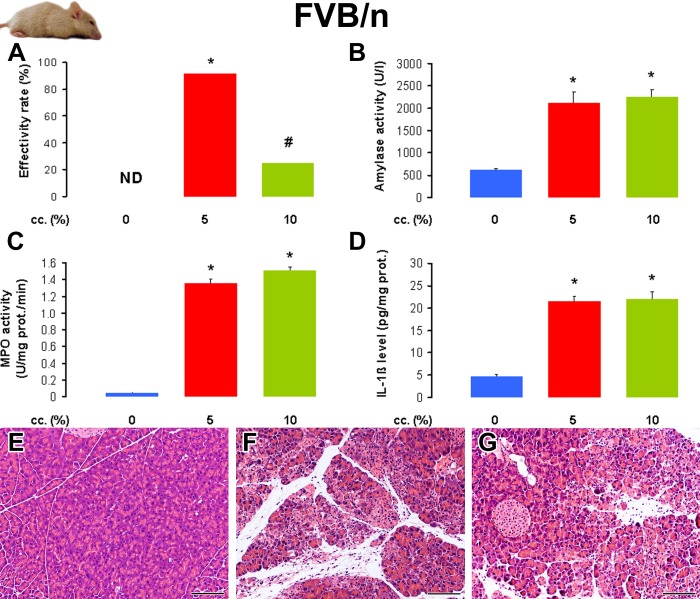
Animal models are ideal to study the pathomechanism and therapy of acute pancreatitis (AP). The use of L-arginine-induced AP model is nowadays becoming increasingly popular in mice. However, carefully looking through the literature, marked differences in disease severity could be observed. In fact, while setting up the L-arginine (2×4 g/kg i.p.)-induced AP model in BALB/c mice, we found a relatively low rate (around 15%) of pancreatic necrosis, whereas others have detected much higher rates (up to 55%). We suspected that this may be due to differences between mouse strains. We administered various concentrations (5-30%, pH = 7.4) and doses (2×4, 3×3, or 4×2.5 g/kg) of L-arginine-HCl in BALB/c, FVB/n and C57BL/6 mice. The potential gender-specific effect of L-arginine was investigated in C57BL/6 mice. The fate of mice in response to the i.p. injections of L arginine followed one of three courses. Some mice (1) developed severe AP or (2) remained AP-free by 72 h, whereas others (3) had to be euthanized (to avoid their death, which was caused by the high dose of L-arginine and not AP) within 12 h., In FVB/n and C57BL/6 mice, the pancreatic necrosis rate (about 50%) was significantly higher than that observed in BALB/c mice using 2×4 g/kg 10% L-arginine, but euthanasia was necessary in a large proportion of animals, The i.p. injection of lower L-arginine concentrations (e.g. 5-8%) in case of the 2×4 g/kg dose, or other L-arginine doses (3×3 or 4×2.5 g/kg, 10%) were better for inducing AP. We could not detect any significant differences between the AP severity of male and female mice. Taken together, when setting up the L-arginine-induced AP model, there are several important factors that are worth consideration such as the dose and concentration of the administered L arginine-HCl solution and also the strain of mice.
动物模型是研究急性胰腺炎(AP)发病机制和治疗方法的理想选择。如今,L-精氨酸诱导的AP模型在小鼠中的应用越来越广泛。然而,仔细查阅文献会发现,疾病严重程度存在显著差异。事实上,在建立BALB/c小鼠L-精氨酸(2×4 g/kg腹腔注射)诱导的AP模型时,我们发现胰腺坏死率相对较低(约15%),而其他人检测到的坏死率要高得多(高达55%)。我们怀疑这可能是由于小鼠品系之间的差异。我们在BALB/c、FVB/n和C57BL/6小鼠中给予了不同浓度(5-30%,pH = 7.4)和剂量(2×4、3×3或4×2.5 g/kg)的L-精氨酸盐酸盐。在C57BL/6小鼠中研究了L-精氨酸潜在的性别特异性作用。腹腔注射L-精氨酸后,小鼠的结局有三种情况。一些小鼠(1)发生了严重的AP,或者(2)在72小时内未发生AP,而其他小鼠(3)在12小时内不得不实施安乐死(以避免因高剂量L-精氨酸而非AP导致的死亡)。在FVB/n和C57BL/6小鼠中,使用2×4 g/kg 10%的L-精氨酸时,胰腺坏死率(约50%)显著高于BALB/c小鼠,但很大一部分动物需要实施安乐死。腹腔注射较低浓度的L-精氨酸(如2×4 g/kg剂量时为5-8%)或其他L-精氨酸剂量(3×3或4×2.5 g/kg,10%)更有利于诱导AP。我们未检测到雄性和雌性小鼠的AP严重程度有任何显著差异。综上所述,在建立L-精氨酸诱导的AP模型时,有几个重要因素值得考虑,如所给予的L-精氨酸盐酸盐溶液的剂量和浓度以及小鼠品系。