Singh Pankaj Kumar, Singh Sweta
Department of Translational Medicine and Neurogenetics, Institut de Génétique et de Biologie Moléculaire et Cellulare (IGBMC) , Illkirch , France.
Front Neurol. 2015 Feb 4;6:14. doi: 10.3389/fneur.2015.00014. eCollection 2015.
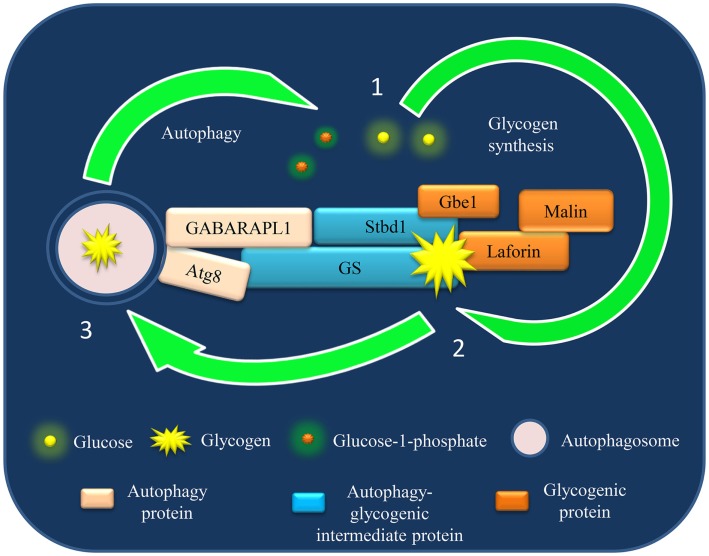
In brain, glycogen metabolism is predominantly restricted to astrocytes but it also indirectly supports neuronal functions. Increased accumulation of glycogen in neurons is mysteriously pathogenic triggering neurodegeneration as seen in "Lafora disease" (LD) and in other transgenic animal models of neuronal glycogen accumulation. LD is a fatal neurodegenerative disorder with excessive glycogen inclusions in neurons. Autophagy, a pathway for bulk degradation of obsolete cellular constituents also degrades metabolites like lipid and glycogen. Recently, defects in this pathway emerged as a plausible reason for glycogen accumulation in neurons in LD, although some contradictions prevail. Albeit surprising, a reciprocal regulation of autophagy by glycogen in neurons has also just been proposed. Notably, increasing evidences of interaction between proteins of autophagy and glycogen metabolism from diverse model systems indicate a conserved, dynamic, and regulatory cross-talk between these two pathways. Concerning these findings, we herein provide certain models for the molecular basis of this cross-talk and discuss its potential implication in the pathophysiology of LD.
在大脑中,糖原代谢主要局限于星形胶质细胞,但它也间接支持神经元功能。神经元中糖原积累的增加具有神秘的致病性,会引发神经退行性变,如在“拉福拉病”(LD)和其他神经元糖原积累的转基因动物模型中所见。LD是一种致命的神经退行性疾病,神经元中存在过多的糖原包涵体。自噬是一种用于大量降解过时细胞成分的途径,它也能降解脂质和糖原等代谢物。最近,尽管存在一些矛盾之处,但该途径的缺陷已成为LD中神经元糖原积累的一个合理原因。尽管令人惊讶,但最近也有人提出神经元中的糖原对自噬有相互调节作用。值得注意的是,来自不同模型系统的越来越多的证据表明自噬蛋白与糖原代谢之间存在相互作用,这表明这两条途径之间存在保守、动态和调节性的相互作用。关于这些发现,我们在此提供了这种相互作用分子基础的某些模型,并讨论了其在LD病理生理学中的潜在意义。