Bianchi Giada, Ghobrial Irene M
Dana-Farber Cancer Institute, Department of Medical Oncology, Harvard Medical School, 450 Brookline Avenue, Boston, MA 02215, USA.
Curr Cancer Ther Rev. 2014;10(2):70-79. doi: 10.2174/157339471002141124121404.
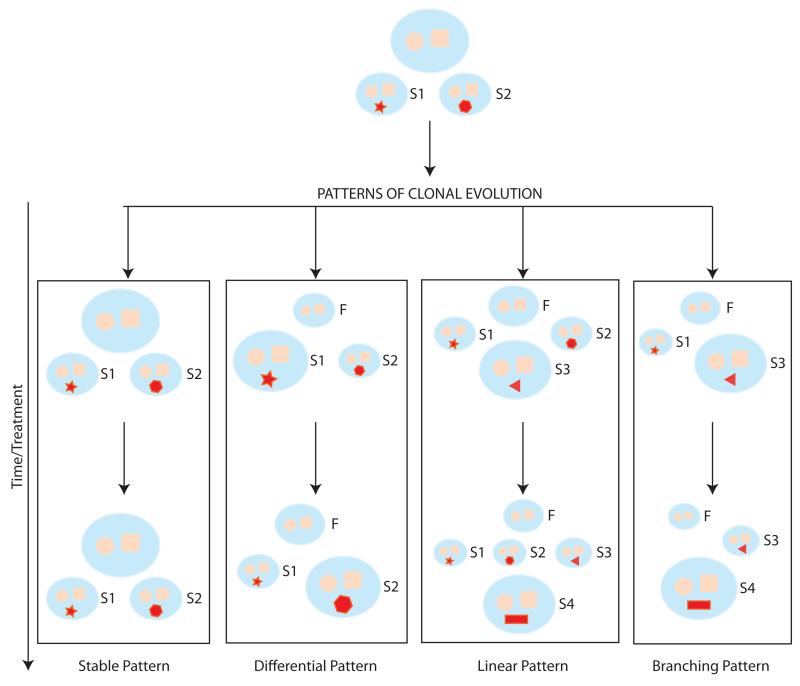
Clonal heterogeneity and clonal evolution have emerged as critical concepts in the field of oncology over the past four decades, largely thanks to the implementation of novel technologies such as comparative genomic hybridization, whole genome/exome sequencing and epigenetic analysis. Along with the identification of cancer stem cells in the majority of neoplasia, the recognition of intertumor and intratumor variability has provided a novel perspective to understand the mechanisms behind tumor evolution and its implication in terms of treatment failure and cancer relapse or recurrence. First hypothesized over two decades ago, clonal heterogeneity and clonal evolution have been confirmed in multiple myeloma (MM), an incurable cancer of plasma cells, almost universally preceded by a pre-malignant conditioned named monoclonal gammopathy of undetermined significance (MGUS). The genetic events and molecular mechanisms underlying such evolution have been difficult to dissect. Moreover, while a role for the bone marrow microenvironment in supporting MM cell survival, proliferation and drug-resistance has been well established, whether it is directly involved in driving evolution from MGUS to MM is at present unclear. We present in this review a historical excursus on the concepts of clonal heterogeneity and clonal evolution in MM with a special emphasis on their role in the progression from MGUS to MM; the contribution of the microenvironment; and the clinical implications in terms of resistance to treatment and disease relapse/recurrence.
在过去的四十年里,克隆异质性和克隆进化已成为肿瘤学领域的关键概念,这在很大程度上得益于比较基因组杂交、全基因组/外显子测序和表观遗传分析等新技术的应用。随着在大多数肿瘤中发现癌症干细胞,肿瘤间和肿瘤内变异性的认识为理解肿瘤进化背后的机制及其在治疗失败和癌症复发或再发方面的影响提供了新的视角。克隆异质性和克隆进化在二十多年前首次被提出,现已在多发性骨髓瘤(MM)中得到证实,多发性骨髓瘤是一种无法治愈的浆细胞癌,几乎普遍先于一种名为意义未明的单克隆丙种球蛋白病(MGUS)的癌前状态出现。这种进化背后的遗传事件和分子机制一直难以剖析。此外,虽然骨髓微环境在支持MM细胞存活、增殖和耐药性方面的作用已得到充分证实,但目前尚不清楚它是否直接参与驱动从MGUS到MM的进化。在本综述中,我们对MM中克隆异质性和克隆进化的概念进行了历史回顾,特别强调它们在从MGUS进展到MM过程中的作用、微环境的贡献以及在治疗耐药性和疾病复发/再发方面的临床意义。