Baló-Banga Joseph M, Schweitzer Katalin, Lakatos Susan, Sipka Sándor
Department of Dermatology, Medical Center of Hungarian Defense Forces, Podmaniczky u. 109-111, Budapest, H-1062 Hungary.
Department of Pathophysiology, Medical Center of Hungarian Defense Forces, Róbert Károly krt. 44, Budapest, H-1134 Hungary.
World Allergy Organ J. 2015 Jan 9;8(1):1. doi: 10.1186/1939-4551-8-1. eCollection 2015.
IL-6 is a pro-inflammatory cytokine which has many well-defined effects. Its synthesis and release from mononuclear cells of drug-sensitized patients was related before to in vitro drug-allergy diagnostics but has not yet been studied in detail.
The specific release of preformed IL-6 from peripheral blood mononuclear cells (PBMC) after 20 minutes incubation with 0.15-0.5 μM of pure drugs was measured in two groups of drug-allergy suspected donors (159) and respective controls (48). IL-6, TNF-alpha, IL-2, IL-4, IFN-gamma have been measured from cell supernatants by ELISA or by cytometric bead assay. Epicutaneous, intradermal and systemic provocation tests were performed to prove or disprove culprit substances (203 in vivo against 482 in vitro tests). T-test (paired and unpaired); chi2 contingency table; Z statistics and McNemar's test were used to evaluate results.
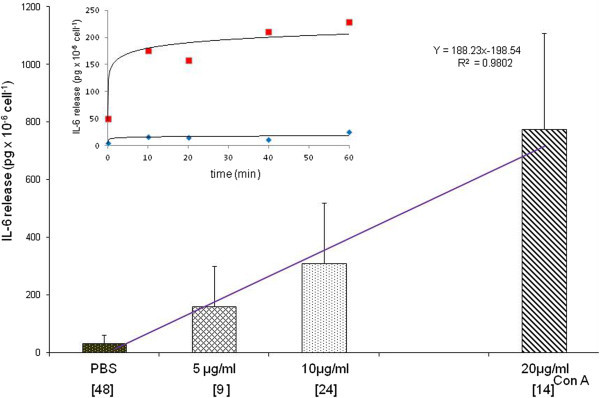
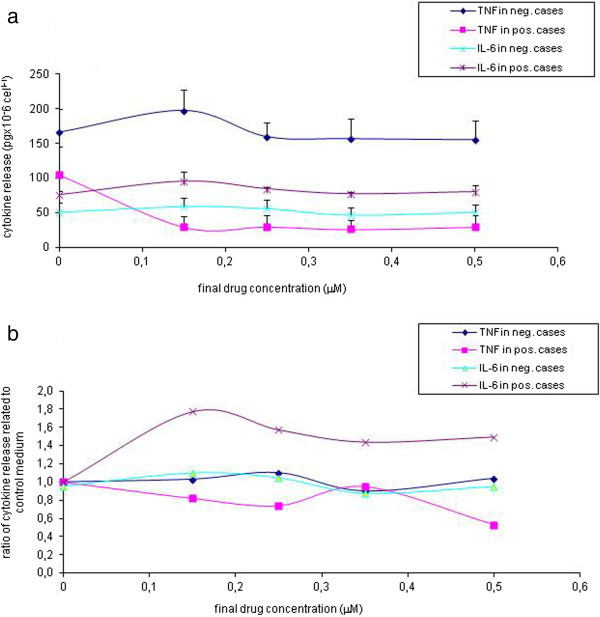
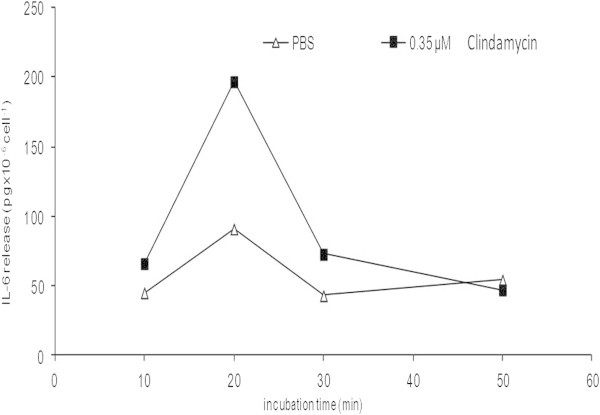
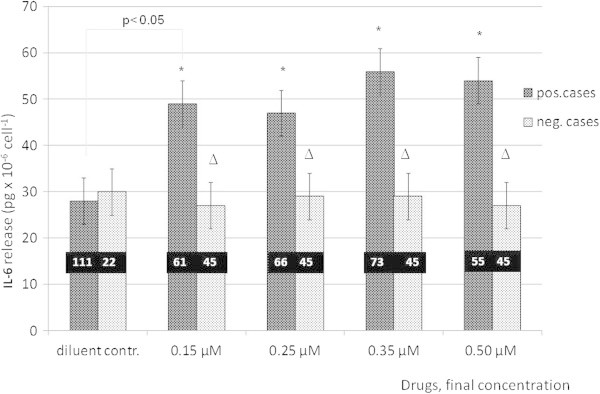
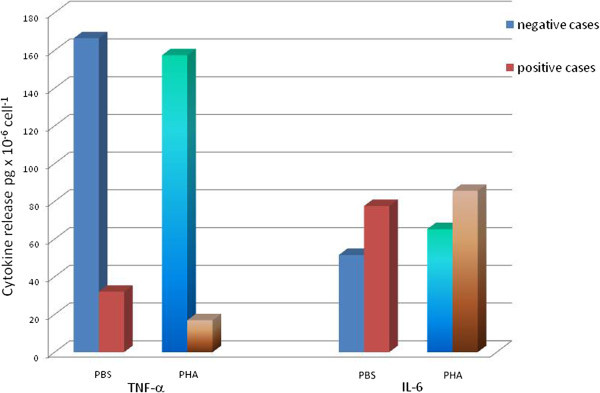
Concanavalin A as positive control released IL-6 from PBMC in linear concentration and exponential time dependent fashion (up to 60 minutes) pointing to the existence of a preformed pool of this cytokine. Preformed IL-6 released at any of 4 standard drug dilutions tested, above 50% over their diluents' levels significantly correlated with the patients' history on drug-induced hypersensitivity symptoms and with in vivo tests. Sensitivity of 85.4% and specificity of 82.4% of the IL-6 release assay were found. The 20' drop in release of TNF-alpha had no diagnostic importance; it has accompanied increased IL-6 release. IL-2, IL-4 and IFN-gamma were undetectable in 20 minutes supernatants. IL-6 release depended on the clinical phenotype but not on the eliciting drug(s) in the molecular mass range of 76-4000 Da. Reactivity of mononuclear cells at the lowest or at multiple drug test concentrations reflected clinical severity per diagnoses and according to area of skin involvement.
This rapid test is applicable to detect a wide scale of drug hypersensitivity.
白细胞介素-6(IL-6)是一种促炎细胞因子,具有多种明确的作用。之前已发现药物致敏患者单核细胞中IL-6的合成与释放与体外药物过敏诊断有关,但尚未进行详细研究。
在两组疑似药物过敏供体(159例)和相应对照组(48例)中,测量外周血单核细胞(PBMC)与0.15 - 0.5 μM纯药物孵育20分钟后预先形成的IL-6的特异性释放。通过酶联免疫吸附测定(ELISA)或细胞计数微球分析从细胞上清液中测量IL-6、肿瘤坏死因子-α(TNF-α)、白细胞介素-2(IL-2)、白细胞介素-4(IL-4)、干扰素-γ(IFN-γ)。进行皮肤点刺试验、皮内试验和全身激发试验以证实或排除可疑物质(体内试验203例,体外试验482例)。采用t检验(配对和非配对)、卡方列联表、Z统计量和McNemar检验来评估结果。
作为阳性对照的刀豆球蛋白A以线性浓度和指数时间依赖性方式(长达60分钟)从PBMC中释放IL-6,表明存在该细胞因子的预先形成的储备池。在测试的4种标准药物稀释液中的任何一种下释放的预先形成的IL-6,比其稀释剂水平高出50%以上,与患者药物诱导的过敏症状病史以及体内试验显著相关。发现IL-6释放试验的敏感性为85.4%,特异性为82.4%。TNF-α释放量在20分钟时的下降没有诊断意义;它伴随着IL-6释放的增加。在20分钟的上清液中未检测到IL-2、IL-4和IFN-γ。IL-6释放取决于临床表型,但不取决于分子量范围为76 - 4000 Da的引发药物。在最低或多种药物测试浓度下单核细胞的反应性反映了每个诊断的临床严重程度以及根据皮肤受累面积。
这种快速检测方法适用于检测广泛的药物过敏。