Department of Physical Therapy, The Graduate School, Yonsei University, Won-ju, Republic of Korea.
Department of Physical Therapy, The Graduate School, Yonsei University, Won-ju, Republic of Korea. ; Department of Physical Therapy, Seoul-chuk Hospital, Seoul, Republic of Korea.
J Hum Kinet. 2014 Dec 30;44:83-90. doi: 10.2478/hukin-2014-0113. eCollection 2014 Dec 9.
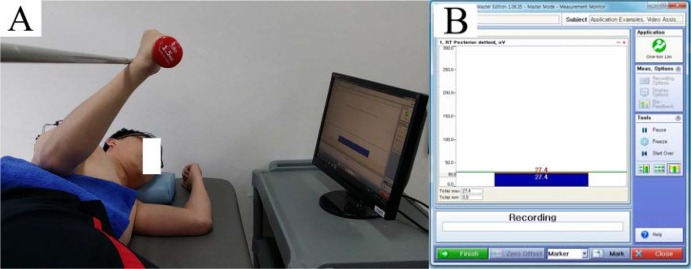
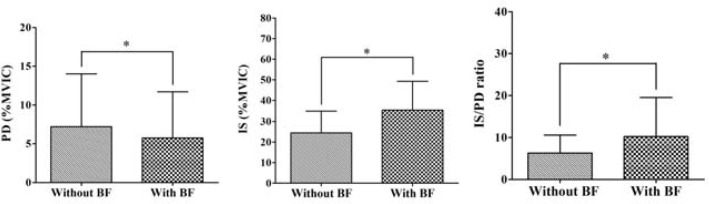
We investigated the effects of visual electromyography (EMG) biofeedback during side-lying shoulder external rotation exercise on the EMG amplitude for the posterior deltoid, infraspinatus, and infraspinatus/posterior deltoid EMG activity ratio. Thirty-one asymptomatic subjects were included. Subjects performed side-lying shoulder external rotation exercise with and without visual EMG biofeedback. Surface EMG was used to collect data from the posterior deltoid and infraspinatus muscles. The visual EMG biofeedback applied the pre-established threshold to prevent excessive posterior deltoid muscle contraction. A paired t-test was used to determine the significance of the measurements between without vs. with visual EMG biofeedback. Posterior deltoid activity significantly decreased while infraspinatus activity and the infraspinatus/posterior activity ratio significantly increased during side-lying shoulder external rotation exercise with visual EMG biofeedback. This suggests that using visual EMG biofeedback during shoulder external rotation exercise is a clinically effective training method for reducing posterior deltoid activity and increasing infraspinatus activity.
我们研究了在侧卧位肩部外旋运动中使用视觉肌电图(EMG)生物反馈对三角肌后束、冈下肌和冈下肌/三角肌后束 EMG 活动比的影响。共纳入 31 名无症状受试者。受试者分别在有无视觉 EMG 生物反馈的情况下进行侧卧位肩部外旋运动。表面肌电图用于收集三角肌后束和冈下肌的肌电数据。视觉 EMG 生物反馈应用预先设定的阈值来防止三角肌后束过度收缩。采用配对 t 检验比较有无视觉 EMG 生物反馈时的测量值的显著性。在侧卧位肩部外旋运动中使用视觉 EMG 生物反馈时,三角肌后束的活动显著降低,而冈下肌的活动和冈下肌/三角肌后束的活动比显著增加。这表明,在肩部外旋运动中使用视觉 EMG 生物反馈是一种减少三角肌后束活动和增加冈下肌活动的临床有效训练方法。