Chitty Lyn S, Mason Sarah, Barrett Angela N, McKay Fiona, Lench Nicholas, Daley Rebecca, Jenkins Lucy A
UCL Institute of Child Health, Genetics and Genomic Medicine, London, UK.
University College London Hospitals NHS Foundation Trust, London, UK.
Prenat Diagn. 2015 Jul;35(7):656-62. doi: 10.1002/pd.4583. Epub 2015 May 26.
Accurate prenatal diagnosis of genetic conditions can be challenging and usually requires invasive testing. Here, we demonstrate the potential of next-generation sequencing (NGS) for the analysis of cell-free DNA in maternal blood to transform prenatal diagnosis of monogenic disorders.
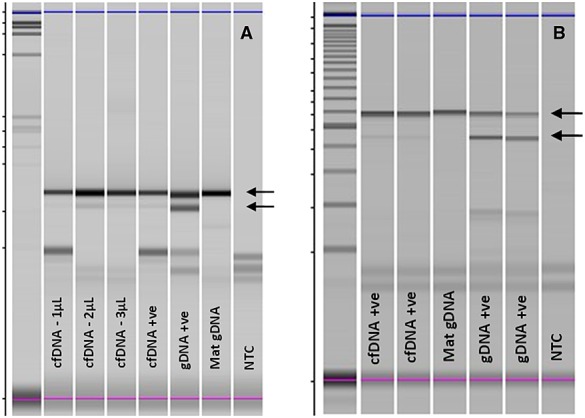
Analysis of cell-free DNA using a PCR and restriction enzyme digest (PCR-RED) was compared with a novel NGS assay in pregnancies at risk of achondroplasia and thanatophoric dysplasia.
PCR-RED was performed in 72 cases and was correct in 88.6%, inconclusive in 7% with one false negative. NGS was performed in 47 cases and was accurate in 96.2% with no inconclusives. Both approaches were used in 27 cases, with NGS giving the correct result in the two cases inconclusive with PCR-RED.
NGS provides an accurate, flexible approach to non-invasive prenatal diagnosis of de novo and paternally inherited mutations. It is more sensitive than PCR-RED and is ideal when screening a gene with multiple potential pathogenic mutations. These findings highlight the value of NGS in the development of non-invasive prenatal diagnosis for other monogenic disorders.
准确的遗传性疾病产前诊断具有挑战性,通常需要进行侵入性检测。在此,我们展示了下一代测序(NGS)技术在分析母血中游离DNA以变革单基因疾病产前诊断方面的潜力。
在有软骨发育不全和致死性骨发育不全风险的妊娠中,将使用聚合酶链反应和限制性内切酶消化(PCR-RED)分析游离DNA的方法与一种新型NGS检测方法进行比较。
72例进行了PCR-RED检测,其中88.6%结果正确,7%结果不确定,有1例假阴性。47例进行了NGS检测,96.2%结果准确,无不确定结果。27例同时采用了两种方法,在PCR-RED检测结果不确定的2例中,NGS得出了正确结果。
NGS为新发和父系遗传突变的非侵入性产前诊断提供了一种准确、灵活的方法。它比PCR-RED更敏感,在筛查具有多种潜在致病突变的基因时是理想选择。这些发现凸显了NGS在其他单基因疾病非侵入性产前诊断发展中的价值。