Boston University Schools of Medicine and Public Health , Boston, Massachusetts.
Policy Analysis Inc. (PAI) , Brookline, Massachusetts.
Open Forum Infect Dis. 2014 May 27;1(1):ofu024. doi: 10.1093/ofid/ofu024. eCollection 2014 Mar.
Although it is widely accepted that adults with immunocompromising conditions are at greatly increased risk of pneumococcal infection, the extent of risk among immunocompetent adults with chronic medical conditions is less certain, particularly in the current era of universal vaccination of children with pneumococcal conjugate vaccines.
We conducted a retrospective cohort study using data from 3 healthcare claims repositories (2006-2010) to compare rates of pneumococcal disease in immunocompetent adults with chronic medical conditions ("at-risk") and immunocompromised adults ("high-risk"), with rates in adults without these conditions ("healthy"). Risk profiles and episodes of pneumococcal disease-all-cause pneumonia, pneumococcal pneumonia, and invasive pneumococcal disease (IPD)-were ascertained from diagnosis, procedure, and drug codes.
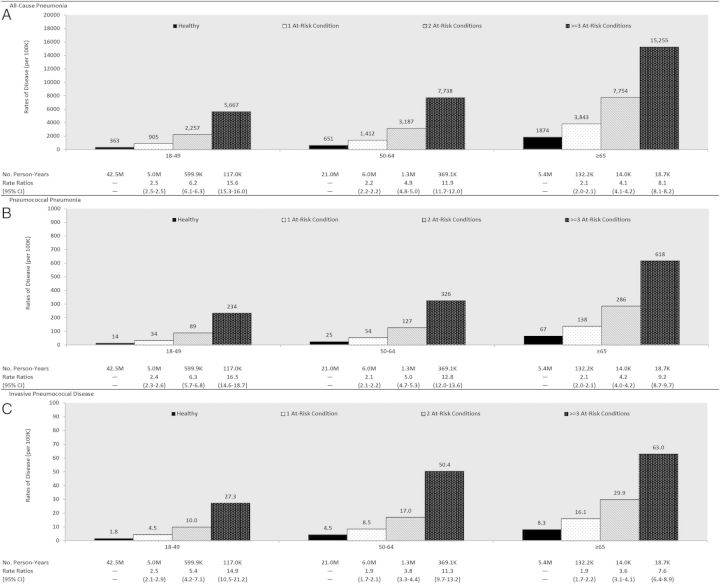
Rates of all-cause pneumonia among at-risk persons aged 18-49 years, 50-64 years, and ≥65 years were 3.2 (95% confidence interval [CI], 3.1-3.2), 3.1 (95% CI, 3.1-3.1), and 3.0 (95% CI, 3.0-3.0) times the rates in age-matched healthy counterparts, respectively. We identified rheumatoid arthritis, systemic lupus erythematosus, Crohn's disease, and neuromuscular or seizure disorders as additional at-risk conditions for pneumococcal disease. Among persons with at-risk conditions, the rate of all-cause pneumonia substantially increased with the accumulation of concurrent at-risk conditions (risk stacking): among persons 18-49 years, rate ratios increased from 2.5 (95% CI, 2.5-2.5) in those with 1 at-risk condition to 6.2 (95% CI, 6.1-6.3) in those with 2 conditions, and to 15.6 (95% CI, 15.3-16.0) in those with ≥3 conditions. Findings for pneumococcal pneumonia and IPD were similar.
Despite widespread use of pneumococcal conjugate vaccines, rates of pneumonia and IPD remain disproportionately high in adults with at-risk conditions, including those with conditions not currently included in the Advisory Committee on Immunization Practices' guidelines for prevention and those with multiple at-risk conditions.
虽然人们普遍认为免疫功能低下的成年人患肺炎球菌感染的风险大大增加,但免疫功能正常的慢性病成年人的风险程度尚不确定,尤其是在当前普遍为儿童接种肺炎球菌结合疫苗的时代。
我们使用来自三个医疗保健索赔数据库(2006-2010 年)的数据进行了回顾性队列研究,比较了患有慢性疾病的免疫功能正常的成年人(“高危人群”)和免疫功能低下的成年人(“高危人群”)与无这些疾病的成年人(“健康人群”)之间的肺炎球菌病发病率。风险状况和肺炎球菌病发作情况-所有病因肺炎、肺炎球菌肺炎和侵袭性肺炎球菌病(IPD)-是通过诊断、程序和药物代码确定的。
18-49 岁、50-64 岁和≥65 岁的高危人群中所有病因肺炎的发病率分别为 3.2(95%置信区间[CI],3.1-3.2)、3.1(95% CI,3.1-3.1)和 3.0(95% CI,3.0-3.0)倍,与年龄匹配的健康对照组相比。我们发现类风湿关节炎、系统性红斑狼疮、克罗恩病和神经肌肉或癫痫发作障碍是肺炎球菌病的其他高危疾病。在患有高危疾病的人群中,所有病因肺炎的发病率随着并发高危疾病的累积而显著增加(风险叠加):在 18-49 岁的人群中,发病率比从患有 1 种高危疾病的 2.5(95%CI,2.5-2.5)增加到患有 2 种疾病的 6.2(95%CI,6.1-6.3),并增加到患有≥3 种疾病的 15.6(95%CI,15.3-16.0)。肺炎球菌肺炎和 IPD 的发现相似。
尽管广泛使用肺炎球菌结合疫苗,但患有高危疾病的成年人(包括目前不符合免疫实践咨询委员会预防指南的疾病和患有多种高危疾病的成年人)的肺炎和 IPD 发病率仍然过高。