Nyondo Alinane Linda, Choko Augustine Talumba, Chimwaza Angela Faith, Muula Adamson Sinjani
School of Public Health and Family Medicine, College of Medicine, University of Malawi, Blantyre, Malawi.
Malawi Liverpool Wellcome Trust Clinical Research Programme, Blantyre, Malawi.
PLoS One. 2015 Mar 3;10(3):e0119273. doi: 10.1371/journal.pone.0119273. eCollection 2015.
Male involvement (MI) is vital for the uptake of Prevention of Mother to Child Transmission (PMTCT) of Human Immunodeficiency Virus (HIV) interventions. Partner notification (PN) is among the strategies identified for MI in PMTCT services. The purpose of this randomized controlled trial was to evaluate the efficacy of an invitation card to the male partners as a strategy for MI in PMTCT services by comparing the proportion of pregnant women that were accompanied by their partners between the intervention and the non-intervention study groups.
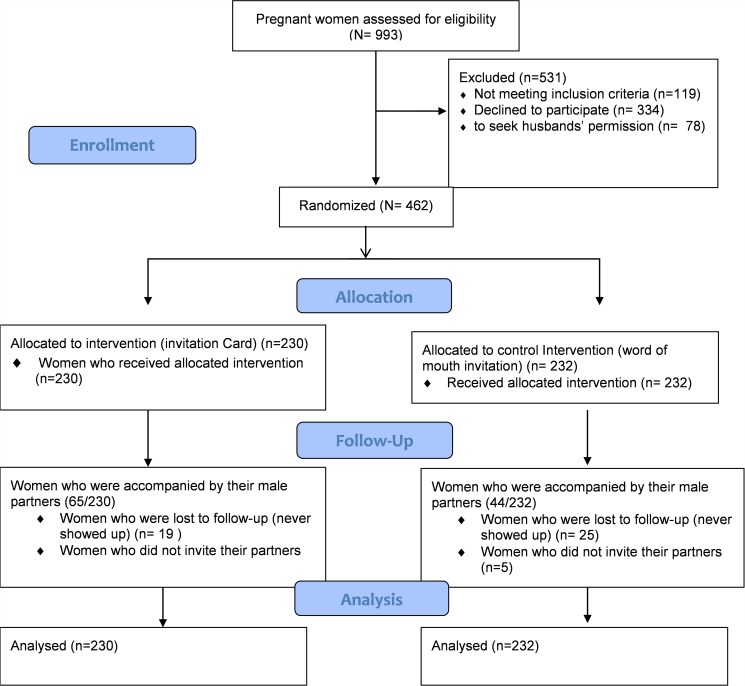
Pregnant women attending antenatal care without a male partner at South Lunzu and Mpemba health centres in Blantyre, Malawi, were enrolled in the study from June to December 2013. In an intention-to-treat analysis, we compared all participants that were randomized in the invitation card group with the standard of care (SoC) group. Risk ratios (RR) with 95% confidence intervals (CI) were computed to assess the efficacy of the invitation card.
Of the 462 randomized women, 65/230 (28.26%) of the women in the invitation card group reported to the antenatal care clinic with their partners compared to 44/232 (18.97%) women in the SoC group. In an unadjusted intention-to-treat analysis women in the invitation card group were 50% more likely to be accompanied by their male partners than those in the SoC group RR: 1.49 (95% CI: 1.06-2.09); p = 0.02. Our random effects analysis showed that there was no clustering by site of recruitment with an inter cluster correlation coefficient (ICC) of 1.98 x 10(-3), (95% CI: 1.78 x10(-7) - 0.96 x 10(-1)); p =0.403.
An invitation card significantly increased the proportion of women who were accompanied by their male partners for the PMTCT services. An invitation card is a feasible strategy for MI in PMTCT.
男性参与对于采用预防人类免疫缺陷病毒(HIV)母婴传播(PMTCT)干预措施至关重要。性伴通知(PN)是在PMTCT服务中确定的促进男性参与的策略之一。这项随机对照试验的目的是通过比较干预组和非干预组中由其伴侣陪同的孕妇比例,评估向男性伴侣发放邀请卡作为PMTCT服务中促进男性参与策略的效果。
2013年6月至12月,在马拉维布兰太尔的南伦祖和姆佩姆巴健康中心,招募了在产前护理时没有男性伴侣陪同的孕妇参与该研究。在意向性分析中,我们将所有随机分配到邀请卡组的参与者与标准护理(SoC)组进行比较。计算风险比(RR)及其95%置信区间(CI)以评估邀请卡的效果。
在462名随机分组的女性中,邀请卡组中有65/230(28.26%)的女性与其伴侣一起到产前护理诊所就诊,而SoC组为44/232(18.97%)的女性。在未经调整的意向性分析中,邀请卡组的女性由其男性伴侣陪同的可能性比SoC组高50%,RR:1.49(95%CI:1.06 - 2.09);p = 0.02。我们的随机效应分析表明招募地点不存在聚类现象,组间相关系数(ICC)为1.98×10(-3),(95%CI:1.78×10(-7) - 0.96×10(-1));p = 0.403。
邀请卡显著提高了在PMTCT服务中有男性伴侣陪同的女性比例。邀请卡是PMTCT中促进男性参与的可行策略。