Zhu Xiaohua, Van Horn Kurt S, Barber Megan M, Yang Sihyung, Wang Michael Zhuo, Manetsch Roman, Werbovetz Karl A
Division of Medicinal Chemistry and Pharmacognosy, College of Pharmacy, The Ohio State University, Columbus, OH 43210, United States.
Department of Chemistry, University of South Florida, 4202 East Fowler Avenue, Tampa, FL 33620, United States.
Bioorg Med Chem. 2015 Aug 15;23(16):5182-9. doi: 10.1016/j.bmc.2015.02.020. Epub 2015 Feb 18.
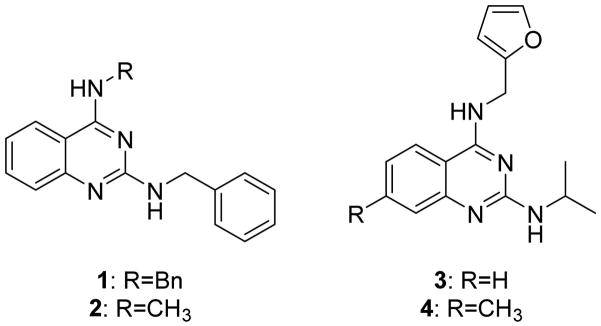
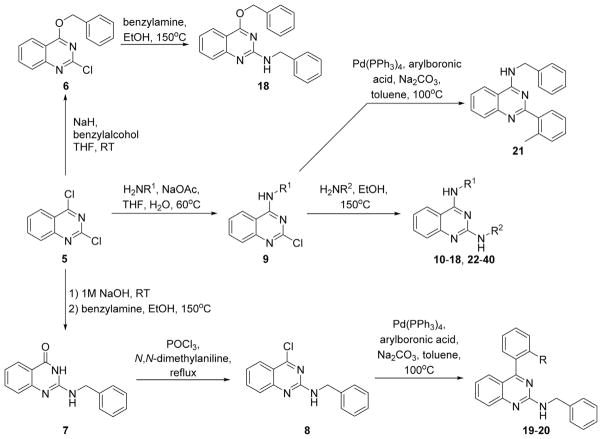
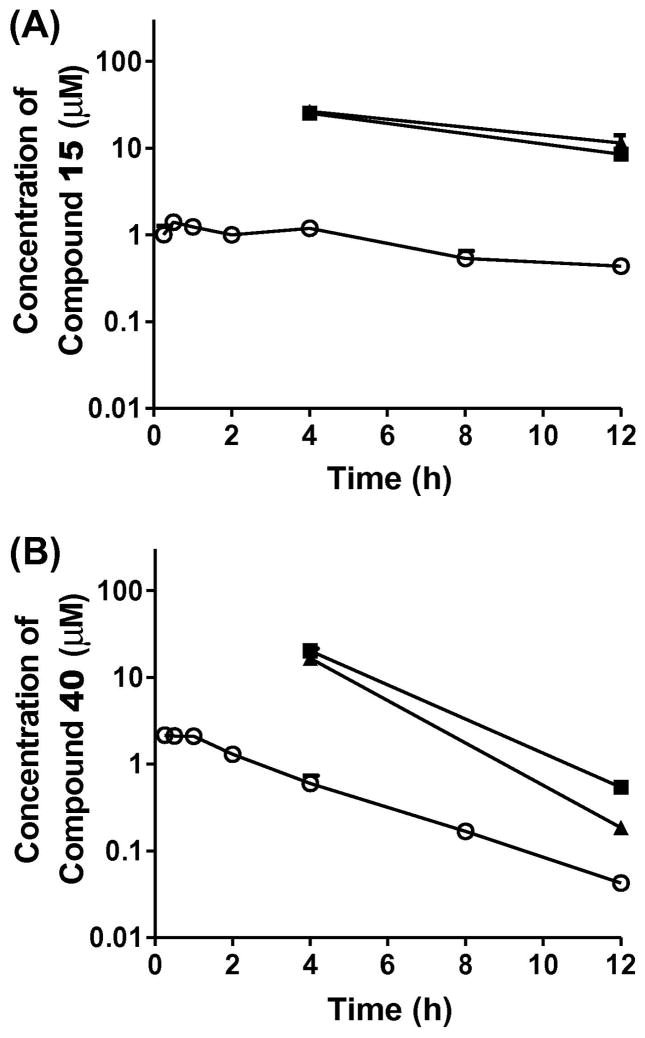
Visceral leishmaniasis is a neglected parasitic disease that has a high fatality rate in the absence of treatment. New drugs that are inexpensive, orally active, and effective could be useful tools in the fight against this disease. We previously showed that N(2),N(4)-disubstituted quinazoline-2,4-diamines displayed low- to sub-micromolar potency against intracellular Leishmania, and lead compound N(4)-(furan-2-ylmethyl)-N(2)-isopropyl-7-methylquinazoline-2,4-diamine (4) exhibited modest efficacy in an acute murine model of visceral leishmaniasis. In the present work, thirty-one N(2),N(4)-disubstituted quinazoline-2,4-diamines that had not previously been examined for their antileishmanial activity were evaluated for their potency and selectivity against Leishmania donovani, the causative parasite of visceral leishmaniasis. Quinazoline-2,4-diamines with aromatic substituents at both N(2) and N(4) exhibited potent in vitro antileishmanial activity but relatively low selectivity, while compounds substituted with small alkyl groups at either N(2) or N(4) generally showed lower antileishmanial potency but were less toxic to a murine macrophage cell line. Based on their in vitro antileishmanial potency, N(4)-benzyl-N(2)-(4-chlorobenzyl)quinazoline-2,4-diamine (15) and N(2)-benzyl-N(4)-isopropylquinazoline-2,4-diamine (40) were selected for in vivo evaluation of their pharmacokinetic and antileishmanial properties. While 15 displayed a longer plasma half-life and a greater area under the curve than 40, both compounds showed low efficacy in an acute murine visceral leishmaniasis model. Although the present study did not identify new quinazoline-2,4-diamines with promising in vivo efficacy, the reduced in vitro toxicity of derivatives bearing small alkyl groups at either N(2) or N(4) may provide clues for the design of safe and effective antileishmanial quinazolines.
内脏利什曼病是一种被忽视的寄生虫病,在未接受治疗的情况下病死率很高。价格低廉、口服有效且有效的新药可能是对抗这种疾病的有用工具。我们之前表明,N(2),N(4)-二取代喹唑啉-2,4-二胺对细胞内利什曼原虫显示出低至亚微摩尔的效力,先导化合物N(4)-(呋喃-2-基甲基)-N(2)-异丙基-7-甲基喹唑啉-2,4-二胺(4)在内脏利什曼病的急性小鼠模型中表现出适度的疗效。在本研究中,对31种之前未检测过抗利什曼活性的N(2),N(4)-二取代喹唑啉-2,4-二胺进行了评估,以确定它们对内脏利什曼病的致病寄生虫杜氏利什曼原虫的效力和选择性。在N(2)和N(4)处都带有芳族取代基的喹唑啉-2,4-二胺在体外显示出强大的抗利什曼活性,但选择性相对较低;而在N(2)或N(4)处被小烷基取代的化合物通常显示出较低的抗利什曼效力,但对小鼠巨噬细胞系的毒性较小。基于它们的体外抗利什曼效力,选择了N(4)-苄基-N(2)-(4-氯苄基)喹唑啉-2,4-二胺(15)和N(2)-苄基-N(4)-异丙基喹唑啉-2,4-二胺(40)对其药代动力学和抗利什曼特性进行体内评估。虽然15的血浆半衰期比40长,曲线下面积也比40大,但两种化合物在急性小鼠内脏利什曼病模型中均显示出低疗效。尽管本研究未鉴定出具有有前景的体内疗效的新喹唑啉-2,4-二胺,但在N(2)或N(4)处带有小烷基的衍生物体外毒性降低可能为设计安全有效的抗利什曼喹唑啉提供线索。