Department of Neurology, Oslo University Hospital Oslo, Norway ; Centre for Molecular Medicine Norway, The Nordic EMBL Partnership, University of Oslo Oslo, Norway ; Letten Centre and GliaLab, Department of Physiology, Institute of Basic Medical Sciences, University of Oslo Oslo, Norway.
Department of Neurology, Oslo University Hospital Oslo, Norway ; Letten Centre and GliaLab, Department of Physiology, Institute of Basic Medical Sciences, University of Oslo Oslo, Norway.
Front Cell Neurosci. 2015 Feb 25;9:49. doi: 10.3389/fncel.2015.00049. eCollection 2015.
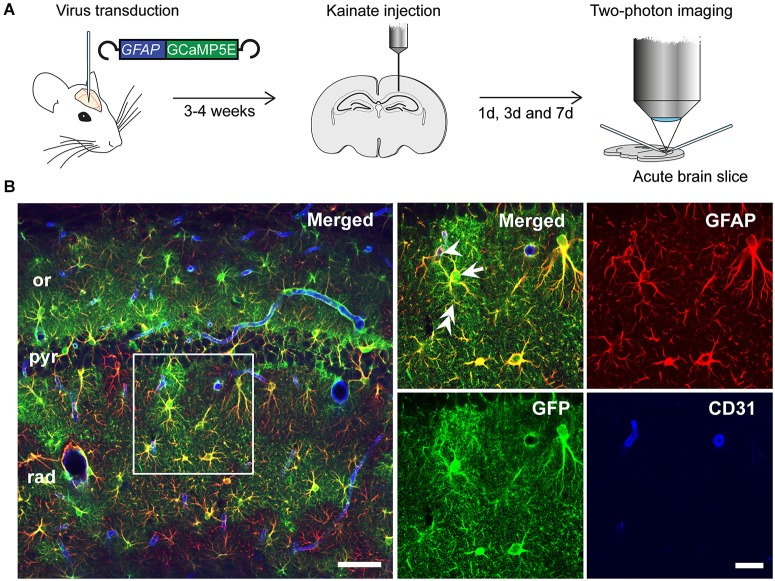
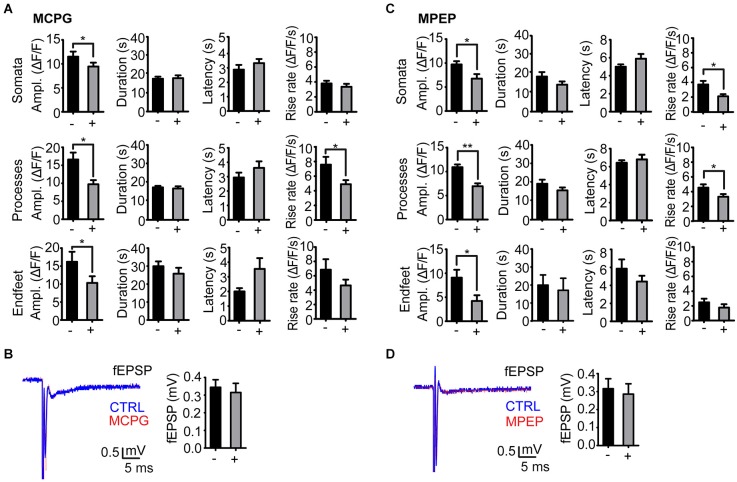
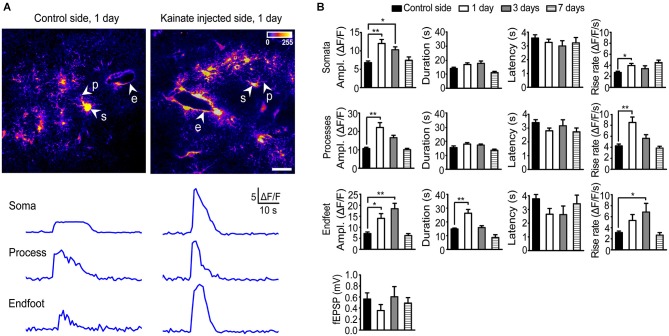
Astrocytic endfeet are specialized cell compartments whose important homeostatic roles depend on their enrichment of water and ion channels anchored by the dystrophin associated protein complex (DAPC). This protein complex is known to disassemble in patients with mesial temporal lobe epilepsy and in the latent phase of experimental epilepsies. The mechanistic underpinning of this disassembly is an obvious target of future therapies, but remains unresolved. Here we show in a kainate model of temporal lobe epilepsy that astrocytic endfeet display an enhanced stimulation-evoked Ca(2+) signal that outlast the Ca(2+) signal in the cell bodies. While the amplitude of this Ca(2+) signal is reduced following group I/II metabotropic receptor (mGluR) blockade, the duration is sustained. Based on previous studies it has been hypothesized that the molecular disassembly in astrocytic endfeet is caused by dystrophin cleavage mediated by Ca(2+) dependent proteases. Using a newly developed genetically encoded Ca(2+) sensor, the present study bolsters this hypothesis by demonstrating long-lasting, enhanced stimulation-evoked Ca(2+) signals in astrocytic endfeet.
星形细胞终足是一种特化的细胞区室,其重要的稳态功能依赖于富含水和离子通道的锚定蛋白复合物(DAPC)。已知该蛋白复合物在颞叶内侧癫痫患者和实验性癫痫的潜伏期中会解体。这种解体的机制基础是未来治疗的一个明显靶点,但仍未解决。在这里,我们在红藻氨酸诱导的颞叶癫痫模型中显示,星形细胞终足显示出增强的刺激诱导的 Ca(2+)信号,其持续时间超过细胞体中的 Ca(2+)信号。虽然这种 Ca(2+)信号的幅度在阻断 I/II 型代谢型谷氨酸受体(mGluR)后减小,但持续时间保持不变。基于先前的研究,人们假设星形细胞终足中的分子解体是由 Ca(2+)依赖性蛋白酶介导的肌营养不良蛋白裂解引起的。本研究使用新开发的基因编码 Ca(2+)传感器,通过证明星形细胞终足中持续时间长、刺激诱导的 Ca(2+)信号增强,支持了这一假说。