Valentini Melissa Bianchetti, Toledo Maria Luíza Guerra de, Fonseca Marise Oliveira, Thiersch Laura Maria Silva, Toledo Ingrid Silva Bremer de, Machado Flávia Cristina Jácome, Tupinambás Unaí
Postgraduate Program on Health Science, Infectious Diseases and Tropical Medicine, Universidade Federal de Minas Gerais (UFMG), Belo Horizonte, MG, Brazil; Voluntary Counseling and Testing Site/Specialized Center in HIV Outclinic Patients Care (CTA-SAE), Belo Horizonte, MG, Brazil.
National School of Statistical Science-Instituto Brasileiro de Geografia e Estatística (IBGE), Rio de Janeiro, RJ, Brazil.
Braz J Infect Dis. 2015 May-Jun;19(3):253-62. doi: 10.1016/j.bjid.2015.01.005. Epub 2015 Mar 10.
Since 1996 Brazil has provided universal access to free antiretroviral therapy, and as a consequence, HIV/AIDS patients' survival rate has improved dramatically. However, according to scientific reports, a significant number of patients are still late presenting for HIV treatment, which leads to consequences both for the individual and society. Clinical and immunological characteristics of HIV patients newly diagnosed were accessed and factors associated with late presentation for treatment were evaluated.
A cross-sectional study was carried out in an HIV/AIDS reference center in Belo Horizonte, Minas Gerais, in Southeastern Brazil from 2008 to 2010. Operationally, patients with late presentation (LP) for treatment were those whose first CD4 cell count was less than 350 cells/mm(3) or presented an AIDS defining opportunistic infection. Patients with late presentation with advanced disease (LPAD) were those whose first CD4 cell count was less than 200 cells/mm(3) or presented an AIDS defining opportunistic infection. LP and LPAD associated risk factors were evaluated using logistic regression methods.
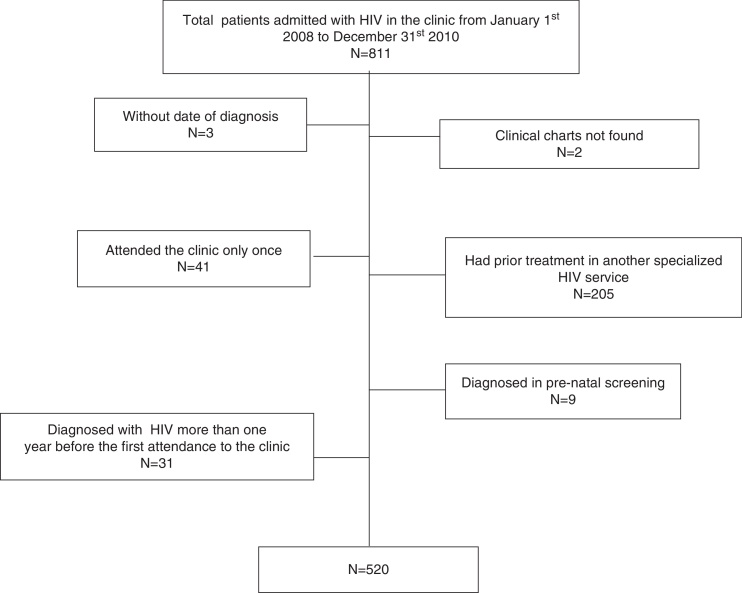
Five hundred and twenty patients were included in the analysis. The median CD4 cell count was 336 cells/mm(3) (IQR: 130-531). Two hundred and seventy-nine patients (53.7%) were classified as LP and 193 (37.1%) as LPAD. On average, 75% of the patients presented with a viral load (VL) >10,000 copies/ml. In multivariate logistic regression analysis the factors associated with LP and LPAD were age, being symptomatic at first visit and VL. Race was a factor associated with LP but not with LPAD.
The proportion of patients who were late attending a clinic for HIV treatment is still high, and effective strategies to improve early HIV detection with a special focus on the vulnerable population are urgently needed.
自1996年以来,巴西已实现免费抗逆转录病毒疗法的普遍可及,因此,艾滋病毒/艾滋病患者的存活率显著提高。然而,根据科学报告,仍有相当数量的患者在艾滋病治疗上就诊过晚,这给个人和社会都带来了后果。我们研究了新诊断的艾滋病毒患者的临床和免疫学特征,并评估了与治疗延迟就诊相关的因素。
2008年至2010年在巴西东南部米纳斯吉拉斯州贝洛奥里藏特的一个艾滋病毒/艾滋病参考中心进行了一项横断面研究。在实际操作中,治疗延迟就诊(LP)的患者是那些首次CD4细胞计数低于350个细胞/mm³或出现艾滋病定义的机会性感染的患者。患有晚期疾病的治疗延迟就诊(LPAD)患者是那些首次CD4细胞计数低于200个细胞/mm³或出现艾滋病定义的机会性感染的患者。使用逻辑回归方法评估LP和LPAD相关的危险因素。
520名患者纳入分析。CD4细胞计数中位数为336个细胞/mm³(四分位间距:130 - 531)。279名患者(53.7%)被归类为LP,193名(37.1%)为LPAD。平均而言,75%的患者病毒载量(VL)>10,000拷贝/ml。在多变量逻辑回归分析中,与LP和LPAD相关的因素是年龄、首次就诊时出现症状和VL。种族是与LP相关的因素,但与LPAD无关。
艾滋病毒治疗就诊延迟的患者比例仍然很高,迫切需要有效的策略来改善艾滋病毒的早期检测,特别关注弱势群体。