Ejaz A Ahsan, Pourafshar Negiin, Mohandas Rajesh, Smallwood Bryan A, Johnson Richard J, Hsu Jack W
Division of Nephrology, Hypertension and Transplantation, North Florida/South Georgia Veterans Health System, Gainesville, Florida, United States of America.
Division of Nephrology, Hypertension and Transplantation, North Florida/South Georgia Veterans Health System, Gainesville, Florida, United States of America; Nephrology & Hypertension Section, Department of Veterans Affairs Medical Center, North Florida/South Georgia Veterans Health System, Gainesville, Florida, United States of America.
PLoS One. 2015 Mar 16;10(3):e0119497. doi: 10.1371/journal.pone.0119497. eCollection 2015.
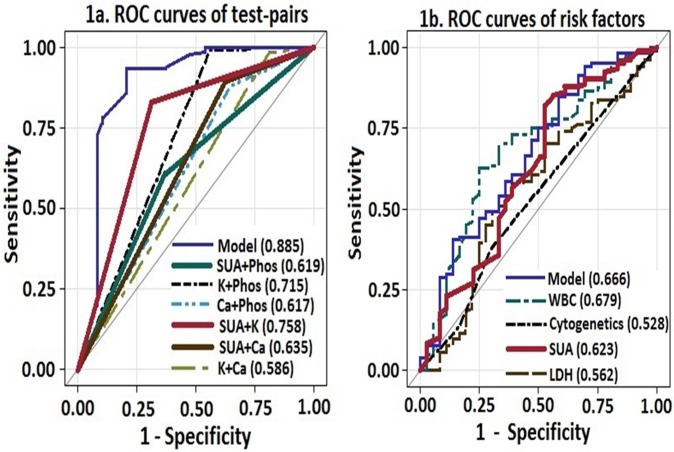
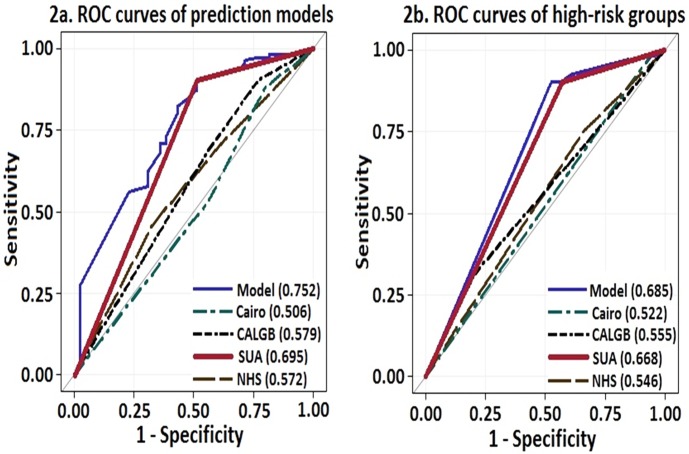
We investigated the ability of serum uric acid (SUA) to predict laboratory tumor lysis syndrome (LTLS) and compared it to common laboratory variables, cytogenetic profiles, tumor markers and prediction models in acute myeloid leukemia patients. In this retrospective study patients were risk-stratified for LTLS based on SUA cut-off values and the discrimination ability was compared to current prediction models. The incidences of LTLS were 17.8%, 21% and 62.5% in the low, intermediate and high-risk groups, respectively. SUA was an independent predictor of LTLS (adjusted OR 1.12, CI95% 1.0-1.3, p = 0.048). The discriminatory ability of SUA, per ROC curves, to predict LTLS was superior to LDH, cytogenetic profile, tumor markers and the combined model but not to WBC (AUCWBC 0.679). However, in comparisons between high-risk SUA and high-risk WBC, SUA had superior discriminatory capability than WBC (AUCSUA 0.664 vs. AUCWBC 0.520; p <0.001). SUA also demonstrated better performance than the prediction models (high-risk SUAAUC 0.695, p<0.001). In direct comparison of high-risk groups, SUA again demonstrated superior performance than the prediction models (high-risk SUAAUC 0.668, p = 0.001) in predicting LTLS, approaching that of the combined model (AUC 0.685, p<0.001). In conclusion, SUA alone is comparable and highly predictive for LTLS than other prediction models.
我们研究了血清尿酸(SUA)预测实验室肿瘤溶解综合征(LTLS)的能力,并将其与急性髓系白血病患者的常见实验室指标、细胞遗传学特征、肿瘤标志物及预测模型进行比较。在这项回顾性研究中,根据SUA临界值对患者进行LTLS风险分层,并将其判别能力与当前的预测模型进行比较。低、中、高风险组的LTLS发生率分别为17.8%、21%和62.5%。SUA是LTLS的独立预测因子(校正OR 1.12,CI95% 1.0 - 1.3,p = 0.048)。根据ROC曲线,SUA预测LTLS的判别能力优于乳酸脱氢酶(LDH)、细胞遗传学特征、肿瘤标志物及联合模型,但不如白细胞计数(WBC)(AUCWBC 0.679)。然而,在高风险SUA与高风险WBC的比较中,SUA的判别能力优于WBC(AUCSUA 0.664 vs. AUCWBC 0.520;p <0.001)。SUA的表现也优于预测模型(高风险SUA AUC 0.695,p<0.001)。在高风险组的直接比较中,SUA在预测LTLS方面再次表现出优于预测模型的性能(高风险SUA AUC 0.668,p = 0.001),接近联合模型(AUC 0.685,p<0.001)。总之,单独的SUA与其他预测模型相比,对LTLS具有相当的预测能力且预测性较高。