Go Se-Il, Ko Gyung Hyuck, Lee Won Sup, Kim Rock Bum, Lee Jeong-Hee, Jeong Sang-Ho, Lee Young-Joon, Hong Soon Chan, Ha Woo Song
Department of Internal Medicine, Institute of Health Sciences, Gyeongsang National University School of Medicine, Jinju, Korea.
Department of Pathology, Institute of Health Sciences, Gyeongsang National University School of Medicine, Jinju, Korea.
Cancer Res Treat. 2016 Jan;48(1):142-52. doi: 10.4143/crt.2014.227. Epub 2015 Mar 17.
The present study is to investigate the significance of CD44 variant 9 (CD44v9) expression as a biomarker in primary gastric cancer.
With various gastric tissues, we performed immunohistochemical staining for CD44v9.
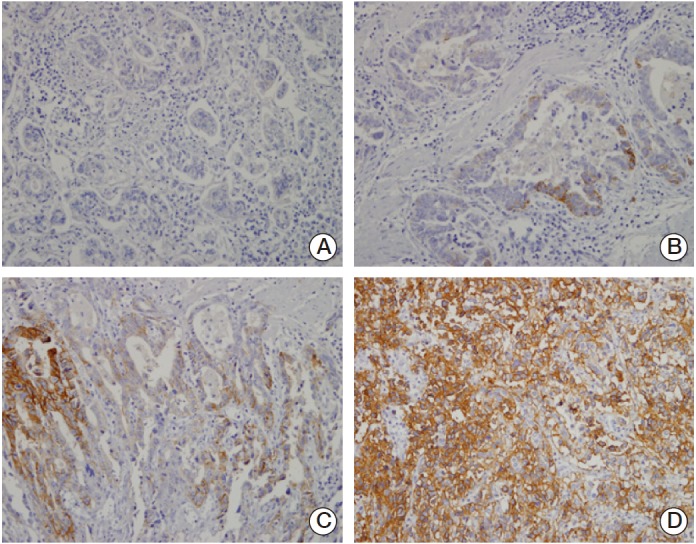
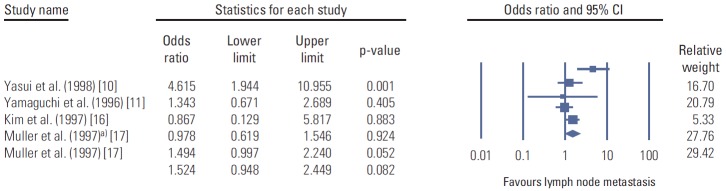
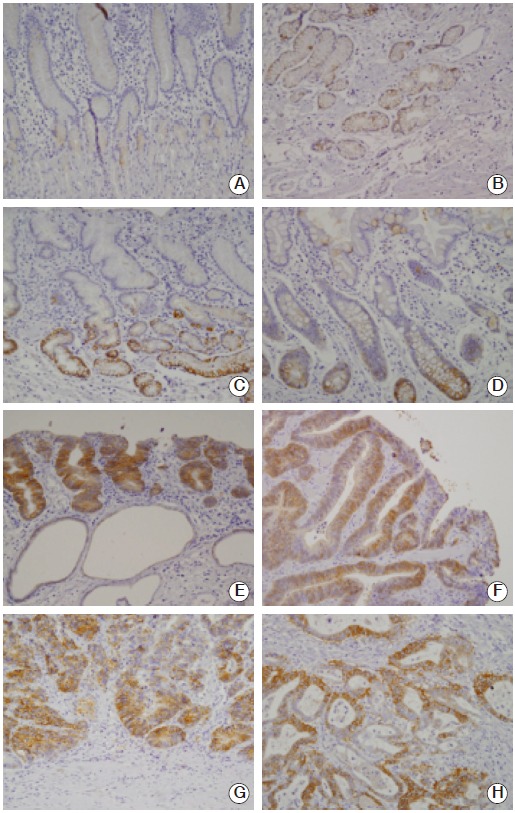
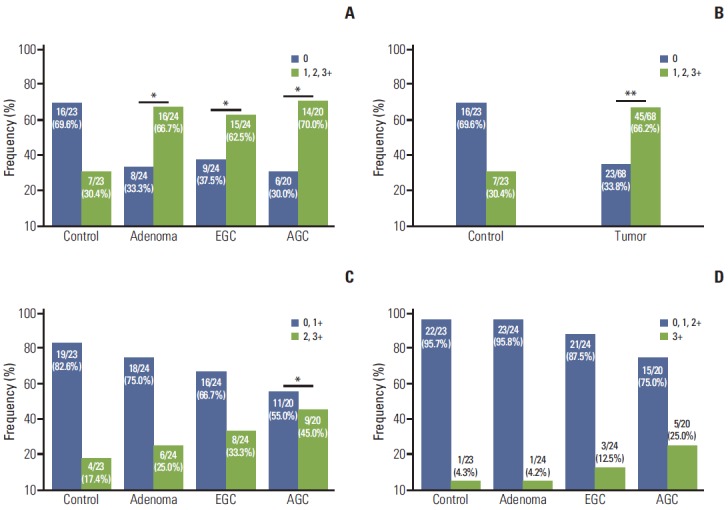
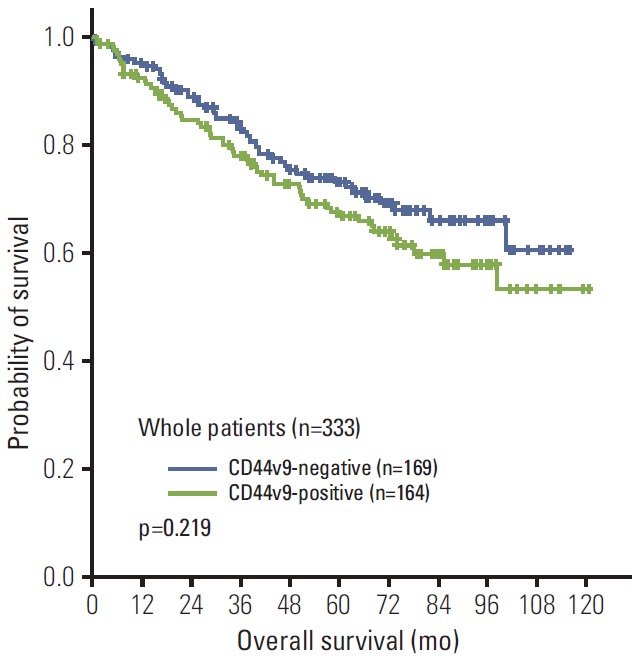
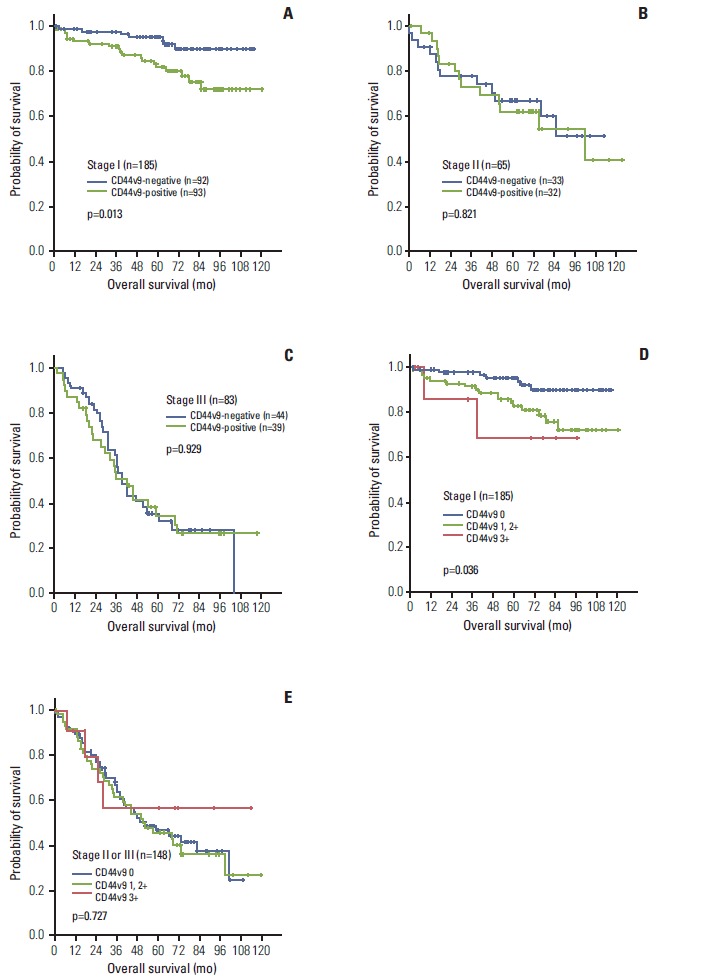
The positive expression rates for CD44v9 in tumor, including adenoma, early gastric cancer (EGC), and advanced gastric cancer (AGC), were higher than those in non-tumor tissues (p=0.003). In addition, the higher expression for CD44v9 was observed as the tissue becomes malignant. In the analysis of 333 gastric cancer tissues, we found that positive expression rates for CD44v9 were higher in the intestinal type or well differentiated gastric cancer than in the diffuse type or poorly differentiated gastric cancer. Interestingly, the positive expression indicated poor prognosis in EGC (5-year survival rate [5-YSR] in stage I, 81.7% vs. 95.2%; p=0.013), but not in AGC (5-YSR in stage II, 66.9% vs. 62.2%; p=0.821; 5-YSR in stage III, 34.5% vs. 32.0%; p=0.929). Moreover, strong positive expression (3+) showed a trend suggesting worse prognosis only in EGC, and it appeared to be associated with lymph node metastasis.
This study suggests that CD44v9 may be a good biomarker for prognosis prediction and for chemoprevention or biomarker-driven therapies only for EGC.
本研究旨在探讨CD44变异体9(CD44v9)表达作为原发性胃癌生物标志物的意义。
我们对各种胃组织进行了CD44v9的免疫组织化学染色。
CD44v9在肿瘤组织(包括腺瘤、早期胃癌(EGC)和进展期胃癌(AGC))中的阳性表达率高于非肿瘤组织(p = 0.003)。此外,随着组织恶变,CD44v9的表达升高。在对333例胃癌组织的分析中,我们发现CD44v9在肠型或高分化胃癌中的阳性表达率高于弥漫型或低分化胃癌。有趣的是,阳性表达提示EGC预后较差(Ⅰ期5年生存率[5 - YSR],81.7%对95.2%;p = 0.013),但在AGC中并非如此(Ⅱ期5 - YSR,66.9%对62.2%;p = 0.821;Ⅲ期5 - YSR,34.5%对32.0%;p = 0.929)。此外,强阳性表达(3 +)仅在EGC中显示出预后较差的趋势,并且似乎与淋巴结转移有关。
本研究表明,CD44v9可能是一种良好的生物标志物,仅用于EGC的预后预测、化学预防或生物标志物驱动的治疗。