Allen Heather K, An Ran, Handelsman Jo, Moe Luke A
Food Safety and Enteric Pathogens Research Unit, National Animal Disease Center, Agricultural Research Service, United States Department of Agriculture, Ames, Iowa, 50010, United States of America.
Department of Plant & Soil Sciences, University of Kentucky, Lexington, Kentucky, 40546-0312, United States of America.
PLoS One. 2015 Mar 17;10(3):e0120094. doi: 10.1371/journal.pone.0120094. eCollection 2015.
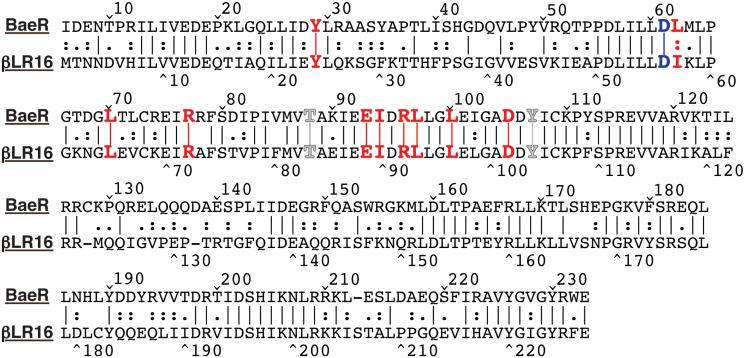
Functional metagenomic analysis of soil metagenomes is a method for uncovering as-yet unidentified mechanisms for antibiotic resistance. Here we report an unconventional mode by which a response regulator derived from a soil metagenome confers resistance to the β-lactam antibiotic carbenicillin in Escherichia coli. A recombinant clone (βlr16) harboring a 5,169 bp DNA insert was selected from a metagenomic library previously constructed from a remote Alaskan soil. The βlr16 clone conferred specific resistance to carbenicillin, with limited increases in resistance to other tested antibiotics, including other β-lactams (penicillins and cephalosporins), rifampin, ciprofloxacin, erythromycin, chloramphenicol, nalidixic acid, fusidic acid, and gentamicin. Resistance was more pronounced at 24°C than at 37°C. Zone-of-inhibition assays suggested that the mechanism of carbenicillin resistance was not due to antibiotic inactivation. The DNA insert did not encode any genes known to confer antibiotic resistance, but did have two putative open reading frames (ORFs) that were annotated as a metallopeptidase and a two-component response regulator. Transposon mutagenesis and subcloning of the two ORFs followed by phenotypic assays showed that the response regulator gene was necessary and sufficient to confer the resistance phenotype. Quantitative reverse transcriptase PCR showed that the response regulator suppressed expression of the ompF porin gene, independently of the small RNA regulator micF, and enhanced expression of the acrD, mdtA, and mdtB efflux pump genes. This work demonstrates that antibiotic resistance can be achieved by the modulation of gene regulation by heterologous DNA. Functional analyses such as these can be important for making discoveries in antibiotic resistance gene biology and ecology.
土壤宏基因组的功能宏基因组分析是一种揭示尚未明确的抗生素抗性机制的方法。在此,我们报告了一种非常规模式,即源自土壤宏基因组的一个应答调节因子赋予大肠杆菌对β-内酰胺抗生素羧苄青霉素的抗性。从先前由阿拉斯加偏远土壤构建的宏基因组文库中筛选出一个携带5169 bp DNA插入片段的重组克隆(βlr16)。βlr16克隆赋予对羧苄青霉素的特异性抗性,对其他测试抗生素(包括其他β-内酰胺类抗生素(青霉素和头孢菌素)、利福平、环丙沙星、红霉素、氯霉素、萘啶酸、夫西地酸和庆大霉素)的抗性仅有有限增加。在24°C时抗性比在37°C时更明显。抑菌圈试验表明羧苄青霉素抗性机制不是由于抗生素失活。该DNA插入片段未编码任何已知赋予抗生素抗性的基因,但有两个推定的开放阅读框(ORF),注释为金属肽酶和双组分应答调节因子。对这两个ORF进行转座子诱变和亚克隆,随后进行表型分析,结果表明应答调节因子基因对于赋予抗性表型是必要且充分的。定量逆转录PCR表明,该应答调节因子抑制外膜孔蛋白基因ompF的表达,独立于小RNA调节因子micF,并增强外排泵基因acrD、mdtA和mdtB的表达。这项工作表明,抗生素抗性可通过异源DNA调节基因表达来实现。此类功能分析对于在抗生素抗性基因生物学和生态学方面做出发现可能很重要。