
尼日利亚埃努古退化市立中央垃圾场附近重金属的空间性、季节性和生态风险。
Spatiality, seasonality and ecological risks of heavy metals in the vicinity of a degenerate municipal central dumpsite in Enugu, Nigeria.
机构信息
Department of Civil Engineering, University of Nigeria, Nsukka, Enugu State Nigeria.
出版信息
J Environ Health Sci Eng. 2015 Mar 10;13:15. doi: 10.1186/s40201-015-0168-0. eCollection 2015.
BACKGROUND
Improper waste disposal is responsible for the contamination of both surface and ground water resources. Heavy metals leached from improperly disposed solid waste constitute grave environmental and health hazards because of their toxic and persistent nature. There are thousands of open dumps in Nigeria one of which is the Enugu State Waste Management Authority dumpsite.
METHOD
Forty sampling nodes were systematically established around the Enugu State waste Management Authority central dumpsite located at Ugwuaji, Enugu State, Nigeria. Ten heavy metals (arsenic, cadmium, cobalt, copper, chromium, iron, lead, manganese, nickel and zinc) were sampled at different depths of each node in both rainy and dry seasons.
RESULT
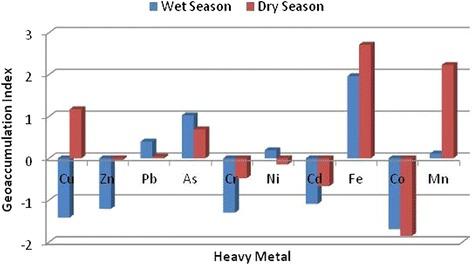
Iron and lead were the predominant metals in the vicinity of the waste dump with average values of 132.10 mg/kg and 117.52 mg/kg respectively. The order of abundance of the ten heavy metals monitored is Pb > Fe > As > Zn > Cu > Co > Ni > Cd > Cr > Mn. Generally, there was significant correlation (0.25 to 0.74) among all the metals except between cobalt and manganese in the rainy season. In the dry season, all the metals were significantly correlated (0.29 to 0.813) except for copper and lead, copper and arsenic, zinc and arsenic, and cobalt and manganese. The concentrations of most of the heavy metals approached a constant level at a depth of 1 m. On the other hand, the concentrations of arsenic, cobalt and iron continued to decrease even at a depth of 2 m. The pollution loading index values for the soil are 1.706 for rainy season and 2.54 for dry season.
CONCLUSION
The high pollution loading index represents a significant level of deterioration. It can be concluded that the dumpsite constitute a serious environmental and health hazard.
背景
不当的废物处理导致地表水和地下水资源受到污染。从不当处理的固体废物中浸出的重金属因其毒性和持久性而构成严重的环境和健康危害。尼日利亚有成千上万的露天垃圾场,其中一个是埃努古州废物管理局垃圾场。
方法
在尼日利亚埃努古州位于 Ugwuaji 的废物管理局中央垃圾场周围系统地建立了 40 个采样节点。在雨季和旱季,在每个节点的不同深度采集了十种重金属(砷、镉、钴、铜、铬、铁、铅、锰、镍和锌)。
结果
在废物堆附近,铁和铅是主要金属,平均含量分别为 132.10 mg/kg 和 117.52 mg/kg。监测的十种重金属的丰度顺序为 Pb>Fe>As>Zn>Cu>Co>Ni>Cd>Cr>Mn。一般来说,除了雨季钴和锰之间外,所有金属之间都存在显著相关性(0.25 至 0.74)。在旱季,除了铜和铅、铜和砷、锌和砷以及钴和锰之外,所有金属都存在显著相关性(0.29 至 0.813)。大多数重金属的浓度在 1 米深度处接近恒定水平。另一方面,砷、钴和铁的浓度即使在 2 米深度处仍继续下降。雨季土壤污染负荷指数值为 1.706,旱季为 2.54。
结论
高污染负荷指数代表了严重的恶化程度。可以得出结论,该垃圾场构成了严重的环境和健康危害。



 Zotero 插件