Ma Xiaotu, Edmonson Michael, Yergeau Donald, Muzny Donna M, Hampton Oliver A, Rusch Michael, Song Guangchun, Easton John, Harvey Richard C, Wheeler David A, Ma Jing, Doddapaneni HarshaVardhan, Vadodaria Bhavin, Wu Gang, Nagahawatte Panduka, Carroll William L, Chen I-Ming, Gastier-Foster Julie M, Relling Mary V, Smith Malcolm A, Devidas Meenakshi, Guidry Auvil Jaime M, Downing James R, Loh Mignon L, Willman Cheryl L, Gerhard Daniela S, Mullighan Charles G, Hunger Stephen P, Zhang Jinghui
Computational Biology, St Jude Children's Research Hospital, Memphis, Tennessee 38105, USA.
Pediatric Cancer Genome Project Validation Lab, St Jude Children's Research Hospital, Memphis, Tennessee 38105, USA.
Nat Commun. 2015 Mar 19;6:6604. doi: 10.1038/ncomms7604.
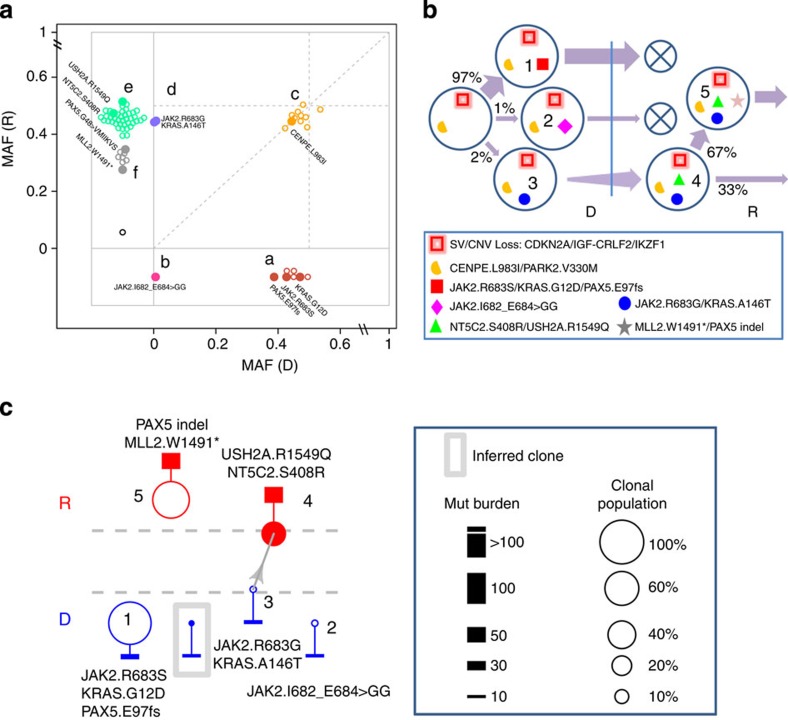
There is incomplete understanding of genetic heterogeneity and clonal evolution during cancer progression. Here we use deep whole-exome sequencing to describe the clonal architecture and evolution of 20 pediatric B-acute lymphoblastic leukaemias from diagnosis to relapse. We show that clonal diversity is comparable at diagnosis and relapse and clonal survival from diagnosis to relapse is not associated with mutation burden. Six pathways were frequently mutated, with NT5C2, CREBBP, WHSC1, TP53, USH2A, NRAS and IKZF1 mutations enriched at relapse. Half of the leukaemias had multiple subclonal mutations in a pathway or gene at diagnosis, but mostly with only one, usually minor clone, surviving therapy to acquire additional mutations and become the relapse founder clone. Relapse-specific mutations in NT5C2 were found in nine cases, with mutations in four cases being in descendants of the relapse founder clone. These results provide important insights into the genetic basis of treatment failure in ALL and have implications for the early detection of mutations driving relapse.
目前对于癌症进展过程中的基因异质性和克隆进化尚未完全理解。在此,我们使用深度全外显子测序来描述20例儿童B淋巴细胞急性白血病从诊断到复发的克隆结构和进化。我们发现,诊断时和复发时的克隆多样性相当,且从诊断到复发的克隆存活与突变负担无关。有六个通路经常发生突变,NT5C2、CREBBP、WHSC1、TP53、USH2A、NRAS和IKZF1突变在复发时富集。一半的白血病在诊断时有一个通路或基因存在多个亚克隆突变,但大多数情况下只有一个,通常是较小的克隆,在治疗后存活下来并获得额外突变,成为复发的起始克隆。在9例病例中发现了NT5C2的复发特异性突变,其中4例病例的突变存在于复发起始克隆的后代中。这些结果为急性淋巴细胞白血病治疗失败的遗传基础提供了重要见解,并对驱动复发的突变的早期检测具有启示意义。