Cruz-Mora Jose, Pérez-Valdespino Abigail, Gupta Srishti, Withange Nilumi, Kuwana Ritsuko, Takamatsu Hiromu, Christie Graham, Setlow Peter
Department of Molecular Biology and Biophysics, University of Connecticut Health Center, Farmington, Connecticut, United States of America.
Department of Chemical Engineering and Biotechnology, University of Cambridge, Cambridge, United Kingdom.
PLoS One. 2015 Mar 19;10(3):e0119125. doi: 10.1371/journal.pone.0119125. eCollection 2015.
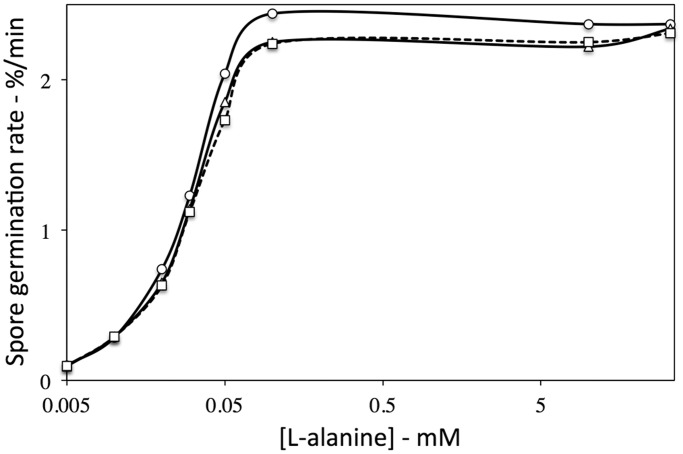
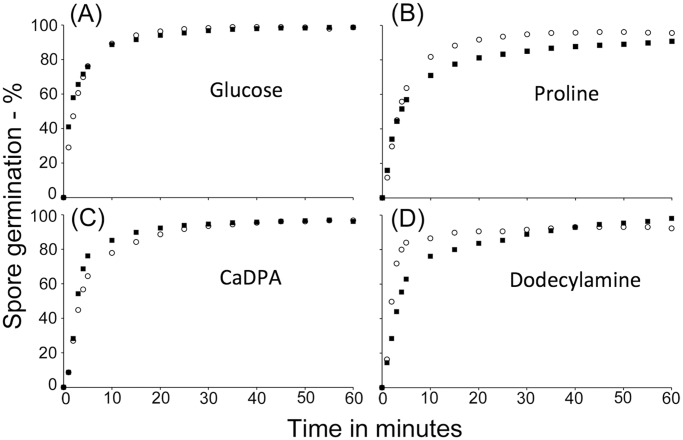
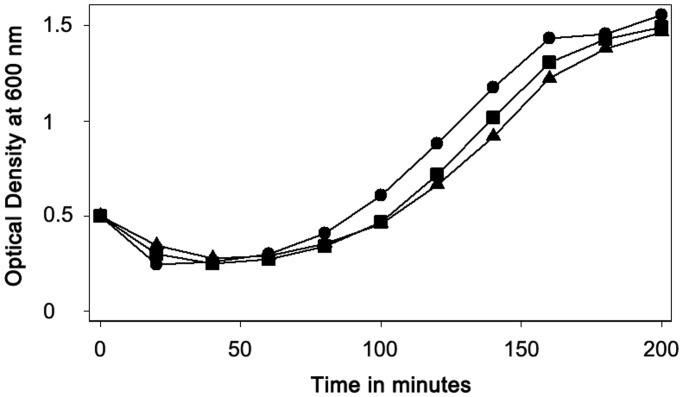
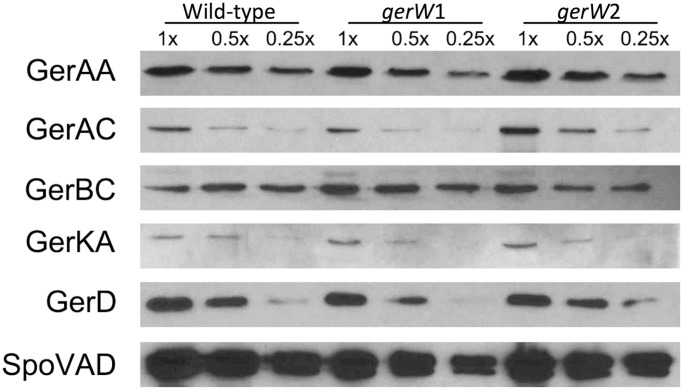
Germination of dormant spores of Bacillus species is initiated when nutrient germinants bind to germinant receptors in spores' inner membrane and this interaction triggers the release of dipicolinic acid and cations from the spore core and their replacement by water. Bacillus subtilis spores contain three functional germinant receptors encoded by the gerA, gerB, and gerK operons. The GerA germinant receptor alone triggers germination with L-valine or L-alanine, and the GerB and GerK germinant receptors together trigger germination with a mixture of L-asparagine, D-glucose, D-fructose and KCl (AGFK). Recently, it was reported that the B. subtilis gerW gene is expressed only during sporulation in developing spores, and that GerW is essential for L-alanine germination of B. subtilis spores but not for germination with AGFK. However, we now find that loss of the B. subtilis gerW gene had no significant effects on: i) rates of spore germination with L-alanine; ii) spores' levels of germination proteins including GerA germinant receptor subunits; iii) AGFK germination; iv) spore germination by germinant receptor-independent pathways; and v) outgrowth of germinated spores. Studies in Bacillus megaterium did find that gerW was expressed in the developing spore during sporulation, and in a temperature-dependent manner. However, disruption of gerW again had no effect on the germination of B. megaterium spores, whether germination was triggered via germinant receptor-dependent or germinant receptor-independent pathways.
当营养萌发剂与芽孢杆菌属休眠孢子内膜中的萌发受体结合时,休眠孢子的萌发就会启动,这种相互作用会触发二吡啶羧酸和阳离子从孢子核心释放出来,并被水取代。枯草芽孢杆菌孢子含有由gerA、gerB和gerK操纵子编码的三种功能性萌发受体。单独的GerA萌发受体可通过L-缬氨酸或L-丙氨酸触发萌发,而GerB和GerK萌发受体共同作用可通过L-天冬酰胺、D-葡萄糖、D-果糖和KCl(AGFK)的混合物触发萌发。最近有报道称,枯草芽孢杆菌gerW基因仅在发育中的孢子形成过程中表达,并且GerW对于枯草芽孢杆菌孢子的L-丙氨酸萌发至关重要,但对于AGFK引发的萌发并非如此。然而,我们现在发现,枯草芽孢杆菌gerW基因的缺失对以下方面没有显著影响:i)L-丙氨酸引发的孢子萌发率;ii)包括GerA萌发受体亚基在内的孢子萌发蛋白水平;iii)AGFK引发的萌发;iv)不依赖萌发受体途径的孢子萌发;v)萌发孢子的生长。巨大芽孢杆菌的研究确实发现,gerW在孢子形成过程中于发育中的孢子中表达,且呈温度依赖性。然而,gerW的破坏对巨大芽孢杆菌孢子的萌发再次没有影响,无论萌发是通过依赖萌发受体的途径还是不依赖萌发受体的途径触发。