Luz Daniela, Chen Gang, Maranhão Andrea Q, Rocha Leticia B, Sidhu Sachdev, Piazza Roxane M F
Laboratório de Bacteriologia, Instituto Butantan, São Paulo, Brazil.
Banting and Best Department of Medical Research, Terrence Donnelly Centre for Cellular and Biomolecular Research, University of Toronto, Toronto, Canada.
PLoS One. 2015 Mar 19;10(3):e0120481. doi: 10.1371/journal.pone.0120481. eCollection 2015.
Stx toxin is a member of the AB5 family of bacterial toxins: the active A subunit has N-glycosidase activity against 28S rRNA, resulting in inhibition of protein synthesis in eukaryotic cells, and the pentamer ligand B subunits (StxB) bind to globotria(tetra)osylceramide receptors (Gb3/Gb4) on the cell membrane. Shiga toxin-producing Escherichia coli strains (STEC) may produce Stx1 and/or Stx2 and variants. Strains carrying Stx2 are considered more virulent and related to the majority of outbreaks, besides being usually associated with hemolytic uremic syndrome in humans. The development of tools for the detection and/or neutralization of these toxins is a turning point for early diagnosis and therapeutics. Antibodies are an excellent paradigm for the design of high-affinity, protein-based binding reagents used for these purposes.
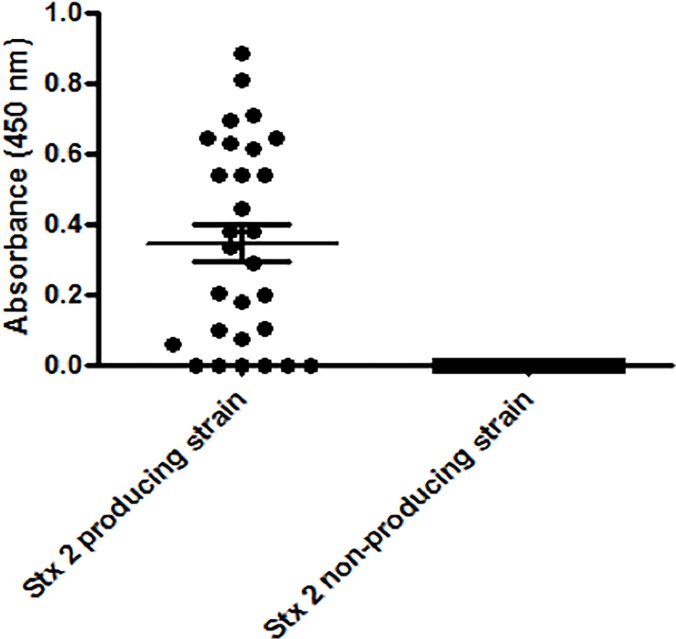
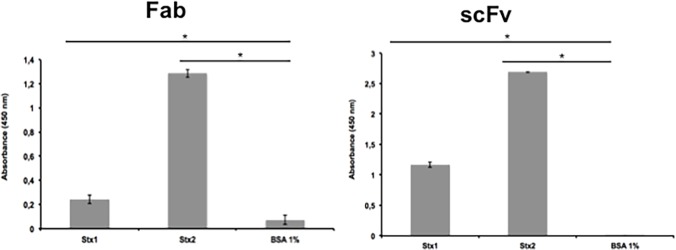
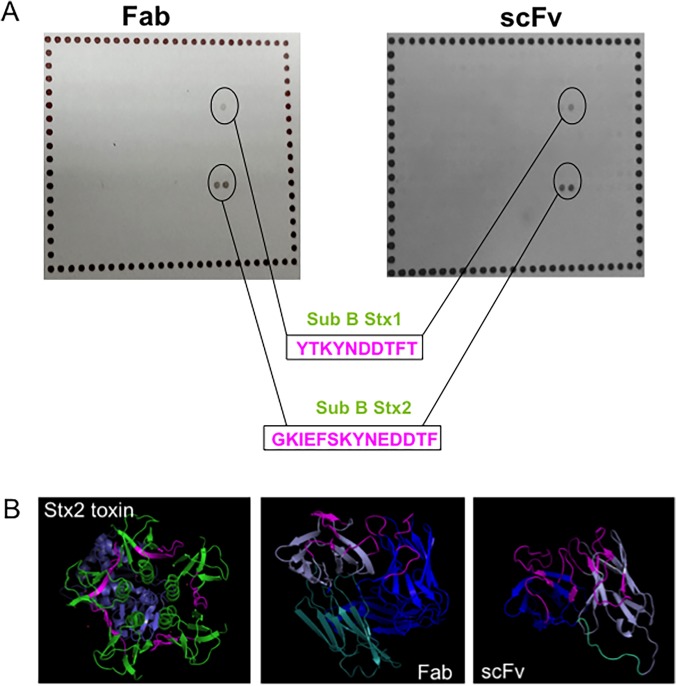
In this work, we developed two recombinant antibodies; scFv fragments from mouse hybridomas and Fab fragments by phage display technology using a human synthetic antibody library. Both fragments showed high binding affinity to Stx2, and they were able to bind specifically to the GKIEFSKYNEDDTF region of the Stx2 B subunit and to neutralize in vitro the cytotoxicity of the toxin up to 80%. Furthermore, the scFv fragments showed 79% sensitivity and 100% specificity in detecting STEC strains by ELISA.
In this work, we developed and characterized two recombinant antibodies against Stx2, as promising tools to be used in diagnosis or therapeutic approaches against STEC, and for the first time, we showed a human monovalent molecule, produced in bacteria, able to neutralize the cytotoxicity of Stx2 in vitro.
志贺毒素(Stx)是细菌毒素AB5家族的成员:活性A亚基具有针对28S rRNA的N - 糖苷酶活性,导致真核细胞中蛋白质合成的抑制,而五聚体配体B亚基(StxB)与细胞膜上的球三(四)糖神经酰胺受体(Gb3 / Gb4)结合。产志贺毒素大肠杆菌菌株(STEC)可能产生Stx1和/或Stx2及其变体。携带Stx2的菌株被认为更具毒性,与大多数疫情爆发相关,此外通常还与人类溶血尿毒综合征有关。开发检测和/或中和这些毒素的工具是早期诊断和治疗的转折点。抗体是用于这些目的的高亲和力、基于蛋白质的结合试剂设计的优秀范例。
在这项工作中,我们开发了两种重组抗体;通过使用人源合成抗体库的噬菌体展示技术从鼠杂交瘤获得单链抗体片段(scFv)和Fab片段。两种片段均显示出对Stx2的高结合亲和力,它们能够特异性结合Stx2 B亚基的GKIEFSKYNEDDTF区域,并在体外中和高达80%的毒素细胞毒性。此外,scFv片段在通过ELISA检测STEC菌株时显示出79%的灵敏度和100%的特异性。
在这项工作中,我们开发并鉴定了两种针对Stx2的重组抗体,作为用于诊断或治疗STEC的有前景的工具,并且首次展示了一种在细菌中产生的人单价分子能够在体外中和Stx2的细胞毒性。