
继发于急性播散性脑脊髓炎的持续性假性球麻痹。
Persistent pseudobulbar affect secondary to acute disseminated encephalomyelitis.
作者信息
Li Zhendong, Luo Shijian, Ou Jianying, Huang Rihe, Wang Ying
机构信息
Department of Neurology, The Fifth Affiliated Hospital of Sun Yat-Sen University, Zhuhai, China;
Department of Neurology, The Fifth Affiliated Hospital of Sun Yat-Sen University, Zhuhai, China.
出版信息
Socioaffect Neurosci Psychol. 2015 Mar 18;5:26210. doi: 10.3402/snp.v5.26210. eCollection 2015.
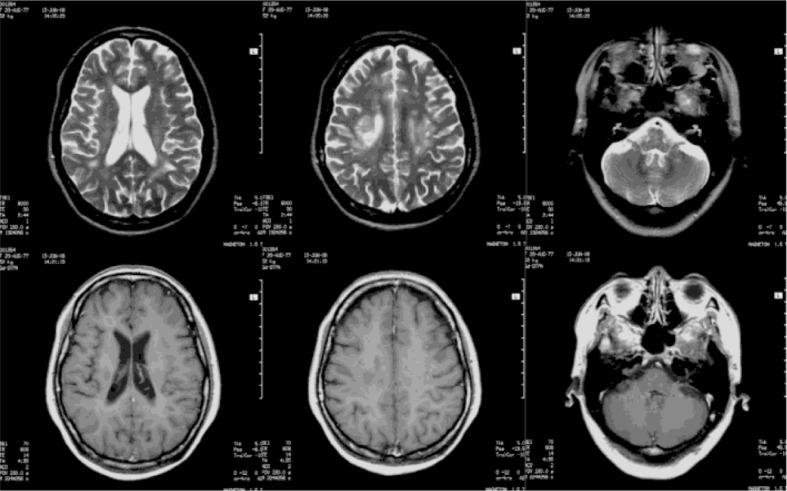
Pseudobulbar affect (PBA) is a common complication of central nervous system diseases such as stroke, multiple sclerosis, and other neurological diseases, but it remains under-recognized and under-treated in the clinic. PBA caused by acute disseminated encephalomyelitis (ADEM) has rarely been reported. Here, we report a 30-year-old Chinese woman who has experienced PBA from ADEM for 7 years. The patient's principal manifestations were extreme emotions or tears when she saw, heard, or spoke about sad news or other sad things; the durations of these unmanageable emotions were often less than 30 sec, and they occurred at frequencies that ranged from one to several times a day. Occasionally, she laughed uncontrollably while people were talking despite a lack of funny or sad stimuli in the conversation or the surrounding environment. Thus, her social functioning was impaired. This case indicates that the long-term PBA can occur secondarily to ADEM, and this possibility should be considered clinically to ensure timely identification and treatment.
假性延髓情绪(PBA)是中风、多发性硬化症等中枢神经系统疾病以及其他神经疾病的常见并发症,但在临床上仍未得到充分认识和治疗。急性播散性脑脊髓炎(ADEM)引起的PBA鲜有报道。在此,我们报告一名30岁的中国女性,她患ADEM引发的PBA已达7年。患者的主要表现为在看到、听到或谈论悲伤消息或其他悲伤事情时出现极端情绪或流泪;这些难以控制的情绪持续时间通常少于30秒,每天发生频率为1至几次。偶尔,在人们交谈时,尽管对话或周围环境中没有有趣或悲伤的刺激因素,她也会 uncontrollably 大笑。因此,她的社交功能受到了损害。该病例表明,长期PBA可继发于ADEM,临床上应考虑到这种可能性,以确保及时识别和治疗。 (注:原文中“uncontrollably”未翻译完整,应是“无法控制地”,但按照要求未添加解释)


 Zotero 插件