Center of Infectious Disease, State Key Laboratory of Biotherapy, West China Hospital, West China School of Medicine, Sichuan University, Chengdu, People's Republic of China.
Ther Clin Risk Manag. 2015 Mar 12;11:417-23. doi: 10.2147/TCRM.S78128. eCollection 2015.
The aims of this study were to explore the correlation between chronic hepatitis B virus (HBV) drug-resistant mutation profiles and the efficacy of nucleoside analog rescue therapy in patients with initial antiviral treatment failure.
Patients with initial antiviral therapy failure were recruited between January 2011 and January 2013 from the Division of Infectious Disease, West China Hospital, Sichuan University, Chengdu, People's Republic of China. Following drug-resistant mutation testing, eligible patients received nucleoside analog rescue therapy for 24 weeks. The primary endpoint was rescue therapy efficacy, and the secondary endpoint was adverse events.
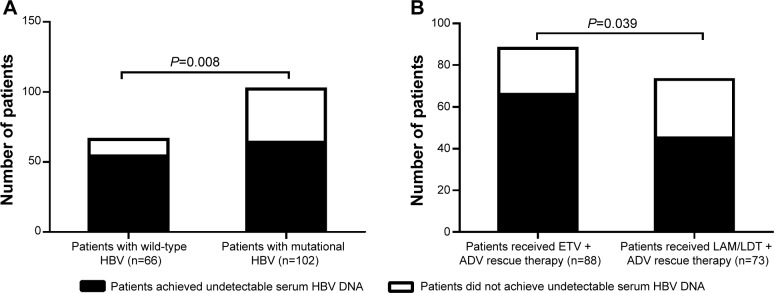
We recruited 168 patients with chronic HBV infection who had initial antiviral treatment failure. Eighty-nine patients (52.98%) experienced virological breakthrough (group A); 79 patients (47.02%) had partial/null response (group B). Among the patients, 102 (102/168, 60.7%) carried at least one HBV drug resistance mutation. The prevalence of genotypic resistance was significantly higher in group A than in group B (P<0.001). In addition, 118 patients (118/168, 70.2%) achieved undetectable serum HBV DNA with the nucleoside analog rescue therapy. Rescue therapy (P=0.002) and no evidence of genotypic resistance (P=0.001) were related to a higher rate of virological response.
These data indicate that patients with chronic HBV infection who have initial antiviral therapy failure with or without signs of genotypic resistance may still stand a chance of gaining therapeutic benefit with nucleoside analog rescue therapy.
本研究旨在探讨慢性乙型肝炎病毒(HBV)耐药突变谱与初始抗病毒治疗失败患者核苷(酸)类似物挽救治疗疗效的相关性。
2011 年 1 月至 2013 年 1 月,我们从中国四川省四川大学华西医院传染病科招募了初始抗病毒治疗失败的患者。耐药突变检测后,合格的患者接受核苷(酸)类似物挽救治疗 24 周。主要终点是挽救治疗疗效,次要终点是不良事件。
我们招募了 168 例初始抗病毒治疗失败的慢性 HBV 感染患者。89 例(52.98%)发生病毒学突破(A 组);79 例(47.02%)有部分/无应答(B 组)。在这些患者中,102 例(102/168,60.7%)携带至少一种 HBV 耐药突变。A 组基因型耐药的发生率明显高于 B 组(P<0.001)。此外,118 例(118/168,70.2%)患者经核苷(酸)类似物挽救治疗后血清 HBV DNA 不可检测。挽救治疗(P=0.002)和无基因型耐药证据(P=0.001)与更高的病毒学应答率相关。
这些数据表明,初始抗病毒治疗失败的慢性 HBV 感染患者,无论有无基因型耐药迹象,仍有可能通过核苷(酸)类似物挽救治疗获得治疗益处。