Alobaidi Rashid, Basu Rajit K, Goldstein Stuart L, Bagshaw Sean M
Department of Pediatrics, Division of Critical Care Medicine, Faculty of Medicine and Dentistry, University of Alberta, Edmonton, Alberta, Canada.
Center for Acute Care Nephrology, Cincinnati Children's Hospital and Medical Center, Department of Pediatrics, University of Cincinnati, Cincinnati, Ohio.
Semin Nephrol. 2015 Jan;35(1):2-11. doi: 10.1016/j.semnephrol.2015.01.002.
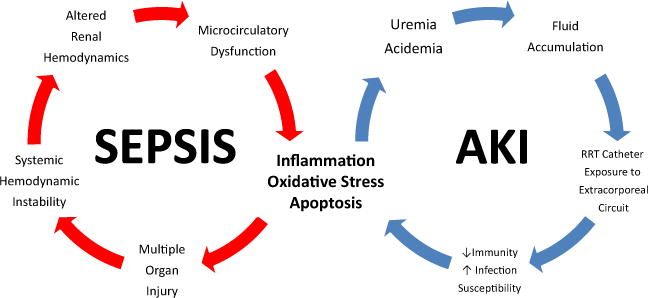
Acute kidney injury (AKI) is an epidemic problem. Sepsis has long been recognized as a foremost precipitant of AKI. Sepsis-associated AKI (SA-AKI) portends a high burden of morbidity and mortality in both children and adults with critical illness. Although our understanding of its pathophysiology is incomplete, SA-AKI likely represents a distinct subset of AKI contributed to by a unique constellation of hemodynamic, inflammatory, and immune mechanisms. SA-AKI poses significant clinical challenges for clinicians. To date, no singular effective therapy has been developed to alter the natural history of SA-AKI. Rather, current strategies to alleviate poor outcomes focus on clinical risk identification, early detection of injury, modifying clinician behavior to avoid harm, early appropriate antimicrobial therapy, and surveillance among survivors for the longer-term sequelae of kidney damage. Recent evidence has confirmed that patients no longer die with AKI, but from AKI. To improve the care and outcomes for sufferers of SA-AKI, clinicians need a robust appreciation for its epidemiology and current best-evidence strategies for prevention and treatment.
急性肾损伤(AKI)是一个普遍存在的问题。脓毒症长期以来一直被认为是AKI的首要诱因。脓毒症相关的AKI(SA-AKI)在患有危重症的儿童和成人中都预示着高发病率和死亡率。尽管我们对其病理生理学的理解并不完整,但SA-AKI可能代表了AKI的一个独特亚组,由一系列独特的血流动力学、炎症和免疫机制共同导致。SA-AKI给临床医生带来了重大的临床挑战。迄今为止,尚未开发出单一有效的治疗方法来改变SA-AKI的自然病程。相反,目前改善不良预后的策略集中在临床风险识别、损伤的早期检测、改变临床医生行为以避免伤害、早期适当的抗菌治疗以及对幸存者进行肾脏损伤长期后遗症的监测。最近的证据证实,患者不再死于AKI,而是死于由AKI引发的其他病症。为了改善SA-AKI患者的护理和预后,临床医生需要充分了解其流行病学以及当前预防和治疗的最佳循证策略。