School of Education, Bar-Ilan University Ramat Gan, Israel.
School of Education, Bar-Ilan University Ramat Gan, Israel ; Gonda (Goldschmied) Multidisciplinary Brain Research Center, Bar-Ilan University Ramat Gan, Israel.
Front Psychol. 2015 Mar 5;6:225. doi: 10.3389/fpsyg.2015.00225. eCollection 2015.
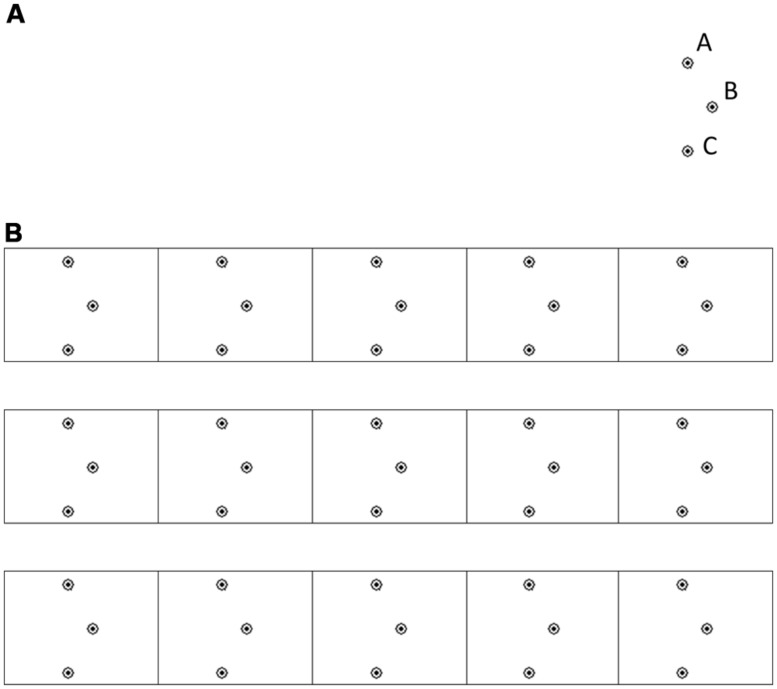
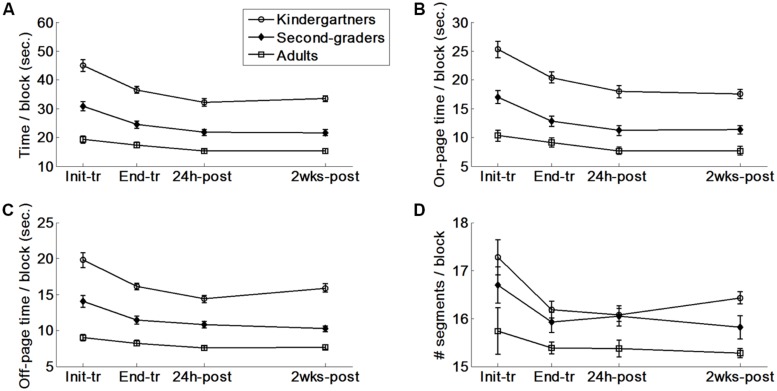
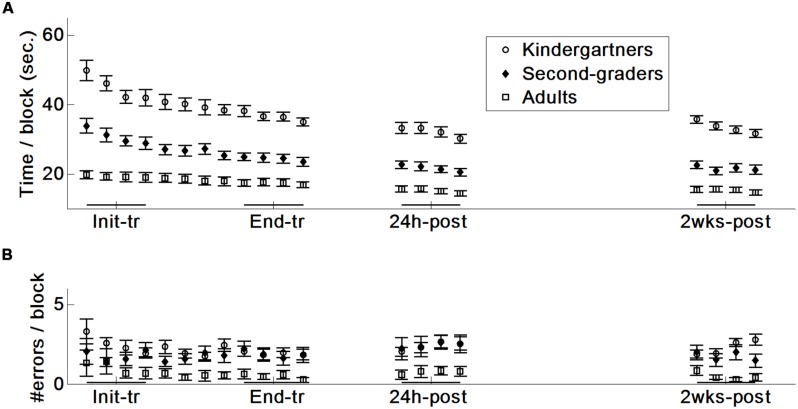
Many new skills are acquired during early childhood. Typical laboratory skill learning tasks are not applicable for developmental studies that involve children younger than 8 years of age. It is not clear whether young children and adults share a basic underlying skill learning mechanism. In the present study, the learning and retention of a simple grapho-motor pattern were studied in three age groups: 5-6, 7-8, and 19-29 years. Each block of the task consists of identical patterns arranged in a spaced writing array. Progression across the block involves on-page movements while producing the pattern, and off-page movements between patterns. The participants practiced the production of the pattern using a digitizing tablet and were tested at 24 h and 2 weeks post-practice. All age groups produced the task blocks more quickly with practice, and the learning rate was inversely related to the initial production time. All groups exhibited additional gains 24 h post-practice that were well-retained 2 weeks later. The accuracy of the participants was maintained throughout the 2-weeks period. These findings suggest that young children and young adults use a similar mechanism when learning the task. Nevertheless, the 6-years-old spent more time off-page during retention testing than when tested at 24 h post-practice, thus supporting the notion that an age advantage may exists in the long-term retention of skills due to planning-dependent aspects.
许多新技能都是在儿童早期获得的。典型的实验室技能学习任务不适用于涉及 8 岁以下儿童的发展研究。目前尚不清楚幼儿和成年人是否具有基本的潜在技能学习机制。在本研究中,研究了三个年龄组(5-6 岁、7-8 岁和 19-29 岁)的简单图形运动模式的学习和保持。任务的每个块由相同的模式按间隔书写数组排列。在块内的进展涉及在页面上的运动,而在模式之间的运动是在页面之外的。参与者使用数字化仪练习模式的产生,并在 24 小时和 2 周练习后进行测试。所有年龄组随着练习的进行,更快地完成了任务块,学习率与初始生产时间成反比。所有组在 24 小时后都表现出额外的进步,并且在 2 周后得到了很好的保留。参与者的准确性在整个 2 周期间都得到了保持。这些发现表明,幼儿和年轻人在学习任务时使用类似的机制。然而,在 2 周的保留测试中,6 岁的孩子在页面之外花费的时间比在 24 小时后的测试中多,因此支持这样的观点,即由于依赖计划的方面,技能的长期保留可能存在年龄优势。