
土壤施用吡虫啉会转移至观赏花卉中,并降低黄斑瓢虫、异色瓢虫和多异瓢虫成虫,以及黑脉金斑蝶和小红蛱蝶幼虫的存活率。
Soil-applied imidacloprid translocates to ornamental flowers and reduces survival of adult Coleomegilla maculata, Harmonia axyridis, and Hippodamia convergens lady beetles, and larval Danaus plexippus and Vanessa cardui butterflies.
作者信息
Krischik Vera, Rogers Mary, Gupta Garima, Varshney Aruna
机构信息
Department of Entomology, University of Minnesota, St. Paul, Minnesota, United States of America.
Department of Horticultural Science, University of Minnesota, St. Paul, Minnesota, United States of America.
出版信息
PLoS One. 2015 Mar 23;10(3):e0119133. doi: 10.1371/journal.pone.0119133. eCollection 2015.
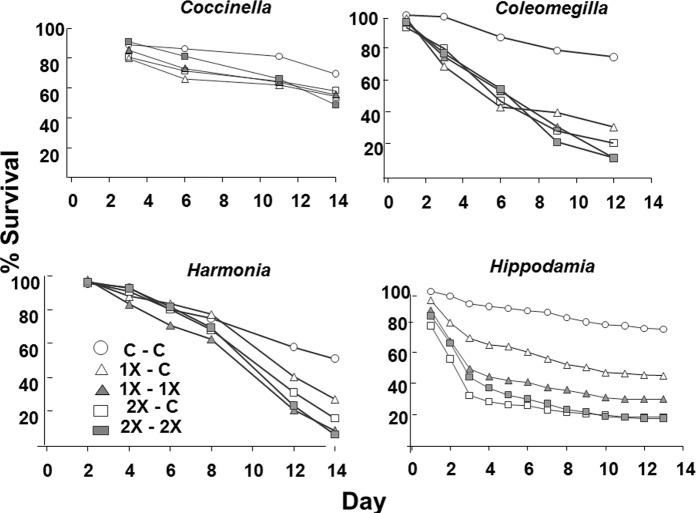
Integrated Pest Management (IPM) is a decision making process used to manage pests that relies on many tactics, including cultural and biological control, which are practices that conserve beneficial insects and mites, and when needed, the use of conventional insecticides. However, systemic, soil-applied neonicotinoid insecticides are translocated to pollen and nectar of flowers, often for months, and may reduce survival of flower-feeding beneficial insects. Imidacloprid seed-treated crops (0.05 mg AI (active ingredient) /canola seed and 1.2 mg AI/corn seed) translocate less than 10 ppb to pollen and nectar. However, higher rates of soil-applied imidacloprid are used in nurseries and urban landscapes, such as 300 mg AI/10 L (3 gallon) pot and 69 g AI applied to the soil under a 61 (24 in) cm diam. tree. Translocation of imidacloprid from soil (300 mg AI) to flowers of Asclepias curassavica resulted in 6,030 ppb in 1X and 10,400 ppb in 2X treatments, which are similar to imidacloprid residues found in another plant species we studied. A second imidacloprid soil application 7 months later resulted in 21,000 ppb in 1X and 45,000 ppb in 2X treatments. Consequently, greenhouse/nursery use of imidacloprid applied to flowering plants can result in 793 to 1,368 times higher concentration compared to an imidacloprid seed treatment (7.6 ppb pollen in seed- treated canola), where most research has focused. These higher imidacloprid levels caused significant mortality in both 1X and 2X treatments in 3 lady beetle species, Coleomegilla maculata, Harmonia axyridis, and Hippodamia convergens, but not a fourth species, Coccinella septempunctata. Adult survival were not reduced for monarch, Danaus plexippus and painted lady, Vanessa cardui, butterflies, but larval survival was significantly reduced. The use of the neonicotinoid imidacloprid at greenhouse/nursery rates reduced survival of beneficial insects feeding on pollen and nectar and is incompatible with the principles of IPM.
综合虫害管理(IPM)是一种用于管理害虫的决策过程,它依赖多种策略,包括文化和生物防治,这些措施旨在保护有益昆虫和螨虫,必要时还会使用传统杀虫剂。然而,土壤施用的系统性新烟碱类杀虫剂会转移到花朵的花粉和花蜜中,通常会持续数月,这可能会降低以花为食的有益昆虫的存活率。吡虫啉种子处理过的作物(每粒油菜籽含0.05毫克活性成分(AI),每粒玉米种子含1.2毫克AI)转移到花粉和花蜜中的量低于10 ppb。然而,在苗圃和城市景观中,土壤施用吡虫啉的剂量更高,例如每10升(3加仑)花盆施用300毫克AI,在直径61厘米(24英寸)的树下土壤中施用69克AI。吡虫啉从土壤(300毫克AI)转移到马利筋花中,在1倍处理中导致含量为6030 ppb,在2倍处理中为10400 ppb,这与我们研究的另一种植物物种中发现的吡虫啉残留量相似。7个月后再次进行土壤施用吡虫啉,在1倍处理中导致含量为21000 ppb,在2倍处理中为45000 ppb。因此,与大多数研究集中的吡虫啉种子处理(种子处理过的油菜籽花粉中含7.6 ppb)相比,温室/苗圃中对开花植物施用吡虫啉会导致浓度高出793至1368倍。这些较高的吡虫啉含量在3种瓢虫物种,即黄斑盘瓢虫、异色瓢虫和多异瓢虫的1倍和2倍处理中均导致了显著的死亡率,但对第四种物种七星瓢虫没有影响。帝王蝶和小苎麻赤蛱蝶成虫的存活率没有降低,但幼虫的存活率显著降低。以温室/苗圃剂量使用新烟碱类吡虫啉会降低以花粉和花蜜为食的有益昆虫的存活率,这与综合虫害管理的原则不相容。

 Zotero 插件