Bossong Matthijs G, Mehta Mitul A, van Berckel Bart N M, Howes Oliver D, Kahn René S, Stokes Paul R A
Brain Center Rudolf Magnus, Department of Psychiatry, A01.126, University Medical Center Utrecht, Heidelberglaan 100, 3584 CX, Utrecht, The Netherlands,
Psychopharmacology (Berl). 2015 Aug;232(15):2723-9. doi: 10.1007/s00213-015-3915-0. Epub 2015 Mar 25.
Elevated dopamine function is thought to play a key role in both the rewarding effects of addictive drugs and the pathophysiology of schizophrenia. Accumulating epidemiological evidence indicates that cannabis use is a risk factor for the development of schizophrenia. However, human neurochemical imaging studies that examined the impact of ∆9-tetrahydrocannabinol (THC), the main psychoactive component in cannabis, on striatal dopamine release have provided inconsistent results.
The objective of this study is to assess the effect of a THC challenge on human striatal dopamine release in a large sample of healthy participants.
We combined human neurochemical imaging data from two previous studies that used [(11)C]raclopride positron emission tomography (PET) (n = 7 and n = 13, respectively) to examine the effect of THC on striatal dopamine neurotransmission in humans. PET images were re-analysed to overcome differences in PET data analysis.
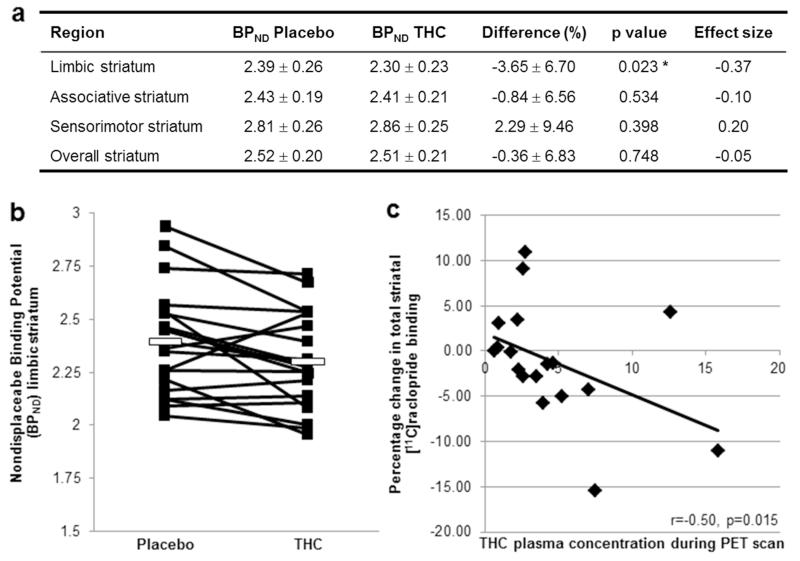
THC administration induced a significant reduction in [(11)C]raclopride binding in the limbic striatum (-3.65 %, from 2.39 ± 0.26 to 2.30 ± 0.23, p = 0.023). This is consistent with increased dopamine levels in this region. No significant differences between THC and placebo were found in other striatal subdivisions.
In the largest data set of healthy participants so far, we provide evidence for a modest increase in human striatal dopamine transmission after administration of THC compared to other drugs of abuse. This finding suggests limited involvement of the endocannabinoid system in regulating human striatal dopamine release and thereby challenges the hypothesis that an increase in striatal dopamine levels after cannabis use is the primary biological mechanism underlying the associated higher risk of schizophrenia.
多巴胺功能增强被认为在成瘾性药物的奖赏效应以及精神分裂症的病理生理学中均起关键作用。越来越多的流行病学证据表明,使用大麻是精神分裂症发病的一个风险因素。然而,研究大麻中主要精神活性成分Δ9 - 四氢大麻酚(THC)对纹状体多巴胺释放影响的人类神经化学成像研究结果并不一致。
本研究的目的是在大量健康参与者样本中评估THC激发对人类纹状体多巴胺释放的影响。
我们合并了之前两项研究的人类神经化学成像数据,这两项研究分别使用[(11)C]雷氯必利正电子发射断层扫描(PET)(分别为n = 7和n = 13)来研究THC对人类纹状体多巴胺神经传递的影响。对PET图像进行重新分析以克服PET数据分析中的差异。
给予THC后,边缘纹状体中[(11)C]雷氯必利结合显著降低(-3.65%,从2.39±0.26降至2.30±0.23,p = 0.023)。这与该区域多巴胺水平升高一致。在其他纹状体亚区中,未发现THC与安慰剂之间存在显著差异。
在目前最大的健康参与者数据集中,我们提供了证据表明,与其他滥用药物相比,给予THC后人类纹状体多巴胺传递有适度增加。这一发现表明内源性大麻素系统在调节人类纹状体多巴胺释放方面的参与有限,从而对大麻使用后纹状体多巴胺水平升高是精神分裂症相关较高风险的主要生物学机制这一假设提出了挑战。