Department of Food Science, Aarhus University, Kirstinebjergvej 10, DK-5792 Aarslev, Denmark Present address: Department of Chemistry and Bioscience, Aalborg University, Fredrik Bajers Vej 7H, DK-9220 Aalborg East, Denmark
Department of Food Science, Aarhus University, Kirstinebjergvej 10, DK-5792 Aarslev, Denmark.
AoB Plants. 2015 Mar 23;7:plv024. doi: 10.1093/aobpla/plv024.
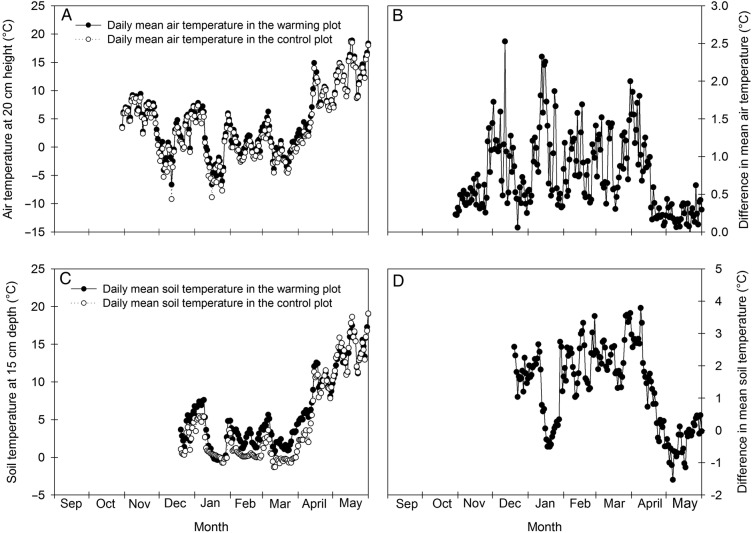
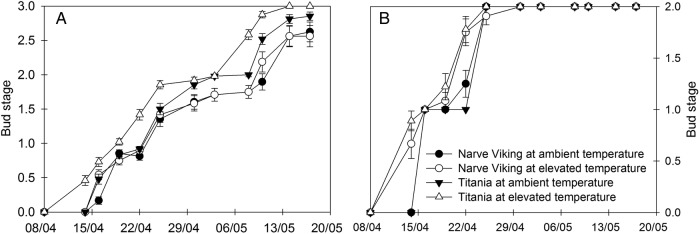
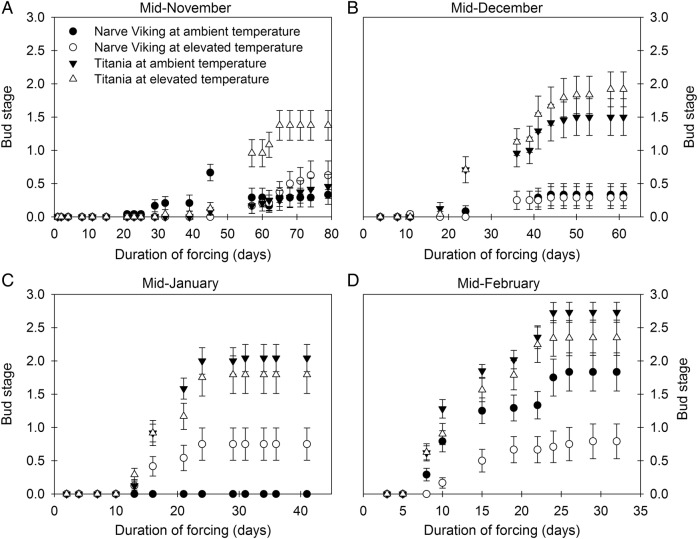
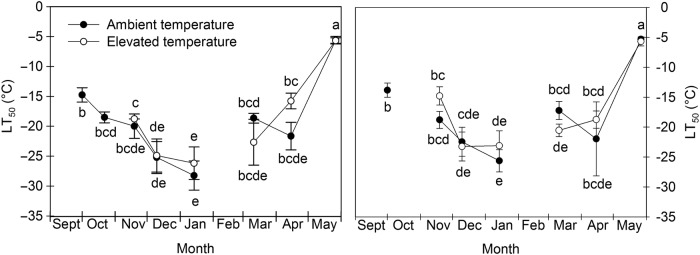
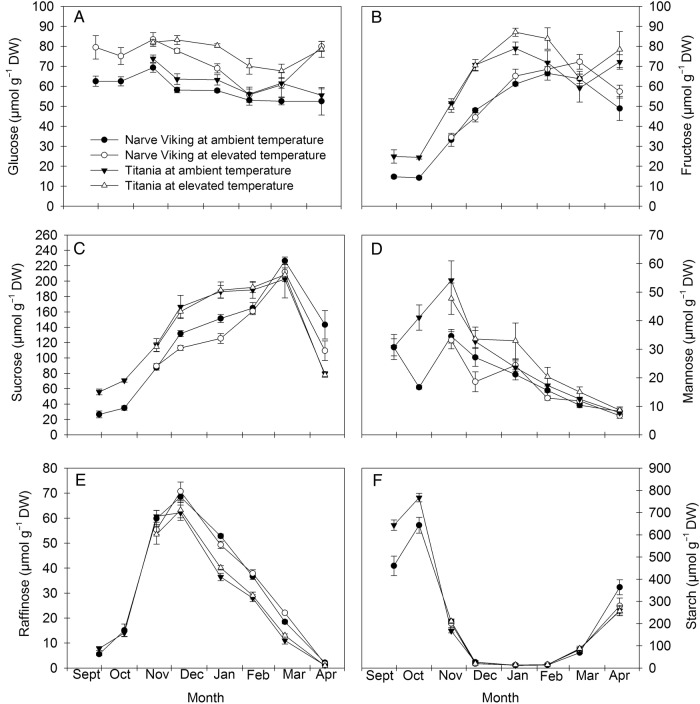
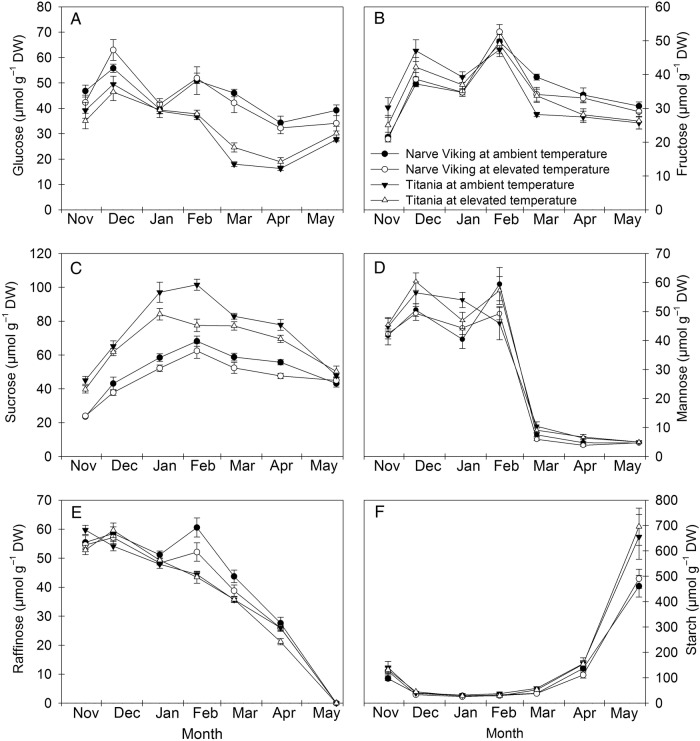
Global climate models predict an increase in the mean surface air temperature, with a disproportionate increase during winter. Since temperature is a major driver of phenological events in temperate woody perennials, warming is likely to induce changes in a range of these events. We investigated the impact of slightly elevated temperatures (+0.76 °C in the air, +1.35 °C in the soil) during the non-growing season (October-April) on freezing tolerance, carbohydrate metabolism, dormancy release, spring phenology and reproductive output in two blackcurrant (Ribes nigrum) cultivars to understand how winter warming modifies phenological traits in a woody perennial known to have a large chilling requirement and to be sensitive to spring frost. Warming delayed dormancy release more in the cultivar 'Narve Viking' than in the cultivar 'Titania', but advanced budburst and flowering predominantly in 'Titania'. Since 'Narve Viking' has a higher chilling requirement than 'Titania', this indicates that, in high-chilling-requiring genotypes, dormancy responses may temper the effect of warming on spring phenology. Winter warming significantly reduced fruit yield the following summer in both cultivars, corroborating the hypothesis that a decline in winter chill may decrease reproductive effort in blackcurrant. Elevated winter temperatures tended to decrease stem freezing tolerance during cold acclimation and deacclimation, but it did not increase the risk of freeze-induced damage mid-winter. Plants at elevated temperature showed decreased levels of sucrose in stems of both cultivars and flower buds of 'Narve Viking', which, in buds, was associated with increased concentrations of glucose and fructose. Hence, winter warming influences carbohydrate metabolism, but it remains to be elucidated whether decreased sucrose levels account for any changes in freezing tolerance. Our results demonstrate that even a slight increase in winter temperature may alter phenological traits in blackcurrant, but to various extents depending on genotype-specific differences in chilling requirement.
全球气候模型预测地表空气平均温度将升高,冬季的升温幅度不成比例。由于温度是温带木本多年生植物物候事件的主要驱动因素,变暖可能会导致这些事件发生一系列变化。我们研究了非生长季节(10 月至 4 月)中空气温度升高 0.76°C 和土壤温度升高 1.35°C 对两种黑穗醋栗( Ribes nigrum )品种的抗寒性、碳水化合物代谢、休眠释放、春物候和生殖产量的影响,以了解冬季变暖如何改变具有高需冷量且对春季霜敏感的木本多年生植物的物候特征。变暖使“Narve Viking”品种的休眠释放延迟的程度大于“Titania”品种,但主要促进了“Titania”品种的芽萌发和开花。由于“Narve Viking”品种的需冷量高于“Titania”品种,这表明在高需冷量基因型中,休眠反应可能会缓和变暖对春物候的影响。冬温升高显著降低了两个品种次年夏季的果实产量,这印证了冬季低温减少黑穗醋栗生殖力的假说。冬季气温升高在冷驯化和解驯化过程中往往会降低茎的抗寒性,但不会增加冬季中期冻害的风险。在较高温度下的植物在两个品种的茎和“Narve Viking”的花芽中表现出较低水平的蔗糖,在芽中,与葡萄糖和果糖浓度增加相关。因此,冬季变暖会影响碳水化合物代谢,但仍需阐明蔗糖水平降低是否会导致抗寒性发生变化。我们的研究结果表明,即使冬季温度略有升高也可能改变黑穗醋栗的物候特征,但在不同程度上取决于品种特定的需冷量差异。