Schulz Paulina, Prüss Harald
a Department of Neurology , Charité - Universitätsmedizin Berlin , Berlin , Germany.
b German Center for Neurodegenerative Diseases (DZNE) Berlin , Germany.
J Hist Neurosci. 2015;24(4):371-7. doi: 10.1080/0964704X.2015.1021120. Epub 2015 Mar 24.
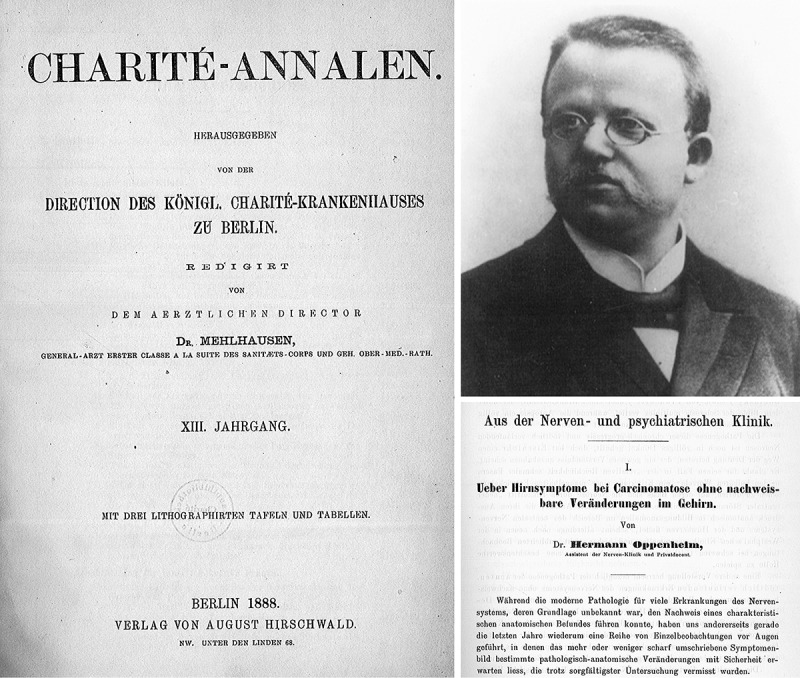
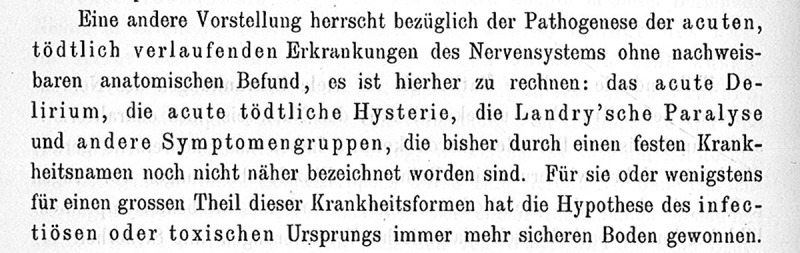
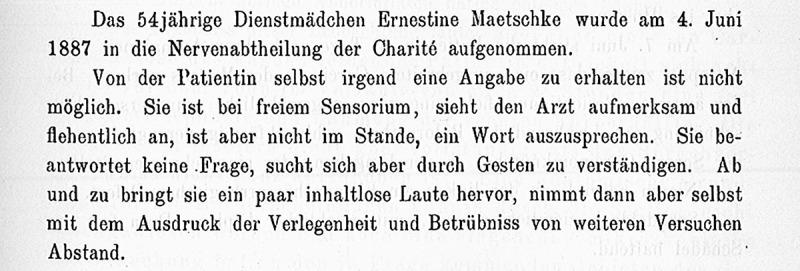
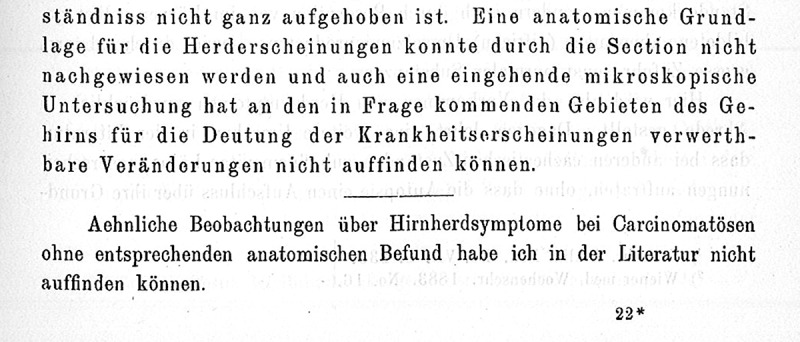
Paraneoplastic neurological syndromes belong to the most enigmatic and fascinating disorders. Their remarkable clinical spectrum ranges from sensory neuronopathy to cerebellar degeneration or limbic encephalitis. We retrace the clinical and pathological description of a forgotten case published by Hermann Oppenheim in 1888, which to our knowledge represents the first report of a paraneoplastic neurological syndrome. The young Oppenheim used thorough observation and good clinical judgment to suggest a causal link between the seemingly mere association of an underlying malignancy and a neurological syndrome, decades before Denny-Brown's identification of sensory neuronopathy in 1948 and a century before the discovery of "anti-Hu" antibodies. Oppenheim anticipated that scientific progress was required to prove this link, and he indicated his finding as "a pointer for future observers." In this way, he leaves the reader with the fascinating question of which observations during our current neurology practice could be the next "pointers" in medical research.
副肿瘤性神经系统综合征属于最神秘且迷人的疾病。它们显著的临床谱涵盖从感觉神经元病到小脑变性或边缘叶脑炎。我们追溯了赫尔曼·奥本海姆于1888年发表的一个被遗忘病例的临床和病理描述,据我们所知,这是副肿瘤性神经系统综合征的首例报告。年轻的奥本海姆运用了全面的观察和良好的临床判断力,在1948年丹尼 - 布朗鉴定感觉神经元病的数十年前以及“抗Hu”抗体发现的一个世纪前,就提出了潜在恶性肿瘤与神经系统综合征看似单纯关联之间的因果联系。奥本海姆预计需要科学进展来证明这种联系,他将自己的发现标注为“给未来观察者的一个提示”。通过这种方式,他给读者留下了一个引人入胜的问题:在我们当前的神经病学实践中,哪些观察结果可能成为医学研究中的下一个“提示”。