Pourcyrous Massroor, Basuroy Shyamali, Tcheranova Dilyara, Arheart Kristopher L, Elabiad Mohamad T, Leffler Charles W, Parfenova Helena
Department of Pediatrics, The University of Tennessee Health Science Center (UTHSC), Memphis, Tennessee Department of Physiology, The University of Tennessee Health Science Center (UTHSC), Memphis, Tennessee Department of Neuroscience Institute, The University of Tennessee Health Science Center (UTHSC), Memphis, Tennessee Department of Obstetrics and Gynecology, The University of Tennessee Health Science Center (UTHSC), Memphis, Tennessee
Department of Physiology, The University of Tennessee Health Science Center (UTHSC), Memphis, Tennessee.
Physiol Rep. 2015 Mar;3(3). doi: 10.14814/phy2.12345.
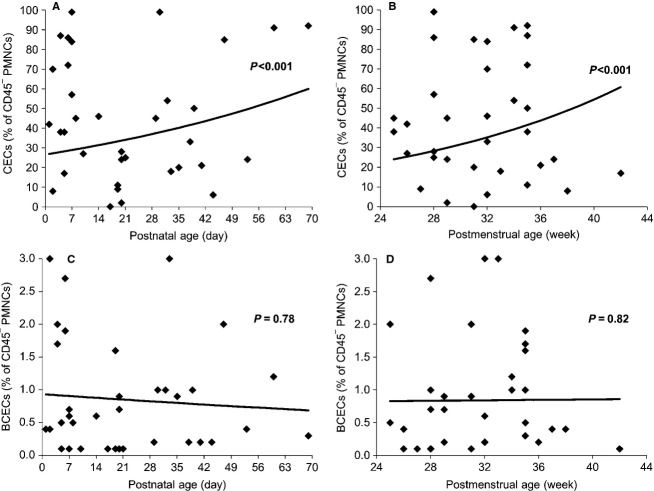
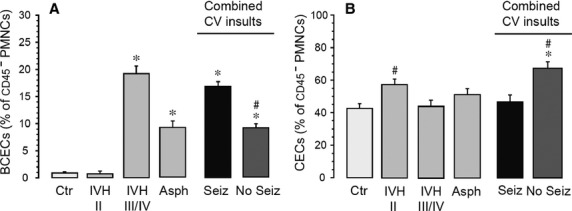
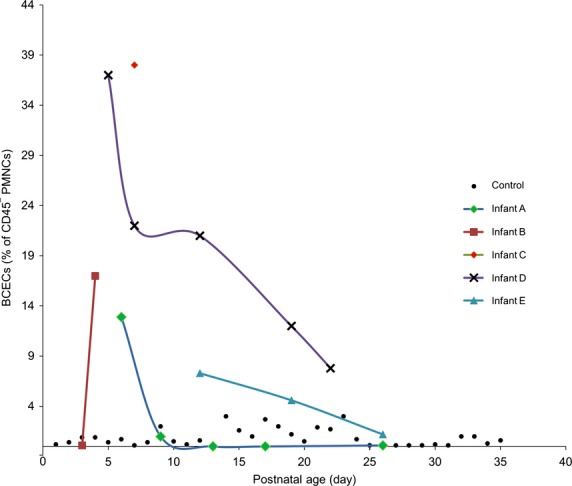
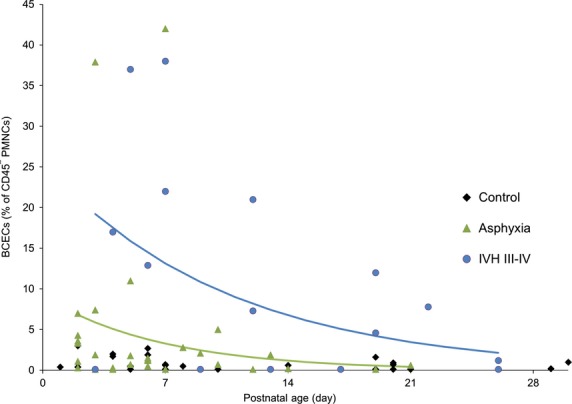
Neonatal seizures have been associated with cerebrovascular endothelial injury and neurological disabilities. In a piglet model, the long-term loss of endothelial regulation of cerebral blood flow coincides with the surge of brain-derived circulating endothelial cells (BCECs) in blood. We hypothesized that BCECs could serve as a noninvasive biomarker of cerebrovascular injury in neonates with seizures. In a prospective pilot feasibility study, we enrolled newborn infants with confirmed diagnoses of perinatal asphyxia and intraventricular hemorrhage (IVH); both are commonly associated with seizures. Infants without clinical evidence of cerebrovascular injuries were representative of the control group. BCECs were detected in the CD45-negative fraction of peripheral blood mononuclear cells by coexpression of CD31 (common endothelial antigen) and GLUT1 (blood-brain barrier antigen) via automated flow cytometry method. In Infants with asphyxia (n = 12) and those with IVH grade III/IV (n = 5), the BCEC levels were 9.9 ± 0.9% and 19.0 ± 2.0%, respectively. These levels were significantly higher than the control group (n = 27), 0.9 ± 0.2%, P < 0.001. BCECs in infants with cerebrovascular insults with documented clinical seizures (n = 10; 16.8 ± 1.3%) were significantly higher than infants with cerebrovascular insults with subclinical or no seizures (n = 7; 9.5 ± 1.2%); P < 0.001. BCEC levels decreased with seizure control. BCECs levels were elevated in infants with seizures caused by severe IVH and perinatal asphyxia. We suggest that monitoring BCEC levels in peripheral blood can potentially offer a biological marker that reflects cerebrovascular insult and recovery. Further studies with a larger number of patients are required to support these findings.
新生儿惊厥与脑血管内皮损伤及神经功能障碍有关。在仔猪模型中,脑血流内皮调节的长期丧失与血液中脑源性循环内皮细胞(BCECs)的激增相吻合。我们假设BCECs可作为新生儿惊厥时脑血管损伤的一种非侵入性生物标志物。在一项前瞻性试点可行性研究中,我们纳入了确诊为围产期窒息和脑室内出血(IVH)的新生儿;这两种情况都常与惊厥相关。无脑血管损伤临床证据的婴儿作为对照组。通过自动流式细胞术方法,通过共表达CD31(常见内皮抗原)和GLUT1(血脑屏障抗原),在外周血单核细胞的CD45阴性部分检测到BCECs。在窒息婴儿(n = 12)和III/IV级IVH婴儿(n = 5)中,BCEC水平分别为9.9±0.9%和19.0±2.0%。这些水平显著高于对照组(n = 27),为0.9±0.2%,P < 0.001。有记录的临床惊厥的脑血管损伤婴儿(n = 10;16.8±1.3%)的BCECs显著高于有亚临床或无惊厥的脑血管损伤婴儿(n = 7;9.5±1.2%);P < 0.001。BCEC水平随惊厥控制而降低。严重IVH和围产期窒息所致惊厥婴儿的BCECs水平升高。我们建议监测外周血中的BCEC水平可能会提供一种反映脑血管损伤和恢复的生物标志物。需要更多患者的进一步研究来支持这些发现。