Lee Seunghee, Shin Jwa Seop, Kim Do-Hwan, Kim Eun Jeong, Hwang Jinyoung, Yoon Hyun Bae
Department of Medical Education, Seoul National University College of Medicine, Korea.
Korean J Med Educ. 2014 Mar;26(1):41-51. doi: 10.3946/kjme.2014.26.1.41. Epub 2014 Mar 1.
The Lee Jong-Wook Seoul Project, which began in 2011, is a training program that aims to educate faculty members of Lao University of Health Sciences in medical knowledge and skills. The project has tremendous significance, attempting to apply the Korean health care developmental model to developing countries. Precise evaluation of the project outcome must be performed to enhance the effectiveness, improve the shortcomings, and adjust the future direction of the program.
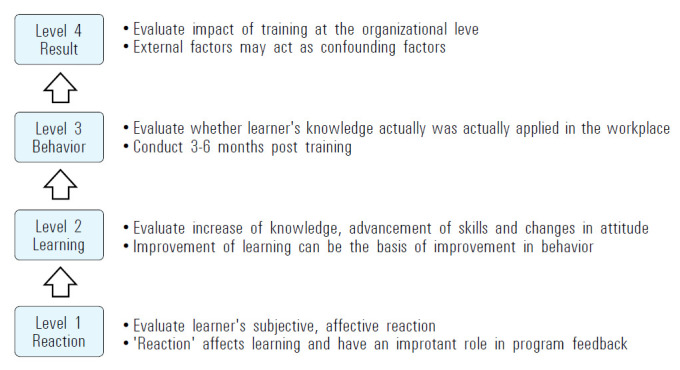
Trainers and exchange professors were asked to fill out questionnaires in the middle and at the end of the program. Eight months after its completion, an evaluation team visited Lao and interviewed each exchange professor individually. Also, 360-degree feedback was obtained from their colleagues. We analyzed the answers to the questionnaires, based on Kirkpatrick's 4-level model.
The trainers and exchange professors had positive reactions to the program. All participants felt that their knowledge and skills improved (in their respective fields), although the actual improvement was not extensive, according to their trainers' assessments. The 360-degree feedback demonstrated that the participants actively passed on their experience, knowledge, and skills to their colleagues on returning to work.
Although a 4-level evaluation was not conducted and despite the limitations in examining academic achievement, interviewing Lao professors, and acquiring quantitative data at Lao University of Health Sciences, this project has demonstrated its value in the development of individual professors and their colleagues.
始于2011年的李钟郁首尔项目是一个培训项目,旨在对老挝卫生科学大学的教员进行医学知识和技能培训。该项目意义重大,试图将韩国医疗保健发展模式应用于发展中国家。必须对项目成果进行精确评估,以提高项目成效、改进不足之处并调整项目未来方向。
培训师和交流教授被要求在项目中期和末期填写问卷。项目结束八个月后,一个评估团队访问了老挝并分别与每位交流教授进行了面谈。此外,还从他们的同事那里获得了360度反馈。我们基于柯克帕特里克的四级模型对问卷答案进行了分析。
培训师和交流教授对该项目反应积极。所有参与者都觉得自己(在各自领域)的知识和技能有所提高,不过据培训师评估,实际提高程度并不显著。360度反馈表明,参与者返回工作岗位后积极地将自己的经验、知识和技能传授给了同事。
尽管未进行四级评估,且在考察老挝卫生科学大学的学术成就、采访老挝教授以及获取定量数据方面存在局限性,但该项目已在各位教授及其同事的发展中展现出了自身价值。