Section Molecular Andrology, Biomedical Research Center Seltersberg, Justus Liebig University of Giessen, 35392 Giessen, Germany.
Laboratory of Reproductive Biology, Institute of Biotechnology AS CR, v.v.i., Videnska 1083, 14220 Prague 4, Czech Republic.
Clin Epigenetics. 2015 Mar 19;7(1):31. doi: 10.1186/s13148-015-0058-4. eCollection 2015.
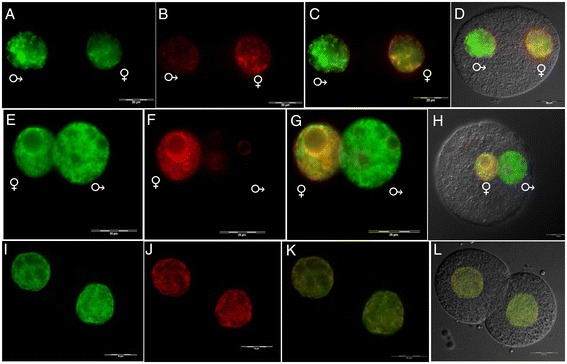
Histone to protamine exchange and the hyperacetylation of the remaining histones are hallmarks of spermiogenesis. Acetylation of histone H4 at lysine 12 (H4K12ac) was observed prior to full decondensation of sperm chromatin after fertilization suggesting an important role for the regulation of gene expression in early embryogenesis. Similarly, DNA methylation may contribute to gene silencing of several developmentally important genes. Following the identification of H4K12ac-binding promoters in sperm of fertile and subfertile patients, we aimed to investigate whether the depletion of histone-binding is associated with aberrant DNA methylation in sperm of subfertile men. Furthermore, we monitored the transmission of H4K12ac, 5-methylcytosine (5mC) and 5-hydroxymethylcytosine (5hmC) from the paternal chromatin to the embryo applying mouse in vitro fertilization and immunofluorescence.
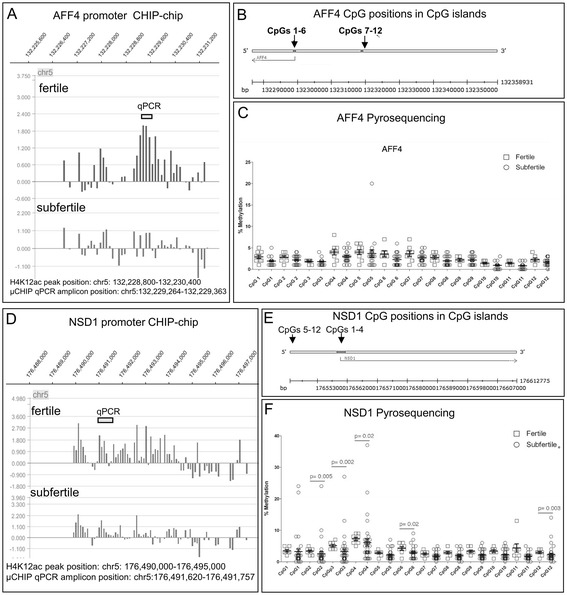
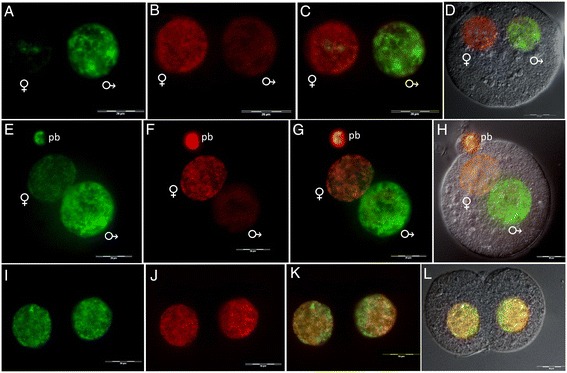
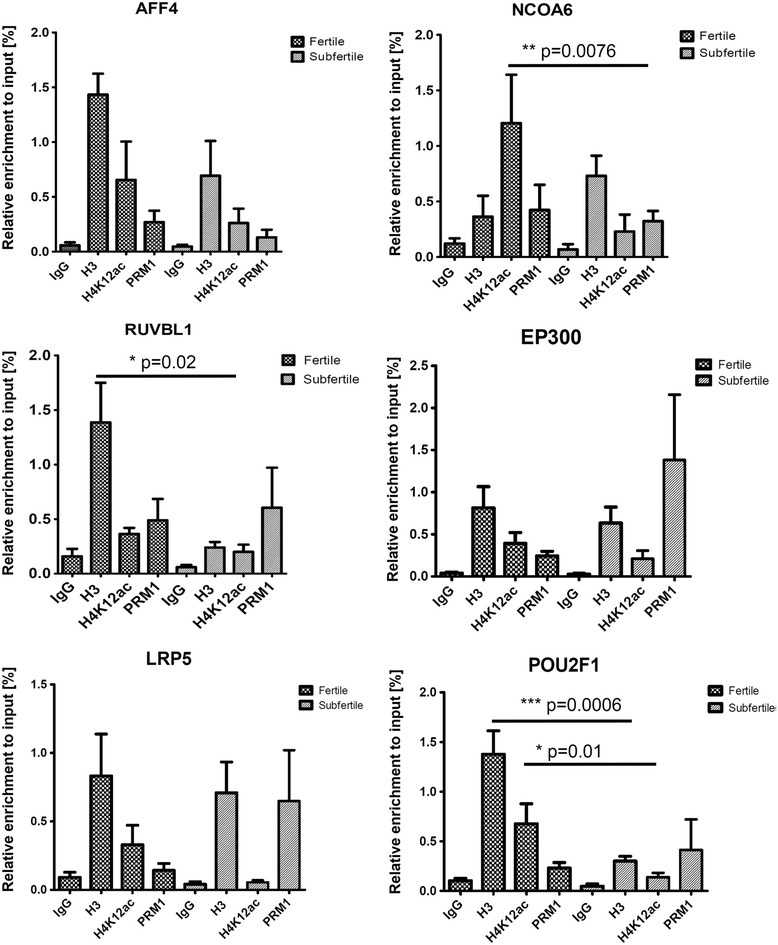
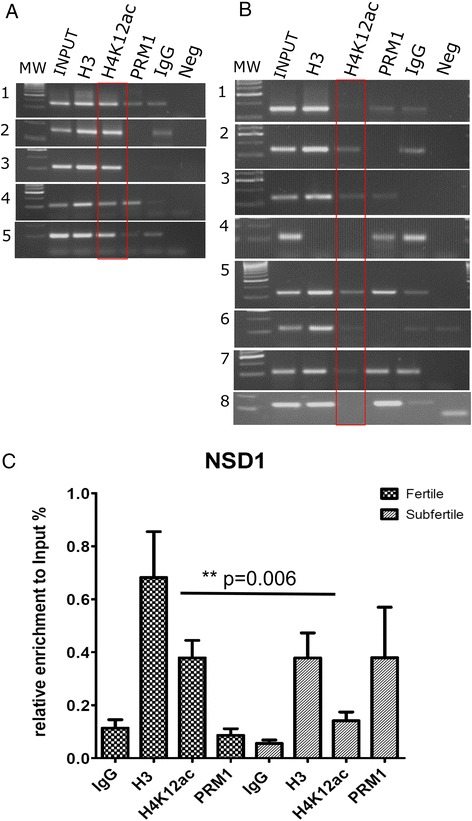
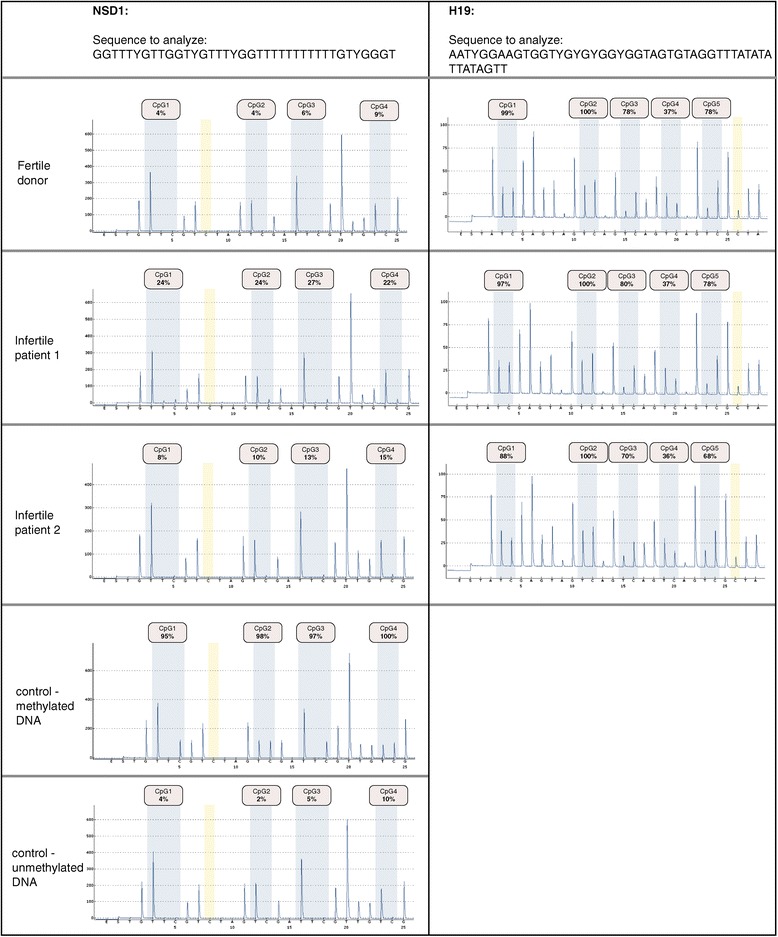
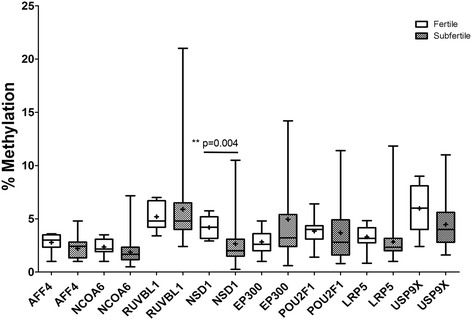
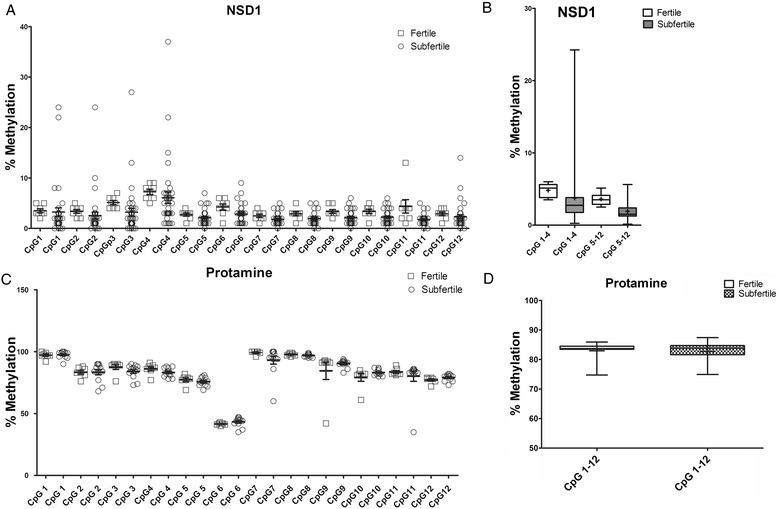
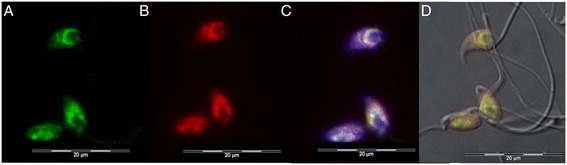
Chromatin immunoprecipitation (ChIP) with anti-H4K12ac antibody was performed with chromatin isolated from spermatozoa of subfertile patients with impaired sperm chromatin condensation assessed by aniline blue staining. Fertile donors were used as control. DNA methylation analysis of selected H4K12ac-interacting promoters in spermatozoa was performed by pyrosequencing. Depletion of binding sites for H4K12ac was observed within the following developmentally important promoters: AFF4, EP300, LRP5, RUVBL1, USP9X, NCOA6, NSD1, and POU2F1. We found 5% to 10% hypomethylation within CpG islands of selected promoters in the sperm of fertile donors, and it was not significantly altered in the subfertile group. Our results demonstrate that the H4K12ac depletion in selected developmentally important promoters of subfertile patients was not accompanied by a change of DNA methylation. Using a murine model, immunofluorescence revealed that H4K12ac co-localize with 5mC in the sperm nucleus. During fertilization, when the pronuclei are formed, the paternal pronucleus exhibits a strong acetylation signal on H4K12, while in the maternal pronucleus, there is a permanent increase of H4K12ac until pronuclei fusion. Simultaneously, there is an increase of the 5hmC signal and a decrease of the 5mC signal.
We suggest that aberrant histone acetylation within developmentally important gene promoters in subfertile men, but not DNA methylation, may reflect insufficient sperm chromatin compaction affecting the transfer of epigenetic marks to the oocyte.
组蛋白与鱼精蛋白的交换以及剩余组蛋白的超乙酰化是精子发生的标志。在受精后精子染色质完全去浓缩之前,观察到组蛋白 H4 赖氨酸 12(H4K12ac)的乙酰化,这表明在早期胚胎发生中,基因表达的调节可能起着重要作用。同样,DNA 甲基化可能有助于几个发育重要基因的沉默。在鉴定出可育和生育能力低下患者精子中 H4K12ac 结合启动子后,我们旨在研究精子中组蛋白结合的耗竭是否与生育能力低下男性精子中的异常 DNA 甲基化有关。此外,我们通过应用小鼠体外受精和免疫荧光监测了从父本染色质到胚胎的 H4K12ac、5-甲基胞嘧啶(5mC)和 5-羟甲基胞嘧啶(5hmC)的传递。
用抗 H4K12ac 抗体进行染色质免疫沉淀(ChIP),用苯胺蓝染色评估精子染色质凝聚受损的生育能力低下患者的精子中的染色质进行。使用可育供体作为对照。通过焦磷酸测序对精子中选定的 H4K12ac 相互作用启动子进行 DNA 甲基化分析。在以下发育重要启动子中观察到 H4K12ac 结合位点的缺失:AFF4、EP300、LRP5、RUVBL1、USP9X、NCOA6、NSD1 和 POU2F1。我们发现可育供体精子中选定启动子的 CpG 岛内存在 5%至 10%的低甲基化,而生育能力低下组中未发生明显改变。我们的结果表明,生育能力低下患者中选定的发育重要启动子中 H4K12ac 的耗竭并不伴有 DNA 甲基化的改变。使用鼠模型,免疫荧光显示 H4K12ac 与精子核中的 5mC 共定位。在受精过程中,当原核形成时,父本原核在 H4K12 上表现出强烈的乙酰化信号,而在母本原核中,H4K12ac 永久增加,直到原核融合。同时,5hmC 信号增加,5mC 信号减少。
我们认为,生育能力低下男性中发育重要基因启动子中异常的组蛋白乙酰化,而不是 DNA 甲基化,可能反映了精子染色质浓缩不足,影响了表观遗传标记向卵母细胞的传递。