McNamara Dylan E, Gopalakrishnan Sathya, Smith Martin D, Murray A Brad
Department of Physics and Physical Oceanography/Center for Marine Science, University of North Carolina Wilmington, Wilmington, NC, 28403-5606, USA.
Department of Agricultural, Environmental and Development Economics, The Ohio State University, Columbus, Ohio, 43210, USA.
PLoS One. 2015 Mar 25;10(3):e0121278. doi: 10.1371/journal.pone.0121278. eCollection 2015.
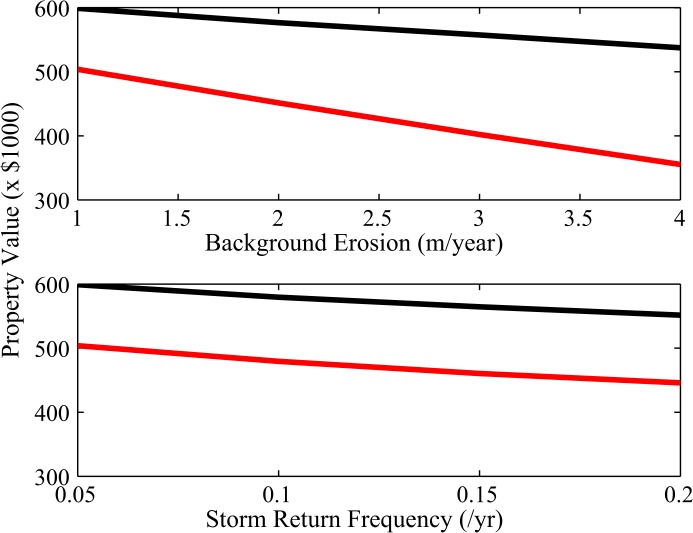
Human population density in the coastal zone and potential impacts of climate change underscore a growing conflict between coastal development and an encroaching shoreline. Rising sea-levels and increased storminess threaten to accelerate coastal erosion, while growing demand for coastal real estate encourages more spending to hold back the sea in spite of the shrinking federal budget for beach nourishment. As climatic drivers and federal policies for beach nourishment change, the evolution of coastline mitigation and property values is uncertain. We develop an empirically grounded, stochastic dynamic model coupling coastal property markets and shoreline evolution, including beach nourishment, and show that a large share of coastal property value reflects capitalized erosion control. The model is parameterized for coastal properties and physical forcing in North Carolina, U.S.A. and we conduct sensitivity analyses using property values spanning a wide range of sandy coastlines along the U.S. East Coast. The model shows that a sudden removal of federal nourishment subsidies, as has been proposed, could trigger a dramatic downward adjustment in coastal real estate, analogous to the bursting of a bubble. We find that the policy-induced inflation of property value grows with increased erosion from sea level rise or increased storminess, but the effect of background erosion is larger due to human behavioral feedbacks. Our results suggest that if nourishment is not a long-run strategy to manage eroding coastlines, a gradual removal is more likely to smooth the transition to more climate-resilient coastal communities.
沿海地区的人口密度以及气候变化的潜在影响凸显了沿海开发与不断侵蚀的海岸线之间日益加剧的冲突。海平面上升和风暴活动增加,可能会加速海岸侵蚀,而对沿海房地产需求的不断增长,尽管用于海滩养护的联邦预算在减少,但仍促使更多资金用于抵御海水侵蚀。随着气候驱动因素和海滩养护联邦政策的变化,海岸线缓解措施和房地产价值的演变尚不确定。我们构建了一个基于实证的随机动态模型,将沿海房地产市场与海岸线演变(包括海滩养护)耦合起来,并表明沿海房地产价值的很大一部分反映了资本化的侵蚀控制。该模型针对美国北卡罗来纳州的沿海房产和物理作用力进行了参数化设置,并且我们使用美国东海岸广泛的沙质海岸线的房产价值进行了敏感性分析。该模型表明,正如所提议的那样,突然取消联邦养护补贴可能会引发沿海房地产市场的大幅下调,类似于泡沫破裂。我们发现,政策导致的房产价值通胀随着海平面上升或风暴活动增加导致的侵蚀加剧而上升,但由于人类行为反馈,背景侵蚀的影响更大。我们的结果表明,如果海滩养护不是管理侵蚀海岸线的长期策略,逐步取消补贴更有可能平稳过渡到更具气候适应能力的沿海社区。