Ueda Shuji, Blee Alexandra M, Macway Katherine G, Renner Derrick J, Yamada Soichiro
Department of Agrobioscience, Graduate School of Agricultural Science, Kobe University, Kobe, Japan.
Department of Biomedical Engineering, University of California Davis, Davis, CA, 95616, United States of America.
PLoS One. 2015 Mar 25;10(3):e0122886. doi: 10.1371/journal.pone.0122886. eCollection 2015.
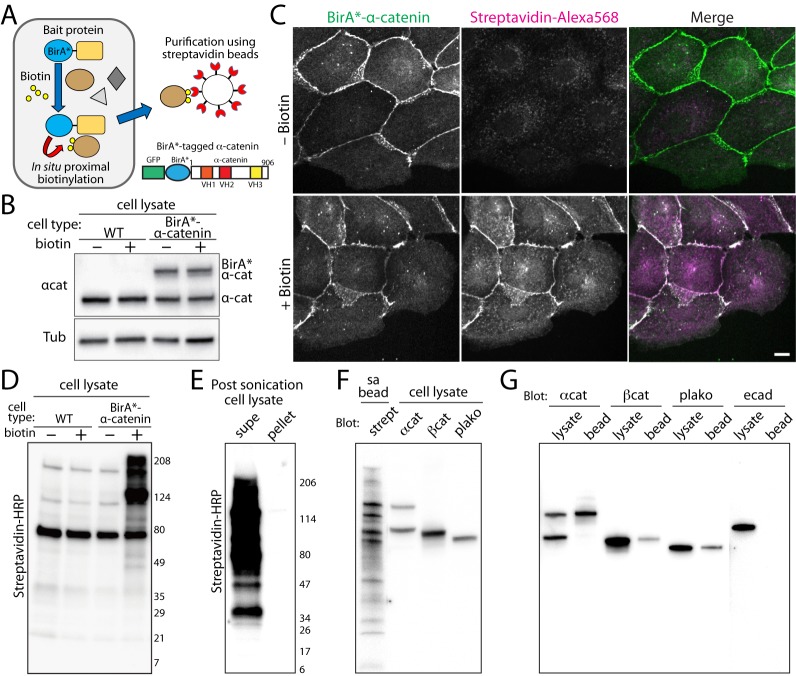
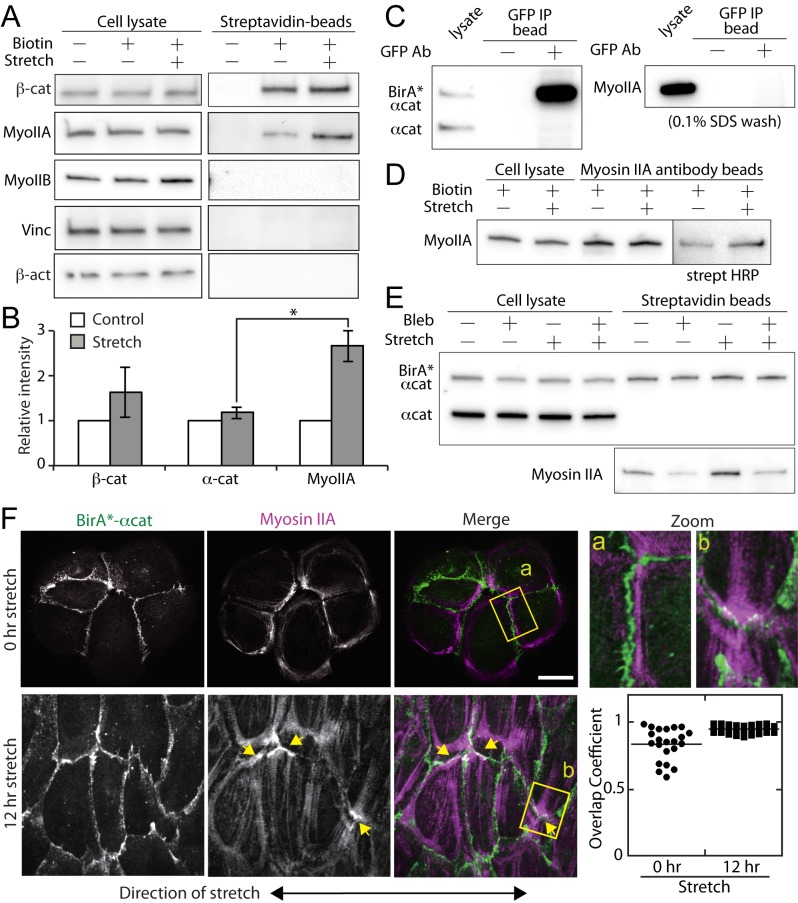
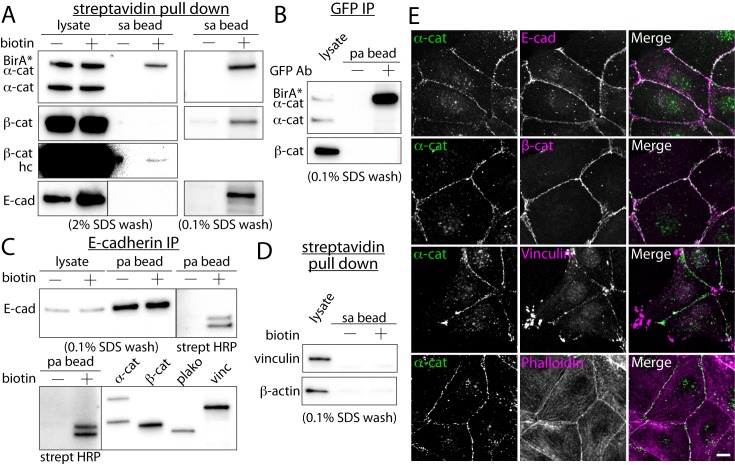
Tissues and organs undergo constant physical perturbations and individual cells must respond to mechanical forces to maintain tissue integrity. However, molecular interactions underlying mechano-transduction are not fully defined at cell-cell junctions. This is in part due to weak and transient interactions that are likely prevalent in force-induced protein complexes. Using in situ proximal biotinylation by the promiscuous biotin ligase BirA tagged to α-catenin and a substrate stretch cell chamber, we sought to identify force-dependent molecular interactions surrounding α-catenin, an actin regulator at the sites of cadherin mediated cell-cell adhesion. While E-cadherin, β-catenin, vinculin and actin localize with α-catenin at cell-cell contacts in immuno-fluorescent staining, only β-catenin and plakoglobin were biotinylated, suggesting that this proximal biotinylation is limited to the molecules that are in the immediate vicinity of α-catenin. In mechanically stretched samples, increased biotinylation of non-muscle myosin IIA, but not myosin IIB, suggests close spatial proximity between α-catenin and myosin IIA during substrate stretching. This force-induced biotinylation diminished as myosin II activity was inhibited by blebbistatin. Taken together, this promising technique enables us to identify force sensitive complexes that may be essential for mechano-responses in force bearing cell adhesion.
组织和器官不断受到物理扰动,单个细胞必须对机械力作出反应以维持组织完整性。然而,细胞间连接中机械转导的分子相互作用尚未完全明确。部分原因是弱相互作用和瞬时相互作用可能在力诱导的蛋白质复合物中普遍存在。我们利用与α-连环蛋白相连的泛素生物素连接酶BirA进行原位近端生物素化,并结合底物拉伸细胞室,试图确定围绕α-连环蛋白的力依赖性分子相互作用,α-连环蛋白是钙黏蛋白介导的细胞间黏附位点处的肌动蛋白调节剂。在免疫荧光染色中,E-钙黏蛋白、β-连环蛋白、纽蛋白和肌动蛋白在细胞间接触处与α-连环蛋白共定位,但只有β-连环蛋白和桥粒斑珠蛋白被生物素化,这表明这种近端生物素化仅限于α-连环蛋白紧邻的分子。在机械拉伸的样本中,非肌肉肌球蛋白IIA(而非肌球蛋白IIB)的生物素化增加,这表明在底物拉伸过程中α-连环蛋白与肌球蛋白IIA在空间上紧密相邻。随着肌球蛋白II的活性被blebbistatin抑制,这种力诱导的生物素化减弱。综上所述,这种有前景的技术使我们能够识别对承载力的细胞黏附中机械反应可能至关重要的力敏感复合物。