Bulava Alan, Mokracek Ales, Hanis Jiri, Kurfirst Vojtech, Eisenberger Martin, Pesl Ladislav
Department of Cardiology, Ceske Budejovice Hospital, Ceske Budejovice, Czech Republic (A.B., J.H., M.E., L.P.) Faculty of Health and Social Studies, University of South Bohemia, Ceske Budejovice, Czech Republic (A.B., A.M., M.E.).
Department of Cardiac Surgery, Ceske Budejovice Hospital, Ceske Budejovice, Czech Republic (A.M., V.K.) Faculty of Health and Social Studies, University of South Bohemia, Ceske Budejovice, Czech Republic (A.B., A.M., M.E.).
J Am Heart Assoc. 2015 Mar 25;4(3):e001754. doi: 10.1161/JAHA.114.001754.
Catheter ablation of persistent atrial fibrillation yields an unsatisfactorily high number of failures. The hybrid approach has recently emerged as a technique that overcomes the limitations of both surgical and catheter procedures alone.
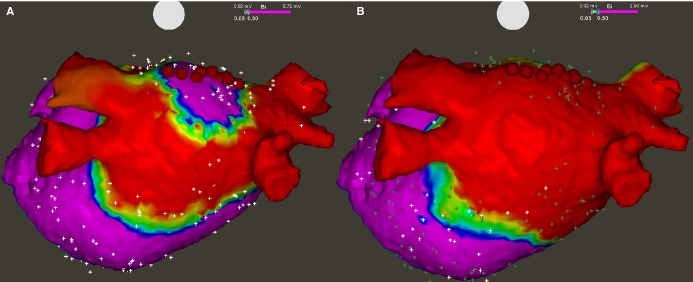
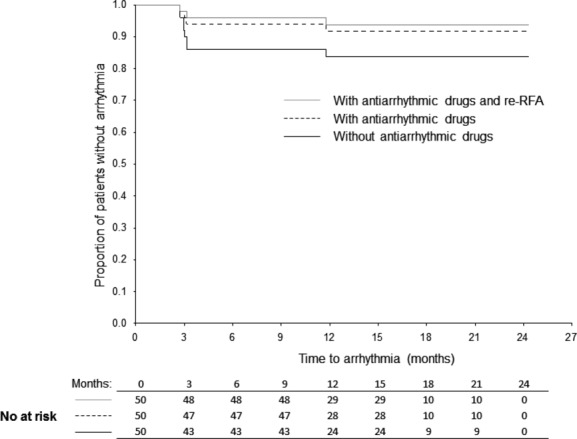
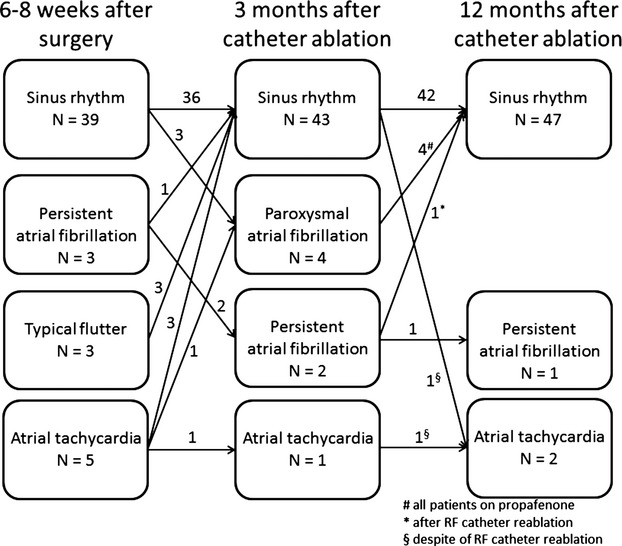
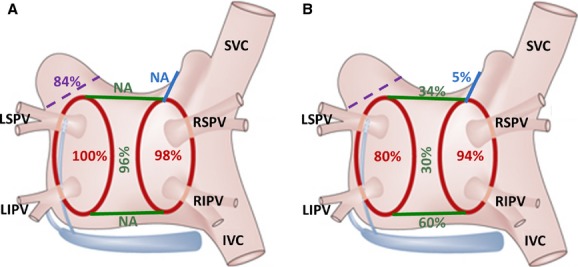
We investigated the sequential (staged) hybrid method, which consists of a surgical thoracoscopic radiofrequency ablation procedure followed by radiofrequency catheter ablation 6 to 8 weeks later using the CARTO 3 mapping system. Fifty consecutive patients (mean age 62±7 years, 32 males) with long-standing persistent atrial fibrillation (41±34 months) and a dilated left atrium (>45 mm) were included and prospectively followed in an unblinded registry. During the electrophysiological part of the study, all 4 pulmonary veins were found to be isolated in 36 (72%) patients and a complete box-lesion was confirmed in 14 (28%) patients. All gaps were successfully re-ablated. Twelve months after the completed hybrid ablation, 47 patients (94%) were in normal sinus rhythm (4 patients with paroxysmal atrial fibrillation required propafenone and 1 patient underwent a redo catheter procedure). The majority of arrhythmias recurred during the first 3 months. Beyond 12 months, there were no arrhythmia recurrences detected. The surgical part of the procedure was complicated by 7 (13.7%) major complications, while no serious adverse events were recorded during the radiofrequency catheter part of the procedure.
The staged hybrid epicardial-endocardial treatment of long-standing persistent atrial fibrillation seems to be extremely effective in maintenance of normal sinus rhythm compared to radiofrequency catheter or surgical ablation alone. Epicardial ablation alone cannot guarantee durable transmural lesions.
URL: www.ablace.cz Unique identifier: cz-060520121617.
持续性心房颤动的导管消融失败率高,令人不满意。近年来,杂交手术作为一种克服单纯外科手术和导管手术局限性的技术应运而生。
我们研究了序贯(分期)杂交手术方法,该方法包括外科胸腔镜下射频消融手术,随后在6至8周后使用CARTO 3标测系统进行射频导管消融。纳入50例连续的长期持续性心房颤动(41±34个月)且左心房扩大(>45 mm)的患者(平均年龄62±7岁,男性32例),并在非盲登记中进行前瞻性随访。在研究的电生理部分,36例(72%)患者的所有4条肺静脉均被隔离,14例(28%)患者证实有完整的盒状损伤。所有间隙均成功再次消融。杂交消融完成12个月后,47例(94%)患者处于正常窦性心律(4例阵发性心房颤动患者需要普罗帕酮,1例患者接受了再次导管手术)。大多数心律失常在最初3个月内复发。12个月后,未检测到心律失常复发。手术部分有7例(13.7%)发生严重并发症,而在射频导管部分未记录到严重不良事件。
与单纯射频导管消融或外科消融相比,分期杂交的心外膜-心内膜治疗长期持续性心房颤动在维持正常窦性心律方面似乎极为有效。单纯心外膜消融不能保证持久的透壁损伤。
网址:www.ablace.cz 唯一标识符:cz-060520121617