Ishimoto Kazuya, Hayano Satoru, Yanagita Takeshi, Kurosaka Hiroshi, Kawanabe Noriaki, Itoh Shinsuke, Ono Mitsuaki, Kuboki Takuo, Kamioka Hiroshi, Yamashiro Takashi
Department of Orthodontics, Okayama University Graduate School of Medicine, Dentistry and Pharmaceutical sciences, Okayama, Japan.
Department of Orthodontics, Okayama University Hospital, Okayama, Japan.
PLoS One. 2015 Mar 26;10(3):e0121938. doi: 10.1371/journal.pone.0121938. eCollection 2015.
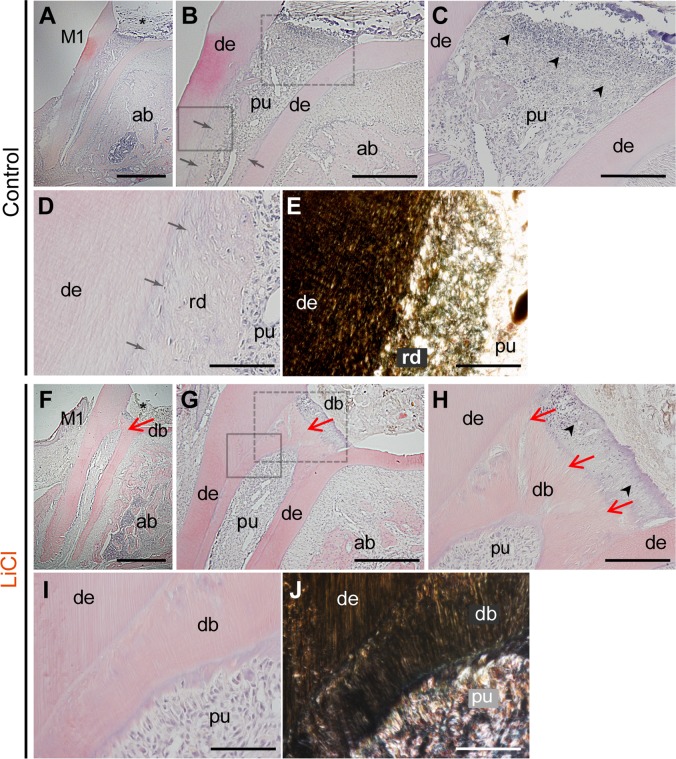
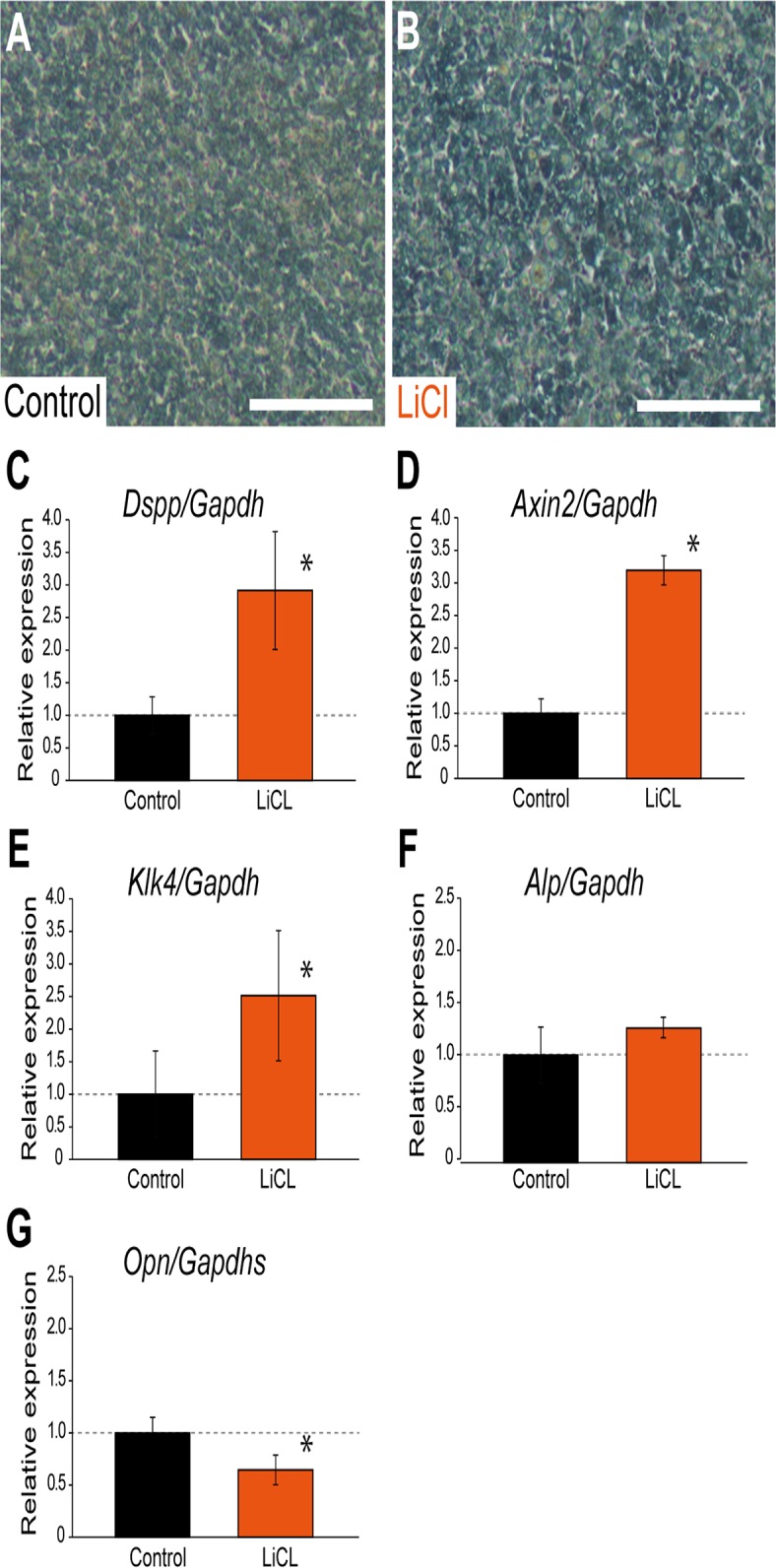
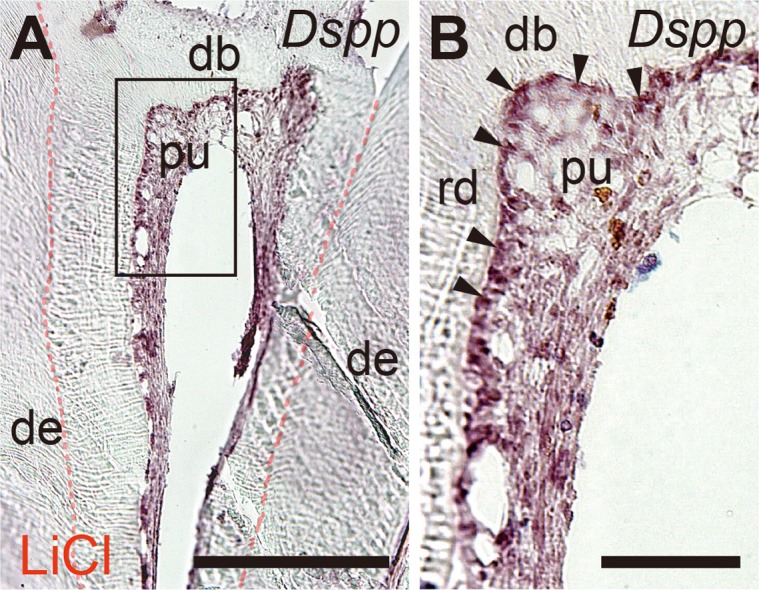
We herein describe a novel procedure for dentin regeneration that mimics the biological processes of tooth development in nature. The canonical Wnt signaling pathway is an important regulator of the Dentin sialophosphoprotein (Dspp) expression. Our approach mimics the biological processes underlying tooth development in nature and focuses on the activation of canonical Wnt signaling to trigger the natural process of dentinogenesis. The coronal portion of the dentin and the underlying pulp was removed from the first molars. We applied lithium chloride (LiCl), an activator of canonical Wnt signaling, on the amputated pulp surface to achieve transdifferentiation toward odontoblasts from the surrounding pulpal cells. MicroCT and microscopic analyses demonstrated that the topical application of LiCl induced dentin repair, including the formation of a complete dentin bridge. LiCl-induced dentin is a tubular dentin in which the pulp cells are not embedded within the matrix, as in primary dentin. In contrast, a dentin bridge was not induced in the control group treated with pulp capping with material carriers alone, although osteodentin without tubular formation was induced at a comparatively deeper position from the pulp exposure site. We also evaluated the influence of LiCl on differentiation toward odontoblasts in vitro. In the mDP odontoblast cell line, LiCl activated the mRNA expression of Dspp, Axin2 and Kallikrein 4 (Klk4) and downregulated the Osteopontin (Osp) expression. These results provide a scientific basis for the biomimetic regeneration of dentin using LiCl as a new capping material to activate dentine regeneration.
我们在此描述了一种模仿自然牙齿发育生物学过程的牙本质再生新方法。经典Wnt信号通路是牙本质涎磷蛋白(Dspp)表达的重要调节因子。我们的方法模仿了自然牙齿发育的生物学过程,重点是激活经典Wnt信号以触发牙本质形成的自然过程。从第一磨牙中去除牙本质的冠部和下方的牙髓。我们将经典Wnt信号激活剂氯化锂(LiCl)应用于截断的牙髓表面,以使周围牙髓细胞向成牙本质细胞转分化。显微CT和显微镜分析表明,局部应用LiCl可诱导牙本质修复,包括形成完整的牙本质桥。LiCl诱导形成的牙本质是一种管状牙本质,其中牙髓细胞不像在原发性牙本质中那样嵌入基质中。相比之下,仅用材料载体进行盖髓治疗的对照组未诱导出牙本质桥,尽管在距牙髓暴露部位相对较深的位置诱导出了无管状结构的骨样牙本质。我们还评估了LiCl对体外成牙本质细胞分化的影响。在mDP成牙本质细胞系中,LiCl激活了Dspp、Axin2和激肽释放酶4(Klk4)的mRNA表达,并下调了骨桥蛋白(Osp)的表达。这些结果为使用LiCl作为新型盖髓材料激活牙本质再生的仿生再生提供了科学依据。