Atsumi Jun, Hanami Takeshi, Enokida Yasuaki, Ogawa Hiroomi, Delobel Diane, Mitani Yasumasa, Kimura Yasumasa, Soma Takahiro, Tagami Michihira, Takase Yoshiaki, Ichihara Tatsuo, Takeyoshi Izumi, Usui Kengo, Hayashizaki Yoshihide, Shimizu Kimihiro
Departments of Thoracic and Visceral Organ Surgery, Gunma University Graduate School of Medicine, Maebashi, Japan.
Division of Genomic Technologies, RIKEN Center for Life Science Technologies, Yokohama, Kanagawa, Japan.
Oncol Rep. 2015 Jun;33(6):2719-27. doi: 10.3892/or.2015.3883. Epub 2015 Mar 30.
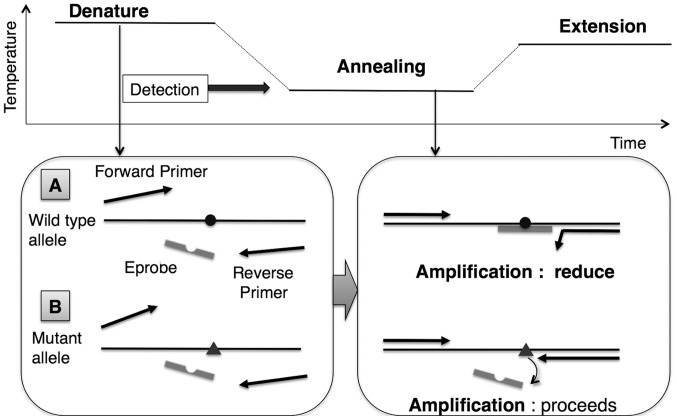
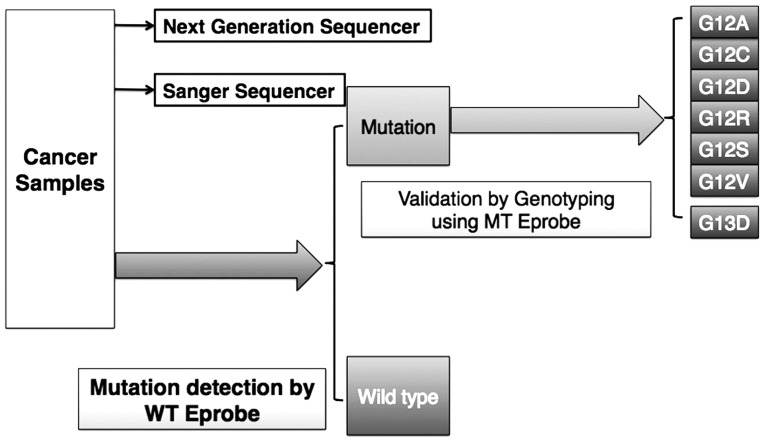
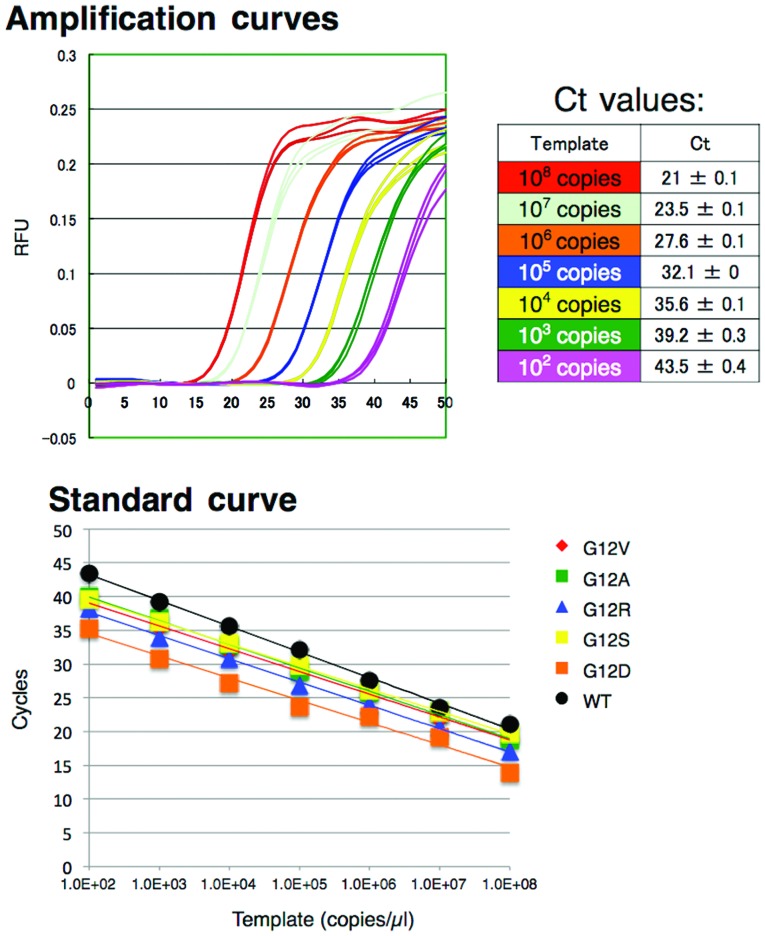
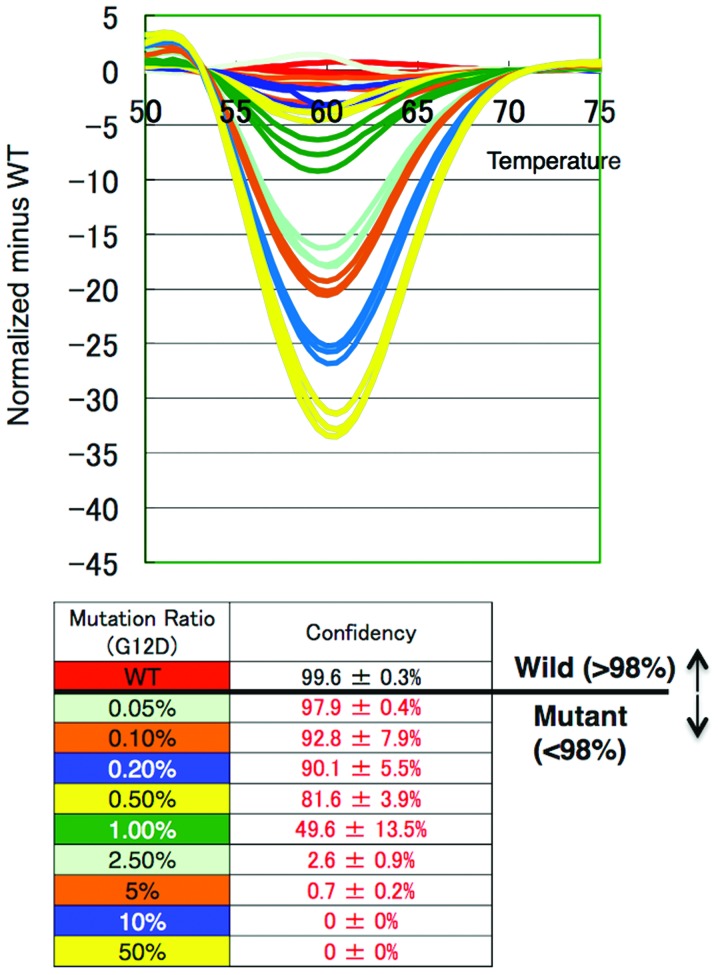
Activating mutations in the Kirsten rat sarcoma viral oncogene homolog (KRAS) loci are largely predictive of resistance to epidermal growth factor receptor (EGFR) therapy in colorectal cancer (CRC). A highly sensitive detection system for the KRAS gene mutations is urgently needed; however, conventional methods have issues with feasibility and cost performance. Here, we describe a novel detection system using a fluorescence 'Eprobe' capable of detecting low level KRAS gene mutations, via real-time PCR, with high sensitivity and simple usability. We designed our Eprobes to be complementary to wild-type (WT) KRAS or to the commonly mutated codons 12 and 13. The WT Eprobe binds strongly to the WT DNA template and suppresses amplification by blocking annealing of the primer during PCR. Eprobe-PCR with WT Eprobe shows high sensitivity (0.05-0.1% of plasmid DNA, 1% of genomic DNA) for the KRAS mutation by enrichment of the mutant type (MT) amplicon. Assay performance was compared to Sanger sequencing using 92 CRC samples. Discrepancies were analyzed by mutation genotyping via Eprobe-PCR with full match Eprobes for 7 prevalent mutations and the next generation sequencing (NGS). Significantly, the Eprobe system had a higher sensitivity for detecting KRAS mutations in CRC patient samples; these mutations could not be identified by Sanger sequencing. Thus, the Eprobe approach provides for highly sensitive and convenient mutation detection and should be useful for diagnostic applications.
Kirsten大鼠肉瘤病毒癌基因同源物(KRAS)位点的激活突变在很大程度上可预测结直肠癌(CRC)对表皮生长因子受体(EGFR)治疗的耐药性。迫切需要一种用于KRAS基因突变的高灵敏度检测系统;然而,传统方法在可行性和性价比方面存在问题。在此,我们描述了一种新型检测系统,该系统使用一种荧光“E探针”,能够通过实时PCR以高灵敏度和简单易用性检测低水平的KRAS基因突变。我们将E探针设计为与野生型(WT)KRAS或常见的第12和13密码子突变互补。WT E探针与WT DNA模板强烈结合,并在PCR过程中通过阻止引物退火来抑制扩增。使用WT E探针的E探针PCR通过富集突变型(MT)扩增子对KRAS突变显示出高灵敏度(质粒DNA的0.05 - 0.1%,基因组DNA的1%)。使用92份CRC样本将检测性能与桑格测序进行比较。通过使用针对7种常见突变的完全匹配E探针的E探针PCR和下一代测序(NGS)对突变基因分型来分析差异。值得注意的是,E探针系统在检测CRC患者样本中的KRAS突变方面具有更高的灵敏度;这些突变无法通过桑格测序鉴定。因此,E探针方法提供了高灵敏度和便捷的突变检测,应有助于诊断应用。