Aldrink Jennifer H, McManaway Cindy, Wang Wei, Nwomeh Benedict C
*Division of Pediatric Surgery, Department of Surgery, Ohio State University College of Medicine †Department of Biostatistics, Nationwide Children's Hospital, Columbus, OH.
J Pediatr Gastroenterol Nutr. 2015 Apr;60(4):503-7. doi: 10.1097/MPG.0000000000000651.
Adult literature supports the elimination of mechanical bowel preparation (MBP) for elective colorectal surgical procedures. Prospective data for the pediatric population regarding the utility of MBP are lacking. The primary aim of this study was to compare infectious complications, specifically anastomotic leak, intraabdominal abscess, and wound infection in patients who received MBP with those who did not.
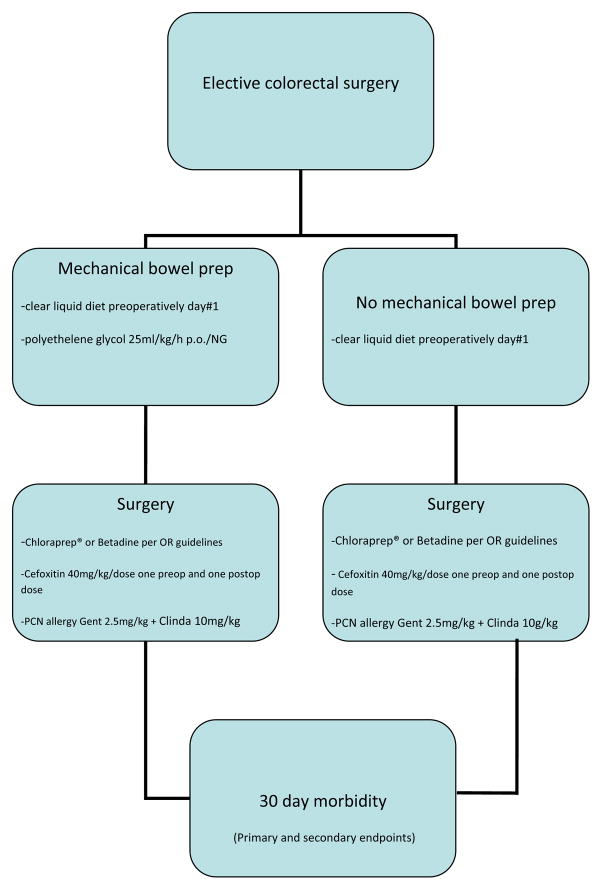
A randomized pilot study comparing MBP with polyethylene glycol with no MBP was performed. Patients, 0 to 21 years old, undergoing elective colorectal surgery were eligible and randomized within 4 age strata. Statistical analyses were performed using χ or Fisher exact test for categorical data and t test or Wilcoxon 2-sample test for continuous data.
Forty-four patients were enrolled in the study from December 2010 to February 2013, of which 24 (55%) received MBP and 20 (45%) did not. Two patients (5%) had anastomotic leak, 4 (9%) had intraabdominal infection, and 7 (16%) had wound infections. The rate of anastomotic leak, intraabdominal abscess, and wound infection did not differ between the 2 groups.
MBP for elective colorectal surgery in children does not affect the incidence of infectious complications. A larger multiinstitutional study is necessary to validate the results of this single-institution pilot study.
成人医学文献支持在择期结直肠手术中取消机械性肠道准备(MBP)。关于儿童群体中MBP效用的前瞻性数据尚缺。本研究的主要目的是比较接受MBP的患者与未接受MBP的患者的感染性并发症,特别是吻合口漏、腹腔内脓肿和伤口感染情况。
进行了一项将MBP与聚乙二醇进行比较且不进行MBP的随机试点研究。年龄在0至21岁、接受择期结直肠手术的患者符合条件,并在4个年龄层内随机分组。对分类数据使用χ²检验或Fisher精确检验,对连续数据使用t检验或Wilcoxon双样本检验进行统计分析。
2010年12月至2013年2月期间,44例患者纳入本研究,其中24例(55%)接受了MBP,20例(45%)未接受。2例患者(5%)发生吻合口漏,4例(9%)发生腹腔内感染,7例(16%)发生伤口感染。两组之间吻合口漏、腹腔内脓肿和伤口感染的发生率无差异。
儿童择期结直肠手术中的MBP不影响感染性并发症的发生率。需要开展一项更大规模的多机构研究来验证这项单机构试点研究的结果。